
How VPN Tunneling Works: The Technology Behind Encrypted Connections


 4 min. read
  Published on
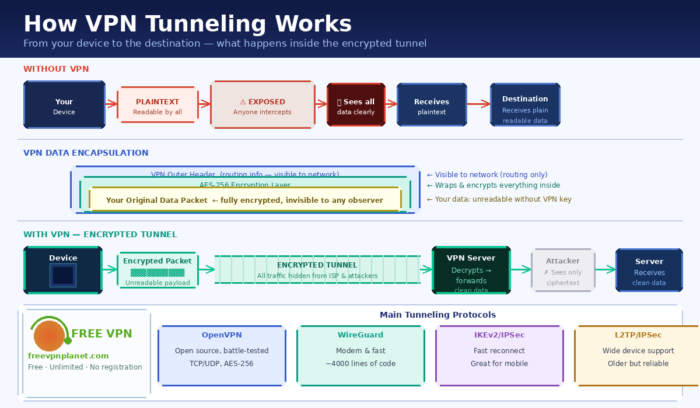
When you connect to a VPN, your traffic doesn’t simply “go private.” Something specific happens to every packet of data before it leaves your device — and understanding that mechanism makes it much clearer what a VPN actually protects, and why.
What a Tunnel Actually Is
In networking, the term “tunnel” refers to a particular metaphor. It explains the process of encasing data from a higher protocol layer so that it can move across a network in a secure, opaque manner by wrapping one kind of network packet within another. The inner packet contains the real payload, concealed from any traffic inspectors along the way, while the outer packet serves as a container that manages routing.

Access content across the globe at the highest speed rate.
🔥 Save 81% + 2 bonus months! 🔥
70% of our readers choose Private Internet Access
70% of our readers choose Private Internet Access
2
Browse the web from multiple devices with industry-standard security protocols.
🔥 Save 73%! 🔥

Faster dedicated servers for specific actions (currently discounted)
🔥 Save 69%! 🔥
The tunnel links your device to a VPN server in the context of a VPN. Everything you send is first encrypted and wrapped locally. It then passes via the public internet as an unintelligible blob of ciphertext before being unwrapped at the server end, where it may proceed to its final destination. From the perspective of any network point in between, all traffic appears to be going to the same place: the VPN server.
Encapsulation: What Happens to Each Packet
Every bit of data transmitted over a network is carried in packets, which are discrete units consisting of a payload (content) and a header (routing information). A new outer header that instructs the network where to deliver the packet (the VPN server) and encryption that makes the original packet’s header and payload unintelligible are added when a packet is encapsulated by a VPN.
This means that to someone on the same network ( ISP , network administrator , or someone using monitoring tools ) just the outer header is visible . While they can observe data being sent to the VPN server, they remain in the dark regarding the nature and destination of the traffic. Until it reaches the computer and is decoded, the initial packet cannot be traced in any way.
The Role of Tunneling Protocols
The aforementioned concept is implemented in specific tunneling protocols, each with different trade-offs in speed, security and compatibility. OpenVPN is a popular open source standard that supports both TCP and UDP, and is encrypted using AES-256. Despite having the same degree of security as OpenVPN, WireGuard’s software is substantially smaller—roughly 4,000 lines as opposed to OpenVPN’s 100,000 lines—making it simpler to manage and audit. Mobile devices like IKEv2/IPSec because it works well for reconnecting after short breaks. Although L2TP/IPSec offers wide interoperability, L2TP does not offer encryption on its own, hence IPSec is needed for genuine encryption.
Authentication and Key Exchange
Before any data can go through the tube, both ends have to prove they are who they say they are and agree on encryption keys. The encryption keys are never sent directly over the network during this handshake process, which usually uses TLS or the Diffie-Hellman key exchange. Since a new key is made for each session, even if an earlier session was hacked, the sessions that follow are safe. We refer to this characteristic as absolute forward secrecy.
The user just connects, and the protocol negotiation, key exchange, and tunnel establishment take place in milliseconds before any traffic flows. This handshake is handled automatically in the background by modern implementations like Planet VPN.
What the Tunnel Doesn’t Do
Data in transit between your device and the VPN server is protected by a VPN tunnel. It does not encrypt traffic between the server and its final destination — that segment depends on whether the destination site itself uses HTTPS. It also doesn’t protect against malware already on your device, or against the VPN provider itself if they choose to log traffic. The tunnel’s security is bounded by these two endpoints.
Understanding this helps set accurate expectations. The tunnel solves a specific problem: making your traffic opaque to anyone who can observe the path between you and the VPN server. That includes your ISP, local network administrators, and anyone on the same access point. For that threat model, tunneling works precisely as intended — and it does so at the protocol level, regardless of which app or service generates the traffic.


Read our disclosure page to find out how can you help VPNCentral sustain the editorial team Read more


Improve this guide




User forum
0 messages