
India Temporarily Blocks Telegram Until June 22 Over NEET Exam Fraud Concerns


 5 min. read
  Published on
India has temporarily restricted access to Telegram until June 22, 2026, ahead of the NEET UG 2026 re-examination scheduled for June 21. The National Testing Agency said the action was recommended to stop cheating rackets from defrauding medical exam candidates, according to its official Telegram statement.
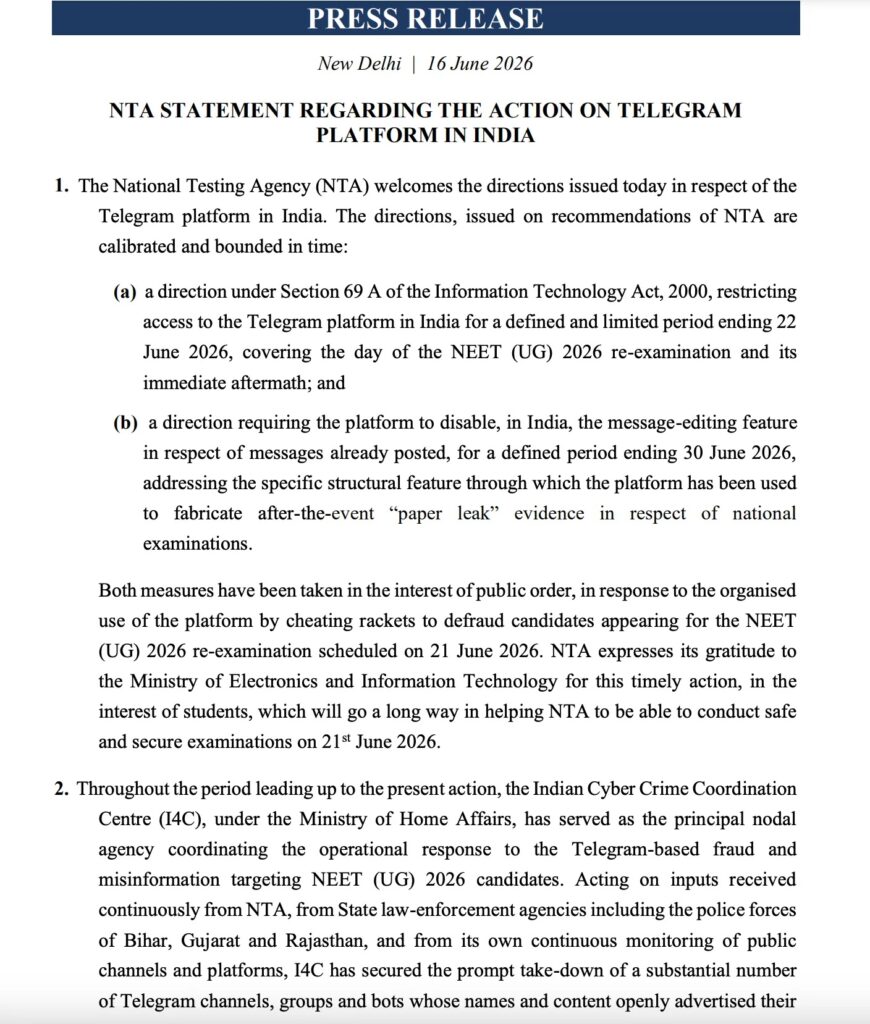
The restriction was issued under Section 69A of the Information Technology Act, 2000. It covers the exam day and its immediate aftermath, while a separate direction requires Telegram to disable editing for already posted messages in India until June 30.

Access content across the globe at the highest speed rate.
70% of our readers choose Private Internet Access
70% of our readers choose ExpressVPN

Browse the web from multiple devices with industry-standard security protocols.

Faster dedicated servers for specific actions (currently at summer discounts)
Reuters reported that India blocked the messaging app after officials said it was being used in attempts to defraud candidates preparing for the national medical entrance test. The move has also triggered a legal and free-speech dispute because Telegram has a large user base in India.
Why India Blocked Telegram Before the NEET Re-Exam
NTA said fraudulent Telegram channels were advertising alleged access to the NEET re-examination paper. The agency named examples such as “PAPER LEAKED NEET,” “Re-NEET 2026,” “Private Mafia,” and “REE NEET MAFIAA,” and said such channels demanded payments from students and families.
The agency said there is no exam paper outside the secure examination chain and that any promise of pre-exam access is fraudulent. It also said the Indian Cyber Crime Coordination Centre, MeitY, and state police forces had already worked on takedowns of suspicious Telegram channels, groups, and bots.
The Ahmedabad City Cyber Crime Branch arrested members of an inter-state cyber-fraud gang allegedly operating eight Telegram channels. NTA said the case involved about ₹1.5 crore in documented fraudulent transactions and roughly 1,000 mobile numbers contacted in one month.
| Measure | Duration | Purpose |
|---|---|---|
| Telegram access restriction in India | Until June 22, 2026 | Cover the NEET UG 2026 re-examination window and the day after the exam |
| Message-editing restriction for already posted messages | Until June 30, 2026 | Prevent edited old posts from being used as fake proof of paper leaks |
| Channel, group, and bot takedowns | Before the platform-level restriction | Remove fraudulent exam-related content and scams |
Message Editing Became a Separate Target
The second part of the order focuses on Telegram’s message-editing feature. NTA said some fraud actors can post a harmless message before an exam, then edit it later to add the real question paper while keeping the original timestamp.
The agency said this tactic creates misleading “proof” that a paper leaked before an exam. Its press release says the editing restriction applies only to previously posted messages and does not stop users from sending or receiving new messages.
The original NEET exam was already under pressure after allegations of leaked papers. Reuters said the earlier controversy led to the cancellation of results for 2.3 million students and protests in several parts of India.
Telegram Challenges the Order in Court
Telegram has challenged the temporary block in the Delhi High Court. In a court filing seen by Reuters, the company argued that blocking the entire platform harms free speech rights and access to information.
Telegram founder Pavel Durov also criticized the move, saying it punishes more than 150 million ordinary users in India rather than the people responsible for leaking exam material. He argued that leaks could simply move to other apps.
The legal fight adds another layer to the dispute between India and major technology platforms over takedowns, platform responsibility, and user rights. Reuters reported that the government was expected to defend the order in court and said it had repeatedly asked Telegram to fix its systems.
Digital Rights Groups Say the Ban Is Too Broad
The Internet Freedom Foundation criticized the measure, saying a nationwide shutdown is a disproportionate response to exam fraud. The group said in its Telegram ban statement that Section 69A is meant for blocking specific information, not for switching off an entire platform used by lawful users.
IFF also argued that the government should publish the MeitY order and the NTA recommendation behind it. The group said India should rely on targeted takedowns, criminal prosecution, and stronger exam security instead of platform-wide restrictions.
- NTA says the action protects the integrity of the NEET UG 2026 re-examination.
- Telegram says the block affects ordinary users and does not solve the source of leaks.
- Digital rights groups say the measure raises proportionality and transparency concerns.
- Students should rely only on official NTA channels for exam updates.
What Students and Telegram Users Should Know
The NEET UG 2026 re-examination is still scheduled for June 21. NTA has asked candidates to ignore unverified claims on any platform and rely on the official NEET website and verified NTA handles for updates.
Anyone who receives an offer claiming access to the NEET paper should treat it as fraud. NTA said suspicious solicitations can be reported to the National Cyber-Crime Helpline at 1930 or through the National Cyber-Crime Reporting Portal.
The restriction is temporary, but the debate around it will likely continue after the exam. As the Internet Freedom Foundation argued, the wider issue is how India can secure high-stakes exams without cutting off a communication platform used by lawful users.
FAQ
India temporarily blocked Telegram ahead of the NEET UG 2026 re-examination because authorities said cheating rackets were using the platform to defraud candidates with fake paper-leak claims and paid access offers.
The Telegram access restriction is scheduled to last until June 22, 2026, covering the NEET UG 2026 re-examination on June 21 and the immediate aftermath.
The message-editing restriction targets a tactic where old Telegram posts can be edited after an exam to insert question papers while keeping the original timestamp. Authorities said this could be used to create fake evidence of paper leaks.
According to NTA, the message-editing restriction applies to already posted messages and does not affect ordinary use of Telegram for sending or receiving new messages once access is available.
Yes. Telegram challenged the temporary block in the Delhi High Court, arguing that a platform-wide restriction affects free speech and access to information for ordinary users.


Read our disclosure page to find out how can you help VPNCentral sustain the editorial team Read more


Improve this guide



User forum
0 messages