
AI Surveillance and Biometric Databases Expand Government Monitoring Risks Worldwide


 9 min. read
  Published on
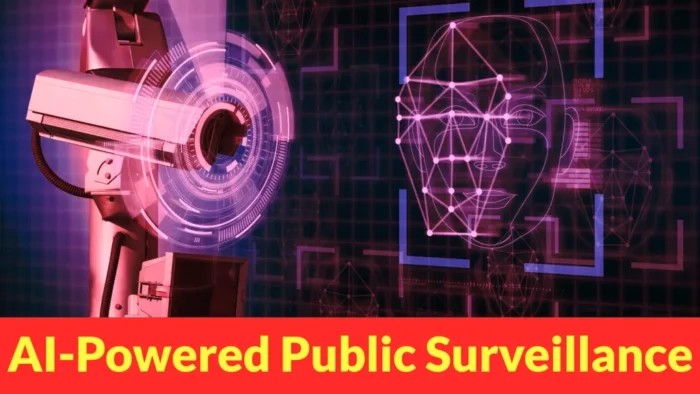
Governments are rapidly expanding digital surveillance through AI-powered monitoring, biometric databases, spyware, network interception, and large-scale data aggregation. A new Recorded Future Insikt Group report says state digital surveillance creates high or very high risk in 31 countries.
The report assessed 193 countries and found that surveillance risk depends on three factors: technical capability, history of abuse, and the strength of independent oversight. It also identified 74 medium-risk countries, including 55 where governments use less advanced tools to monitor dissent, political opposition, journalists, or activists.

Access content across the globe at the highest speed rate.
70% of our readers choose Private Internet Access
70% of our readers choose ExpressVPN

Browse the web from multiple devices with industry-standard security protocols.

Faster dedicated servers for specific actions (currently at summer discounts)
The findings matter for companies, travelers, journalists, activists, and foreign nationals. In high-risk countries, digital surveillance can lead to corporate data loss, intellectual property theft, targeted intelligence collection, reputational harm, legal pressure, and physical detention.
Five surveillance categories define the risk
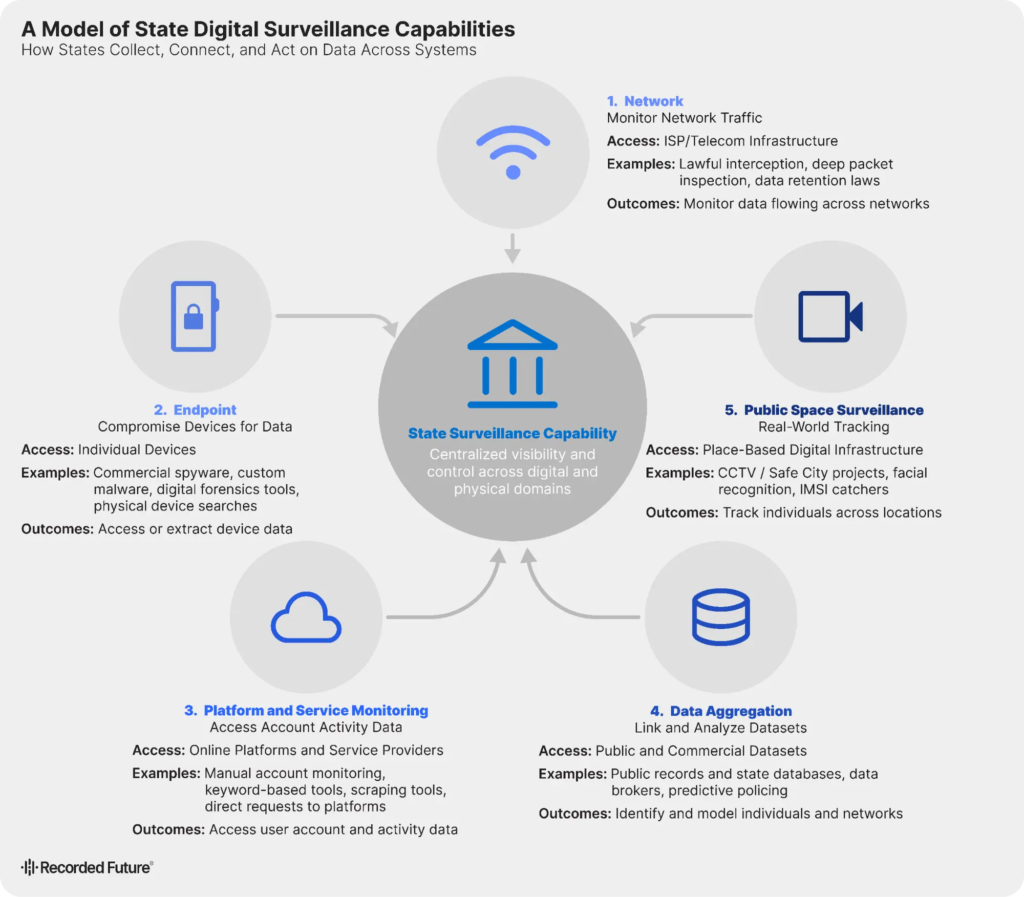
Insikt Group separates modern state surveillance into five broad categories. These are network interception, endpoint compromise, platform-level access, public space surveillance, and data aggregation.
Network interception gives governments access to traffic moving through telecom or internet infrastructure. Endpoint compromise targets devices directly through spyware, malware, or forensic tools.
Platform-level access involves state requests or pressure on online services, while public space surveillance uses cameras, facial recognition, cell-site simulators, and other city-level systems. Data aggregation links records from identity systems, travel databases, SIM cards, biometrics, and public services.
| Surveillance capability | What it can access | Main risk |
|---|---|---|
| Network interception | Internet traffic, metadata, subscriber data, and communications | Mass monitoring through telecom infrastructure |
| Endpoint compromise | Phones, laptops, messages, microphones, cameras, and files | Highly invasive targeting of individuals |
| Platform-level access | Account records, social media data, emails, IP logs, and login history | Broad monitoring through service providers |
| Public space surveillance | Faces, vehicles, movements, phone identifiers, and public behavior | Tracking protesters, minorities, visitors, and dissidents |
| Data aggregation | Biometrics, IDs, SIM records, travel logs, health data, and financial records | Creation of detailed state profiles on individuals |
AI cameras and biometric systems are expanding state monitoring
AI-powered public surveillance has become a central concern because it can identify people in public spaces at scale. Safe City and Smart City projects often combine CCTV, facial recognition, automatic license plate readers, cloud storage, and police monitoring centers.
Recorded Future says these systems are often sold as public safety tools, but governments can also use them to repress protests, track minority groups, or identify political opponents. The report cites examples involving Türkiye, Myanmar, and other countries where surveillance infrastructure has raised human rights concerns.
Biometric databases increase the risk further. When facial images, fingerprints, iris scans, voiceprints, or DNA records are linked with SIM cards, travel data, identity documents, and service records, governments can build persistent profiles that follow people across many parts of daily life.
Commercial spyware lowers the barrier for government hacking
The commercial spyware market has made advanced intrusion tools available to more governments. The UK’s National Cyber Security Centre assessment previously warned that commercial cyber tools lower the barrier for state and non-state actors to obtain capabilities they could not easily build themselves.
Those tools can rival state-linked advanced persistent threat capabilities. They can also be used outside legitimate criminal investigations, especially in countries where courts, parliaments, privacy regulators, or independent oversight bodies have limited power.
Recorded Future says commercial spyware, AI monitoring, and expanding biometric data collection are converging into more complete surveillance ecosystems. In countries with weak checks, that convergence can turn routine travel, messaging, device use, and public movement into intelligence sources.
Spyware cases show how individuals are targeted
In February 2026, Amnesty International reported that Predator spyware was used in 2024 to target Angolan journalist Teixeira Cândido. Amnesty said its Security Lab found forensic traces confirming that Predator was installed and running on his phone for at least part of one day.
The case shows why endpoint surveillance is so intrusive. Once spyware infects a device, it can expose messages, photos, emails, location data, call logs, contacts, stored passwords, screenshots, and microphone access.
From 2024 to 2026, Insikt Group found evidence that at least 16 countries had deployed Predator or Candiru spyware. The affected countries included Angola, Armenia, Azerbaijan, Egypt, Hungary, Indonesia, Iraq, Kazakhstan, Oman, the Philippines, Saudi Arabia, and others.
- Spyware can compromise encrypted messaging by reading data on the device.
- Forensic extraction tools can expose data after device seizure or detention.
- Biometric systems can connect physical identity to digital records.
- AI camera networks can identify people in public spaces.
- Telecom interception can reveal communication patterns without touching a device.
Digital forensics tools can also be abused
Surveillance risk does not come only from remote spyware. In December 2024, Amnesty International reported that Serbian police and intelligence authorities used spyware and mobile forensic tools to target journalists and activists.
Amnesty said Serbian authorities used Cellebrite forensic extraction tools alongside NoviSpy, an Android spyware system that could capture sensitive information and remotely activate a device microphone or camera.
Recorded Future also cited reports from Kazakhstan, where authorities allegedly used Cellebrite tools to unlock the phone of an activist detained in January 2026. These cases show how tools built for law enforcement can become instruments of repression when legal safeguards fail.
Risk is highest where oversight is weak
The problem is not only the existence of surveillance technology. The bigger issue is whether governments have clear laws, independent authorization, transparency, proportional use, and effective remedies for abuse.
The United Nations privacy standards stress that surveillance must follow principles of legality, necessity, and proportionality. Those principles become harder to enforce when surveillance systems operate secretly or when intelligence agencies face little outside review.
The risk is especially high when telecom operators, internet providers, border agencies, police databases, biometric systems, and public camera networks can be linked together. In that environment, a traveler’s device, SIM card, face, hotel stay, flight record, and online activity may become part of one profile.
Very high-risk countries require stricter travel controls
Recorded Future lists Belarus, China, Iran, Myanmar, North Korea, and Russia as very high risk. These countries combine advanced surveillance capabilities, weak independent oversight, and a record of targeting critics, travelers, foreign businesses, or political opposition.
For very high-risk destinations, the report recommends that organizations assume devices may be compromised. Travelers should avoid bringing personal or corporate devices where possible, or use dedicated travel devices with minimized data access.
For high-risk destinations, organizations should limit access to sensitive accounts, apply firmware and operating system updates before departure, use end-to-end encrypted messaging, and use a VPN where legally allowed.
| Risk tier | Recommended approach |
|---|---|
| Very high risk | Avoid non-essential travel, use sterile devices, minimize account access, and store devices in a Faraday bag when not needed |
| High risk | Patch devices before travel, restrict corporate access, use encrypted apps, and avoid unnecessary local apps |
| Medium risk | Keep apps updated, prepare travelers for phishing and device seizure risks, and use strict social media privacy settings |
| Low risk | Maintain standard security hygiene, avoid untrusted Wi-Fi, and use multi-factor authentication |
Business travelers face data and legal exposure
Corporate travelers may carry sensitive files, email access, source code, contracts, credentials, customer data, or strategy documents. In a high-surveillance jurisdiction, one compromised device can expose far more than personal information.
The Insikt Group analysis warns that foreign nationals and business travelers can face sensitive data breaches, intellectual property theft, targeted intelligence operations, reputational damage, and detention risk.
Security teams should treat surveillance risk as part of travel planning. The same process that checks sanctions, political risk, and physical safety should also decide what devices, accounts, apps, and data a traveler can bring.
- Classify destination countries by digital surveillance risk before travel.
- Use dedicated travel devices for high-risk and very high-risk destinations.
- Remove sensitive files, saved passwords, private keys, and unnecessary accounts before departure.
- Apply operating system, browser, firmware, and app updates before travel.
- Use end-to-end encrypted messaging where legally permitted.
- Avoid local apps that request broad access to contacts, files, microphone, camera, or location.
- Disable Bluetooth, AirDrop, file sharing, and unnecessary radios when not needed.
- Reset or securely wipe travel devices after returning from high-risk countries.
Surveillance tools are spreading faster than safeguards
The NCSC commercial cyber proliferation report warned that commercial spyware and hacking services can expand the number and type of victims that defenders must protect. The market also creates incentives for exploit brokers and spyware vendors to find new vulnerabilities.
The OHCHR privacy framework makes clear that unlawful or arbitrary surveillance, biometric collection, hacking, and interception can violate the right to privacy. Yet many surveillance systems now operate in countries where independent review remains limited or ineffective.
The result is a widening gap between capability and accountability. AI-powered cameras, spyware, biometric databases, and national data platforms now give governments more ways to monitor people than ever before, while legal safeguards often lag behind the technology.
What organizations should do now
Organizations should build a formal digital surveillance travel policy for staff who visit high-risk countries. That policy should define approved devices, approved applications, account access, data handling rules, and post-travel inspection steps.
Journalists, activists, lawyers, researchers, executives, and employees with access to sensitive data need extra precautions. The Predator case in Angola and the Serbia spyware findings show how surveillance can target civil society and professional communities, not only criminals or national security suspects.
The safest approach is to assume that surveillance risk is now part of global business risk. Companies should prepare before travel, reduce data exposure during trips, and verify devices after staff return from countries where monitoring is likely.
FAQ
AI-powered public surveillance uses cameras, facial recognition, license plate readers, data analytics, and other tools to identify, track, or profile people in public spaces. Governments often deploy these systems under public safety or smart city programs.
Recorded Future’s Insikt Group assessed 31 countries as high or very high risk for state digital surveillance. It also listed 74 medium-risk countries, including 55 where governments use less advanced surveillance to monitor dissent, activists, journalists, or political opposition.
Biometric databases store identifiers such as facial images, fingerprints, iris scans, voiceprints, or DNA. When governments link these records with SIM cards, travel logs, identity systems, and public services, they can create detailed profiles that support tracking and targeting.
Commercial spyware can compromise phones and computers, collect private data, monitor communications, activate microphones or cameras, and bypass normal device security. Its sale to more governments lowers the barrier for highly invasive surveillance.
Business travelers should use dedicated travel devices for high-risk destinations, update devices before travel, limit account access, avoid storing sensitive files locally, use encrypted apps where legal, avoid unnecessary local apps, and wipe or inspect devices after returning.


Read our disclosure page to find out how can you help VPNCentral sustain the editorial team Read more


Improve this guide


User forum
0 messages