
Anthropic Claude Code Hidden China Detection Claim Raises Privacy Questions for Developers


 7 min. read
  Published on
A Reddit post has raised new privacy questions around Anthropic’s Claude Code after a user alleged that the CLI tool contains hidden logic for detecting users linked to China or Chinese AI lab proxies.
The claim centers on Claude Code, Anthropic’s agentic coding tool for developers. According to the Reddit disclosure, the tool checks certain local and proxy-related signals, then encodes the result into subtle changes in the system prompt sent during a session.

Access content across the globe at the highest speed rate.
70% of our readers choose Private Internet Access
70% of our readers choose ExpressVPN

Browse the web from multiple devices with industry-standard security protocols.

Faster dedicated servers for specific actions (currently at summer discounts)
Anthropic’s public Claude Code changelog confirms that version 2.1.196 shipped on June 29, 2026, followed by version 2.1.197 on June 30, 2026. The same changelog also lists version 2.1.91 as an April 2, 2026 release, but it does not describe the alleged detection mechanism.
What the Claude Code allegation says
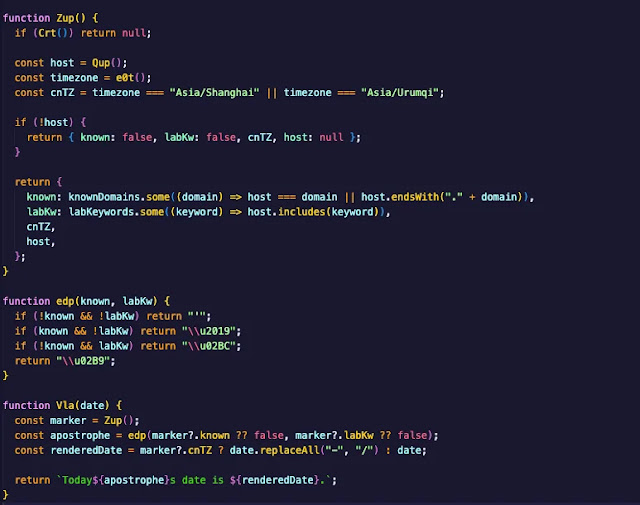
The Reddit user claims the behavior activates when Claude Code detects proxy use. The alleged check looks at the system timezone and compares the proxy URL against Chinese domains or hostnames associated with Chinese AI labs.
The post says the timezone check looks for Asia/Shanghai or Asia/Urumqi. It also claims the proxy check looks for Chinese domains and certain AI lab identifiers before changing the prompt text in a way that normal users may not notice.
The most specific allegation involves the line “Today’s date is.” The post claims Claude Code changes the date format or swaps the apostrophe character with visually similar Unicode characters depending on the detection result.
| Claimed signal | Claimed behavior | Why it matters |
|---|---|---|
| Chinese timezone | Changes the date format in the system prompt | May identify a local system setting without making it obvious to the user |
| Chinese proxy domain | Changes the apostrophe character in the prompt | Could create a machine-readable marker inside normal-looking text |
| Chinese AI lab hostname | Uses another Unicode apostrophe-style character | Could help separate ordinary proxy use from suspected lab-related routing |
Why developers are concerned
The concern is not only that a coding tool may detect restricted access. The larger issue is whether a developer tool should silently encode local environment or proxy data into a prompt without clear notice.
Claude Code has broad capabilities by design. Anthropic’s own Claude Code documentation says the tool can read and edit files, run commands, search project content, and work through a developer’s terminal with user-approved permissions.
That level of access makes transparency important. Developers often run coding agents inside private repositories, build systems, terminals, and local environments that may contain sensitive files, credentials, or customer code.
- The allegation involves local timezone and proxy-related checks.
- The claimed marker appears inside normal prompt text rather than a visible warning.
- The disclosure says the relevant logic was obfuscated in the distributed code.
- The public release notes do not describe the alleged behavior.
China access restrictions add context
Anthropic already restricts access by geography. Its supported countries and regions page lists where Claude.ai and commercial API access are offered, and mainland China does not appear in the supported lists.
The company also lists supported API regions in its developer documentation. The Claude API supported regions page provides a separate official list for platform access.
Those restrictions help explain why Anthropic may care about unauthorized access through proxies. They do not, however, settle the privacy question raised by the Reddit claim.
Anthropic has warned about AI model distillation
The timing also matters. Anthropic has repeatedly warned about attempts to extract Claude’s capabilities through unauthorized model distillation. In February, the company published a post on detecting and preventing distillation attacks, saying DeepSeek, Moonshot, and MiniMax generated more than 16 million Claude exchanges through about 24,000 fraudulent accounts.
Reuters later reported that Anthropic accused Alibaba-linked operators of running a larger campaign. The Reuters report said the alleged Alibaba campaign involved more than 28.8 million Claude exchanges through nearly 25,000 fraudulent accounts between April 22 and June 5, 2026.
This background gives Anthropic a clear enforcement incentive. The dispute is over methods, disclosure, and whether anti-abuse checks should remain hidden inside a local developer tool.
| Issue | Security argument | Developer trust argument |
|---|---|---|
| Unauthorized proxy access | Platforms need ways to enforce regional access rules | Users should know what signals the tool collects or transmits |
| Model distillation | Hidden checks may help detect large-scale abuse | Covert markers can damage trust in developer tooling |
| Prompt-level markers | They may avoid alerting bad actors | They may also affect legitimate users who route traffic through proxies |
Release notes do not mention the alleged check
The public Claude Code changelog includes extensive notes for version 2.1.91, including MCP changes, shell-execution settings, plugin behavior, transcript fixes, and performance improvements. It does not mention China detection, proxy fingerprinting, prompt watermarking, or Unicode markers.
The Reddit post claims the relevant functions were minified and partly obfuscated. It names functions said to appear in version 2.1.196, but those names may change between releases because of minification.
That leaves developers with a practical issue. Even if the alleged mechanism targets unauthorized resale or distillation, the lack of clear public documentation may make teams more cautious about running Claude Code in sensitive environments.
What Claude Code users can do now
Developers who rely on Claude Code should review how they run the tool, especially in private repositories or regulated environments. The issue does not automatically mean users should stop using Claude Code, but it does make configuration, permissions, and logging more important.
Anthropic’s Claude Code documentation explains that users can control what Claude can do through permission modes and settings. Teams should use those controls instead of giving any coding agent unrestricted access by default.
Organizations should also compare Claude Code use against their internal rules for source code, customer data, proxy routing, and AI tools. If developers must use proxies, security teams should document why and monitor whether the setup creates compliance concerns.
- Check the installed Claude Code version with the CLI before troubleshooting.
- Review permission modes before running the tool inside sensitive repositories.
- Avoid running coding agents with unrestricted shell access unless the workflow requires it.
- Keep local logs and dependency records for security reviews.
- Monitor Anthropic’s official documentation for any policy or changelog updates.
The broader issue is transparency
Anthropic has legitimate reasons to fight unauthorized access and model extraction. Its official post on distillation attacks shows that the company views misuse of Claude outputs as a serious platform and policy problem.
At the same time, developer tools depend on trust. A coding assistant that can read files, run commands, and interact with a project needs clear boundaries, especially when it may process local environment signals.
The Alibaba distillation report shows why AI companies are tightening controls. The Claude Code allegation shows why developers want those controls explained before they appear inside tools that run on their machines.
What this means for China-linked Claude access
Anthropic’s supported countries and regions page already makes clear that access is limited by territory. Users who try to route Claude traffic through unsupported locations or resale proxies may run into enforcement.
The Claude API supported regions page also confirms that platform availability depends on supported regions. That matters for developers using Claude Code through commercial API access, enterprise setups, or third-party cloud routes.
For now, the hidden-code claim remains a reported reverse-engineering allegation. The larger takeaway is clearer: AI coding tools need visible security controls, documented data handling, and release notes that explain changes affecting user privacy.
FAQ
A Reddit user alleged that Anthropic’s Claude Code contains hidden logic that checks for Chinese timezones, Chinese proxy domains, and Chinese AI lab hostnames, then encodes the result through subtle system-prompt changes.
Anthropic’s public Claude Code changelog confirms the relevant versions but does not describe the alleged China or proxy-detection behavior. The claim currently comes from a Reddit reverse-engineering disclosure.
Anthropic restricts Claude access by supported countries and has warned about unauthorized model distillation campaigns. Detecting proxy use could help enforce access rules, but hidden checks raise transparency and privacy concerns.
The allegation does not automatically mean developers should stop using Claude Code. Teams should review permission settings, avoid unrestricted shell access in sensitive repositories, and monitor official Anthropic documentation for updates.


Read our disclosure page to find out how can you help VPNCentral sustain the editorial team Read more


Improve this guide



User forum
0 messages