
950 Oracle E-Business Suite Instances Exposed as Critical Flaw Faces Active Exploitation


 7 min. read
  Published on

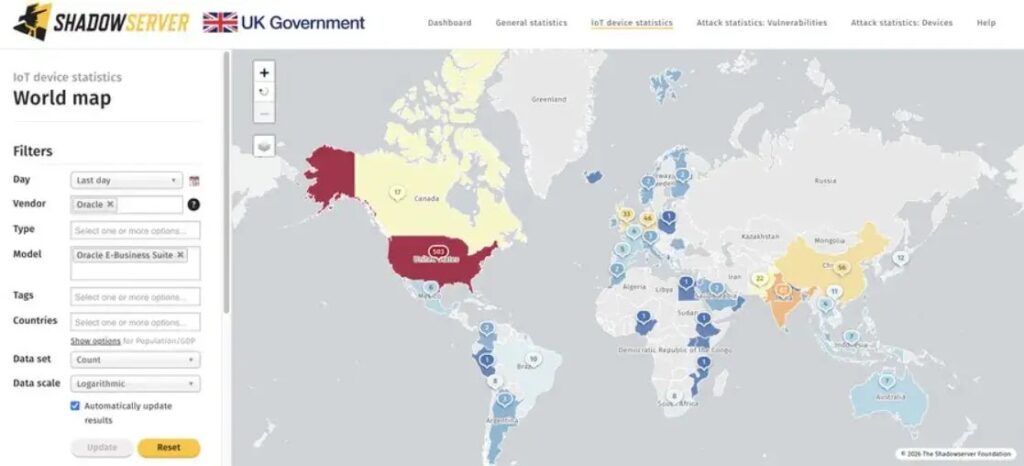
Security researchers have found around 950 Oracle E-Business Suite instances exposed online while attackers are exploiting a critical vulnerability in the platform’s Oracle Payments component.
The vulnerability is tracked as CVE-2026-46817. It affects Oracle E-Business Suite versions 12.2.3 through 12.2.15 and can allow unauthenticated attackers with HTTP access to compromise Oracle Payments, according to Oracle’s May 2026 Critical Security Patch Update.

Access content across the globe at the highest speed rate.
70% of our readers choose Private Internet Access
70% of our readers choose ExpressVPN

Browse the web from multiple devices with industry-standard security protocols.

Faster dedicated servers for specific actions (currently at summer discounts)
The exposure count comes from Shadowserver, which said it improved Oracle E-Business Suite fingerprinting by adding domain-based scans in collaboration with Validin. Shadowserver also noted that the data shows exposed instances, not confirmed vulnerable or compromised systems.
What Researchers Found
Shadowserver said its updated scanning now identifies exposed Oracle E-Business Suite deployments under device_vendor Oracle and device_model Oracle E-Business Suite in its Device ID reporting.
The timing is important because Defused reported active exploitation of CVE-2026-46817 against Oracle E-Business Suite decoys on June 27, 2026. The company described six unauthenticated file-read attempts from a single source before any public proof-of-concept was known.
BleepingComputer reported that the exposed systems are being tracked amid ongoing attacks targeting the same critical Oracle E-Business Suite flaw. The overlap raises risk for organizations that left EBS portals reachable from the public internet.
Why CVE-2026-46817 Is Serious
CVE-2026-46817 sits in the File Transmission component of Oracle Payments. Oracle rated the flaw 9.8 out of 10 and said successful exploitation can result in takeover of Oracle Payments.
The risk is high because the flaw requires no authentication. An attacker only needs network access over HTTP to target affected deployments, based on Oracle’s security patch advisory.
NHS England Digital also warned that CVE-2026-46817 could allow unauthenticated remote takeover of Oracle Payments and assessed further exploitation as highly likely.
Known Details at a Glance
| Item | Current detail |
|---|---|
| Vulnerability | CVE-2026-46817 |
| Affected product | Oracle E-Business Suite Oracle Payments |
| Affected component | File Transmission |
| Affected versions | 12.2.3 through 12.2.15 |
| Attack vector | Unauthenticated HTTP access |
| Severity | CVSS 3.1 score of 9.8 |
| Patch status | Patch available in Oracle’s May 2026 update |
| Exposure count | Around 950 internet-exposed EBS instances seen by Shadowserver |
The observed exploit activity does not prove that all exposed Oracle E-Business Suite instances are vulnerable. It does show that attackers are already testing the flaw against decoy environments.
That means public exposure should move these systems to the top of the patching and investigation queue. EBS environments often support finance, procurement, HR, supply chain, and payment workflows.
How the Exploitation Was Observed
Defused said its decoys captured the first known in-the-wild exploitation of CVE-2026-46817 on June 27, 2026. The activity involved unauthenticated file-read attempts against the Oracle Payments component.
The researcher note from Defused said the activity looked like targeted proof-of-concept testing rather than broad scanning. The company also said there was no public proof-of-concept at the time.
Help Net Security reported that the exploit targets Oracle Payments’ File Transmission functionality and can be used to read files from the server. It also warned that the same technique could put configuration files, database credentials, encryption keys, or payment processor API keys at risk.
Why Exposed EBS Systems Are High-Value Targets
Oracle E-Business Suite is used by organizations to run key business operations, including financial and operational workflows. That makes internet-facing EBS systems attractive targets for data theft, fraud, and lateral movement.
An attacker who compromises Oracle Payments may gain access to sensitive payment workflows and related enterprise data. The exact impact depends on system configuration, data access, integrations, and whether attackers can move beyond the vulnerable component.
ERP systems can also connect to databases, banks, file transfer services, identity providers, and reporting tools. A single exposed application can therefore become a route into a much larger business environment.
What Organizations Should Do Now
Organizations should first identify every Oracle E-Business Suite instance reachable from the internet. Public access should be treated as a major risk until teams confirm patch status and complete log review.
NHS England Digital advised affected organizations to apply the latest Oracle E-Business Suite update as soon as possible. It also said organizations running sustaining support or end-of-life releases should move to a supported version.
- Find all Oracle E-Business Suite instances, including partner-facing and forgotten systems.
- Confirm whether versions 12.2.3 through 12.2.15 are in use.
- Check whether Oracle Payments and File Transmission are enabled or exposed.
- Apply Oracle’s May 2026 Critical Security Patch Update.
- Restrict EBS access to VPNs, private networks, or zero-trust gateways.
- Review HTTP logs for suspicious requests to Oracle Payments endpoints.
- Check for unusual file reads, configuration changes, and new accounts.
Exposure Does Not Equal Compromise
The Shadowserver data should not be read as a list of breached organizations. It shows externally reachable Oracle E-Business Suite instances, which may include patched, unpatched, test, production, or misconfigured systems.
Still, Shadowserver said CVE-2026-46817 attempts have been observed in the wild by Defused, making the exposure picture more urgent for defenders.
BleepingComputer noted that Oracle patched the flaw in May 2026 and urged customers to apply the relevant security updates immediately. Systems left exposed after the patch window may now face probing or exploitation attempts.
Security Teams Should Investigate, Not Just Patch
Patching blocks future exploitation, but it does not answer whether attackers already accessed an exposed system. Any internet-facing Oracle E-Business Suite environment that remained unpatched after May 2026 should receive a compromise assessment.
Help Net Security said administrators should apply Oracle’s May update immediately and keep EBS web interfaces restricted to internal networks until patched.
Teams should review application logs, web server logs, database access, file activity, scheduled jobs, accounts, and outbound network activity. The goal is to determine whether an attacker only probed the system or accessed sensitive data.
Recommended Response Checklist
| Priority | Action | Reason |
|---|---|---|
| Critical | Apply the May 2026 Oracle EBS patches | Oracle has already released fixes for CVE-2026-46817 |
| Critical | Remove direct public access | Internet-facing EBS systems are easier to probe and exploit |
| High | Review Oracle Payments logs | The observed exploitation targeted this component |
| High | Check sensitive file access | The observed activity involved unauthenticated file-read attempts |
| High | Review accounts and privileges | ERP compromises can lead to persistence or fraud |
| Medium | Add detection rules to SIEM and EDR tools | Security teams need fast alerts for follow-up attempts |
The broader lesson is clear. Critical ERP applications should not remain directly exposed unless teams have a specific business reason and strong compensating controls.
Oracle E-Business Suite supports core business operations for many organizations, so compromise can affect more than a single web application. It can expose financial processes, supplier data, payment workflows, and internal operational records.
Security teams should treat CVE-2026-46817 as both a patching issue and an incident response trigger. Any exposed and unpatched Oracle EBS environment needs immediate remediation, access restriction, and forensic review.
FAQ
CVE-2026-46817 is a critical Oracle E-Business Suite vulnerability in the Oracle Payments File Transmission component. It can allow unauthenticated attackers with HTTP access to compromise Oracle Payments.
Shadowserver reported around 950 exposed Oracle E-Business Suite instances globally after improving its fingerprinting with domain-based scans. The count reflects exposure, not confirmed vulnerability or compromise.
Oracle says CVE-2026-46817 affects Oracle E-Business Suite versions 12.2.3 through 12.2.15.
Yes. Defused reported in-the-wild exploitation attempts against Oracle E-Business Suite decoys on June 27, 2026. The reported activity involved six unauthenticated file-read attempts from one source.
Administrators should apply Oracle’s May 2026 Critical Security Patch Update, remove direct public access where possible, review Oracle Payments logs, check for suspicious file-read activity, and investigate any exposed unpatched systems for compromise.


Read our disclosure page to find out how can you help VPNCentral sustain the editorial team Read more


Improve this guide



User forum
0 messages