
Linux Kernel Vulnerability Lets Local Users Gain Root Through DRM Render Nodes


 8 min. read
  Published on
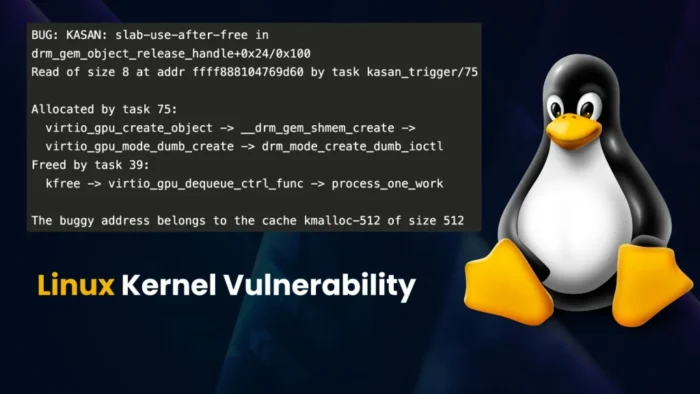
A Linux kernel vulnerability tracked as CVE-2026-46215 allowed a local user with access to GPU render nodes to escalate privileges to root on affected systems.
The flaw sits in the Direct Rendering Manager GEM change-handle path, a graphics memory management area used by kernel DRM drivers. The public GitHub Advisory Database entry describes it as a race condition that can leave a dangling handle and trigger a use-after-free.

Access content across the globe at the highest speed rate.
🔥 Save 81% + 2 bonus months! 🔥
70% of our readers choose Private Internet Access
70% of our readers choose ExpressVPN
2
Browse the web from multiple devices with industry-standard security protocols.
🔥 Save 73%! 🔥

Faster dedicated servers for specific actions (currently at summer discounts)
🔥 Save 69%! 🔥
Security researcher Cyberstan published a technical analysis showing how the bug could be turned into passwordless root access on tested systems. The Cyberstan analysis says the issue affected kernels from v6.18-rc1 through the initial fix.
What is CVE-2026-46215?
CVE-2026-46215 affects DRM_IOCTL_GEM_CHANGE_HANDLE, an ioctl that changes a GEM object from one graphics memory handle to another. The official Linux kernel DRM documentation says the new handle must be unused and that future ioctls should use the new handle after the change succeeds.
The problem appears during a race with DRM_IOCTL_GEM_CLOSE. The change-handle operation can briefly leave one object reachable through two IDR entries, while a concurrent close operation can free the object and leave another handle pointing to memory that has already been released.
That makes the bug a use-after-free issue. In kernel security terms, this class of flaw can let attackers manipulate freed memory and then use the dangling reference to influence kernel behavior.
| Item | Details |
|---|---|
| CVE | CVE-2026-46215 |
| Kernel area | Direct Rendering Manager GEM core |
| Vulnerable path | DRM_IOCTL_GEM_CHANGE_HANDLE |
| Bug class | Race condition leading to use-after-free |
| Attack type | Local privilege escalation |
| Public severity | High, CVSS 3.1 score 7.8 in the GitHub advisory |
Why render nodes matter
The vulnerability matters because DRM render nodes are intentionally available to ordinary desktop sessions. They let unprivileged processes use GPU functionality without giving them full control over display hardware.
Cyberstan said both ioctls involved in the race were reachable from render nodes. On many desktop Linux systems, an active logged-in user can access devices such as /dev/dri/renderD128 through normal session permissions.
The DRM UAPI documentation also explains the role of GEM handles and close operations, which helps explain why a reference-counting or handle-management bug in this area can become security-sensitive.
How the exploit reached root
The public write-up shows that the flaw could move beyond a crash. The exploit path reclaimed freed kernel memory, leaked a kernel pointer to bypass KASLR, and used page-cache manipulation to modify /etc/passwd from an unprivileged process.
The result reported by the researcher was passwordless root access on the tested systems. The write-up said the exploit succeeded in 99 out of 100 test boots, with the race usually won in fewer than 100 attempts.
This does not mean every Linux system can be exploited in the same way. Kernel version, configuration, GPU device access, distribution hardening, and local permissions all affect exposure and reliability.
- The attacker needs local code execution on the target system.
- The attacker needs access to a DRM render node.
- The bug does not require a password for root.
- The exploit relies on timing and kernel memory behavior.
- Systems without the vulnerable ioctl path or without user access to render nodes face lower risk.
Who is affected?
The vulnerability affects Linux kernels that include the vulnerable GEM change-handle implementation. Cyberstan reported the issue to [email protected] on April 12, 2026, and said the first mainline fix landed in May 2026.
The Debian security tracker lists CVE-2026-46215 and shows fixed package status across Debian releases. It also notes that older Debian branches were not affected because the vulnerable code was not present there.
Administrators should check their distribution’s advisory rather than relying only on upstream kernel numbers. Enterprise distributions frequently backport fixes, so a vendor package may carry the patch without matching the upstream version string exactly.
| System type | Risk level | Reason |
|---|---|---|
| Desktop Linux with GPU render-node access | Higher | Logged-in users may have access to /dev/dri/renderD* devices |
| Multi-user Linux workstation | Higher | Any local account may become a privilege-escalation starting point |
| Linux server with GPU workloads | Depends on access | Risk depends on local users, containers, and device exposure |
| Systems without vulnerable kernel code | Lower | The vulnerable ioctl path is not present |
| Systems with patched vendor kernels | Lower | The race condition has been addressed by the distribution package |
The first fix needed follow-up work
The initial fix attempted to close the race by changing how handles were replaced during the operation. However, later kernel work showed that the first correction did not fully settle the issue.
The NVD entry for CVE-2026-53145 describes a follow-up fix for the same change-handle area and says earlier attempts had problems with handle confusion and error handling.
This is an important correction for patch planning. Systems that received the first fix may still need later kernel updates if their distribution marks them affected by the follow-up issue.
Patch status and versions
The GitHub advisory rates CVE-2026-46215 as High and lists the CVSS vector as local attack, low complexity, low privileges required, and no user interaction. That fits a local privilege escalation scenario rather than a remote compromise.
The GitHub advisory also describes the core bug: a single object briefly had two IDR entries, and a concurrent gem_close could delete one handle while leaving another dangling.
Debian’s tracker shows fixed status for multiple releases, including fixed linux package entries for bullseye, bookworm, trixie, forky, and sid. The Debian tracker is useful for admins who need distribution-specific package information.
| Question | Answer |
|---|---|
| Is this remotely exploitable? | No, public scoring and analysis describe a local privilege escalation issue. |
| Does it require root credentials? | No, the attack starts from a local user with the needed render-node access. |
| Does it require clicking a file? | No, the public CVSS vector lists no user interaction. |
| Can containers be affected? | Possibly, if a container receives access to vulnerable GPU render nodes. |
| Is the first fix enough? | Administrators should verify later vendor updates because follow-up fixes were issued. |
What administrators should do
Linux administrators should first identify systems with GPUs, DRM render nodes, and untrusted local users. Workstations, shared development systems, lab machines, remote desktops, and GPU compute servers deserve priority.
Teams should then apply the latest distribution kernel updates, not only the earliest patch tied to CVE-2026-46215. The NVD record for the follow-up issue shows why later fixes matter for this code path.
Where patching cannot happen immediately, administrators should limit who can access /dev/dri/renderD* devices. That may affect desktop acceleration, GPU workloads, browsers, compositors, and compute jobs, so teams should test changes before broad rollout.
- Inventory Linux systems running kernels from the affected development window.
- Check whether /dev/dri/renderD* exists and who can access it.
- Install the newest kernel security update from the distribution vendor.
- Review GPU device passthrough settings for containers and virtual machines.
- Limit render-node access on multi-user systems that do not need broad GPU access.
- Restart systems after kernel updates so the patched kernel actually loads.
- Monitor vendor advisories for follow-up fixes tied to DRM GEM change_handle.
Why this bug pattern keeps appearing
The bug reflects a difficult kernel pattern: compound operations on reference-counted objects. If one path adds, swaps, or removes a handle while another path can close it at the same time, developers must make every transition safe under concurrency.
DRM GEM objects are especially sensitive because they combine device access, memory management, user-space handles, and driver-specific behavior. A small handle-counting or IDR replacement mistake can turn into a powerful local attack surface.
The Cyberstan exploit write-up also highlights the defensive lesson: subsystems should reuse established helper patterns for object lifetime and handle replacement instead of open-coding delicate reference operations.
The bottom line
CVE-2026-46215 gave local users a path from ordinary GPU render-node access to root on affected Linux kernels. The bug did not need a remote network attack, but it created serious risk on multi-user systems and desktops where logged-in users can access DRM render nodes.
Administrators should update kernels through their distribution vendor, reboot into the fixed kernel, and review render-node permissions where untrusted users share the same system.
The later follow-up work around the same ioctl shows that the safest response is not to stop at the first patch. Teams should continue tracking vendor advisories until their distribution confirms that both the original race and related change-handle fixes have landed.
FAQ
CVE-2026-46215 is a Linux kernel vulnerability in the DRM GEM change-handle path. It is a race condition that can lead to a use-after-free and allow local privilege escalation.
Public advisories describe CVE-2026-46215 as a local privilege escalation issue. An attacker needs local code execution and access to a DRM render node, such as /dev/dri/renderD*.
DRM render nodes allow unprivileged applications to use GPU functionality. On many desktop Linux systems, active logged-in users can access these devices, which makes the vulnerable ioctl reachable without root privileges.
The public GitHub advisory rates CVE-2026-46215 as High with a CVSS 3.1 score of 7.8. The vector describes a local attack with low complexity, low privileges required, and no user interaction.
Administrators should apply the latest vendor kernel updates, reboot into the patched kernel, review access to /dev/dri/renderD* devices, limit GPU device exposure on shared systems, and check for follow-up fixes related to the DRM GEM change_handle ioctl.


Read our disclosure page to find out how can you help VPNCentral sustain the editorial team Read more


Improve this guide




User forum
0 messages