
Bit2Watt Attack Turns AI GPU Jobs Into a Potential Power Grid Threat


 8 min. read
  Published on
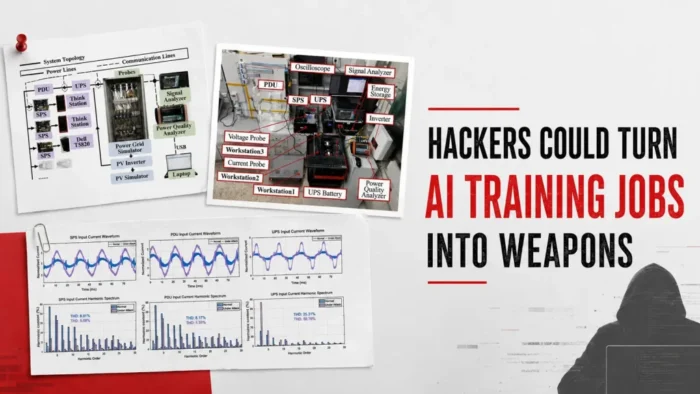
Researchers have demonstrated how a malicious cloud tenant could manipulate legitimate AI workloads to create rapid power fluctuations inside a data center. The proposed Bit2Watt attack requires no malware, administrative access, or direct compromise of power-grid equipment.
Instead, an attacker could repeatedly move large groups of GPUs between computation-heavy and low-activity states. These coordinated changes in electricity demand could affect data-center power equipment and, under certain conditions, disturb the local grid.

Access content across the globe at the highest speed rate.
🔥 Save 81% + 2 bonus months! 🔥
70% of our readers choose Private Internet Access
70% of our readers choose ExpressVPN
2
Browse the web from multiple devices with industry-standard security protocols.
🔥 Save 73%! 🔥

Faster dedicated servers for specific actions (currently at summer discounts)
🔥 Save 69%! 🔥
The Bit2Watt research paper, published by Zhouhao Ji, Kaikai Pan, and Wenyuan Xu of Zhejiang University, combines GPU experiments, electrical hardware testing, impedance analysis, and power-system simulations. It presents a newly researched cyber-physical risk rather than evidence of attacks in the wild.
What is the Bit2Watt attack?
Bit2Watt turns normal GPU workload controls into a method for changing electricity consumption at high frequencies. A malicious tenant could control the timing and intensity of computation to make GPUs alternate rapidly between high and low power demand.
Because cloud customers normally control training scripts, job schedules, batch processing, and GPU utilization, the activity may remain within their authorized permissions. The attacker does not need to change GPU firmware or access data-center electrical controls.
The researchers developed two methods for producing these power fluctuations:
- Synthetic Workload Modulation Attack: A purpose-built CUDA workload switches between computationally intensive and nearly idle modes.
- LLM Training Modulation Attack: Modulation logic is hidden inside a standard large language model training pipeline.
How GPU workloads can influence power systems
GPU power consumption changes with the work performed by processing cores, memory controllers, and other components. Compute-heavy operations raise power demand, while communication, synchronization, and idle periods consume less electricity.
Large AI jobs often involve thousands of GPUs operating in coordinated phases. This synchronization can make individual power changes combine into a larger fluctuation visible at the rack, data-center, or grid level.
Previous research involving Microsoft, OpenAI, and Nvidia identified similar power-management concerns in large AI training clusters. That work found that synchronized changes between computation and communication can produce power swings reaching tens or hundreds of megawatts at scale.
| Bit2Watt component | How it works | Potential effect |
|---|---|---|
| GPU workload | Alternates between high and low computational activity | Creates rapid changes in electricity demand |
| Coordinated cluster | Synchronizes power transitions across multiple GPUs | Combines small fluctuations into a larger electrical disturbance |
| Data-center equipment | Processes the changing load through power supplies, PDUs, and UPS systems | Attenuates some frequencies but may reshape or amplify others |
| Renewable-heavy grid | Uses inverter-controlled distributed energy resources | May experience harmonics, voltage changes, or reduced damping |
Two attack methods were tested
The Synthetic Workload Modulation Attack uses a persistent CUDA kernel with active and passive modes. A user-space controller changes between those modes according to a chosen schedule, allowing precise control over the fluctuation frequency.
The LLM Training Modulation Attack embeds the behavior into an ordinary training pipeline. It changes workload intensity through training parameters and auxiliary operations, making the resulting activity resemble legitimate AI processing.
The researchers tested several Nvidia GPU generations, including the RTX 2080, RTX 3080, RTX 3090, RTX 4090, Tesla V100, and A100. Synthetic workloads achieved modulation frequencies between 1,500 and 6,000 Hz, while the LLM method produced frequencies between 1,200 and 3,000 Hz.
What the hardware experiments showed
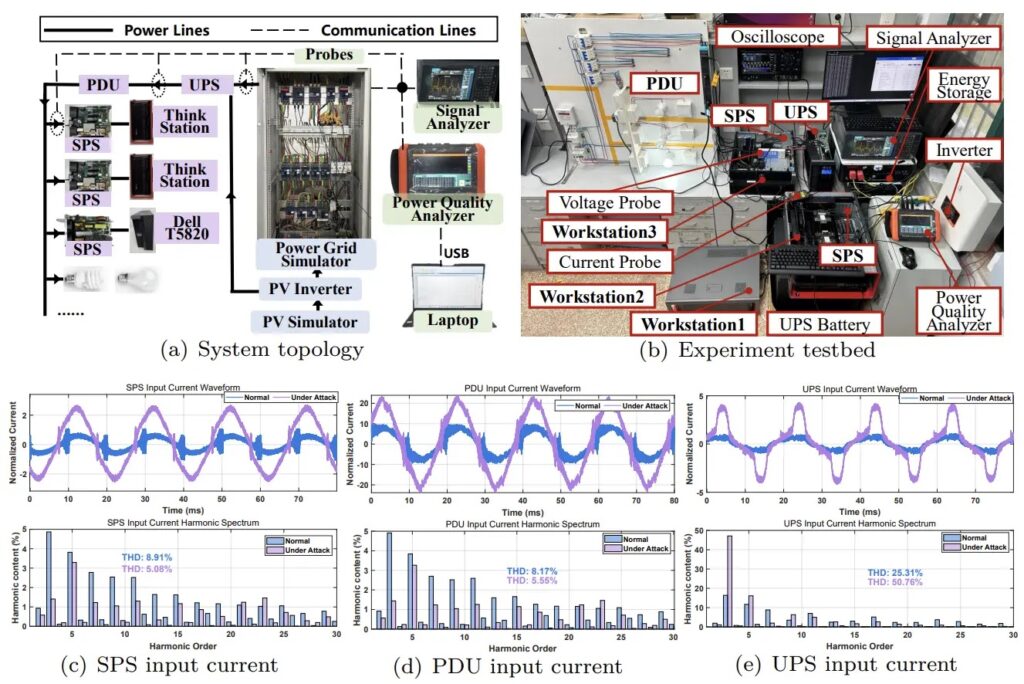
The physical testbed contained three workstations with six GPUs, a grid simulator, a photovoltaic simulator, a grid-connected solar inverter, a storage battery, and several background electrical loads. Total demand reached approximately 8 kW, with solar equipment providing around 40% of the power.
The experiments showed that GPU-induced fluctuations could travel through the power delivery chain. Server power supplies suppressed much of the highest-frequency activity, but intermediate equipment also reshaped parts of the disturbance into lower-frequency components.
The UPS system reduced some high-frequency signals while increasing activity between approximately 200 and 700 Hz. Its DC-bus voltage ripple rose from 0.45% to 2.82% during the experiment, showing that upstream equipment did not eliminate every effect.
| Research result | Environment | What it establishes |
|---|---|---|
| GPU modulation up to 6,000 Hz | Laboratory GPU measurements | User-level workloads can rapidly change GPU power demand |
| Six-GPU electrical testbed | Approximately 8 kW with 40% photovoltaic supply | Fluctuations can pass through and change across power equipment |
| 46.8% current THD | Worst-case 1 MW simulation with 1,000 synchronized GPUs and 90% DER penetration | Perfectly coordinated loads could severely degrade modeled power quality |
| Approximately 81% load loss | Modified 9,241-bus transmission-grid simulation | A modeled local disturbance could contribute to cascading failures |
Worst-case simulation produced severe distortion
In the researchers’ synchronized worst-case simulation, 1,000 RTX 3090-class GPUs operated within a 1 MW local power system. Distributed energy resources supplied 90% of the modeled system’s power.
Under those conditions, current total harmonic distortion reached 46.8%, while the damping ratio fell to minus 0.27. A negative damping ratio indicates that the modeled system amplified oscillations instead of suppressing them.
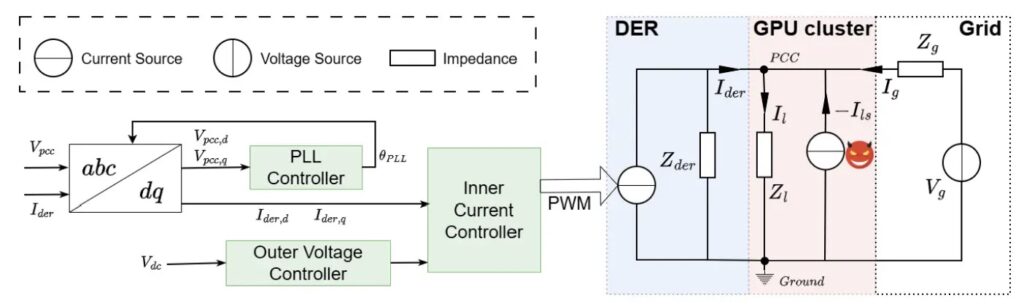
The Bit2Watt study also applied a disturbance representing 2% of system load to a modified 9,241-bus European transmission-network model. The simulation produced 13 cascading stages, disconnected 1,238 transmission lines, and ended with approximately 81% load loss.
The blackout figures require important context
The researchers did not trigger a blackout or disrupt a production power grid. The largest impacts came from computer simulations designed to explore severe conditions and possible upper bounds.
The 1,000-GPU model assumed that every GPU changed power demand at the same frequency and phase. It did not fully model device differences, network delays, operating-system scheduling delays, or phase dispersion across a real cloud environment.
Timing errors reduce the combined signal. In one modeled 2 kHz scenario, a timing-jitter standard deviation of 100 microseconds lowered the aggregated modulation amplitude by about 20%. Higher frequencies became more sensitive to imperfect synchronization.
- No attack against a commercial cloud provider has been reported.
- No real power grid was destabilized during the research.
- The physical testbed used six GPUs rather than 1,000 GPUs.
- The largest outage and distortion figures came from simulations.
- Real-world impact would depend on synchronization, grid design, protections, and power equipment.
Bit2Watt could be difficult to detect
Traditional cloud-security systems typically search for malicious code, unauthorized access, privilege escalation, or suspicious network activity. Bit2Watt instead uses approved workload controls available to an ordinary tenant.
Many monitoring systems also collect averaged power and utilization readings at relatively low sampling rates. High-frequency fluctuations can become smoothed as monitoring moves from the GPU to the server, rack, and facility level.
The researchers found that the LLM-based method proved harder to distinguish from normal work than the synthetic CUDA method. Dedicated physical sensors and high-resolution electrical monitoring provided better detection than routine cloud telemetry.
Watt2Bit brings the impact back to computing systems
The paper also describes a reverse effect called Watt2Bit. Electrical disturbances created by computing workloads could return through the power system and interrupt those workloads or other services.
High-frequency harmonics can increase resistive losses and heat within power supplies, uninterruptible power systems, and power distribution units. Overcurrent or temperature protections could then shut down servers, terminate training jobs, and create denial-of-service conditions.
The researchers also tested a potential electromagnetic side channel. They encoded information by switching between 200 Hz and 2 kHz GPU load patterns and recovered a 50-bit test sequence using nearby radio equipment. This experiment showed a possible covert channel, although practical data theft would require a receiver capable of observing the emissions.
How data centers can reduce the risk
Cloud providers can monitor synchronized changes in GPU utilization, unusual workload schedules, and repeated high-frequency transitions. Combining runtime performance data with high-resolution electrical telemetry would make workload-based disturbances easier to identify.
Providers can also reduce the concentration of suspicious jobs by distributing them across racks, power domains, or facilities. Scheduling controls should prevent an untrusted tenant from synchronizing enough GPUs to create a significant combined electrical load.
Separate AI data-center power stabilization research recommends combining software smoothing, GPU-level power controls, and rack-level energy storage. Batteries, supercapacitors, active filters, and carefully configured power-conditioning equipment can absorb or limit rapid load changes.
- Monitor GPU power behavior at a higher sampling frequency.
- Detect unusually synchronized workloads across large GPU groups.
- Profile training pipelines for repeated artificial load transitions.
- Distribute tenant workloads across separate electrical power domains.
- Apply GPU power floors, ramp limits, or workload-smoothing controls.
- Use batteries or supercapacitors to buffer rapid power changes.
- Coordinate cloud scheduling policies with electrical protection systems.
- Test data-center power equipment against synchronized AI load patterns.
FAQ
Bit2Watt is a proposed cyber-physical attack in which a malicious cloud tenant manipulates GPU workloads to create rapid, coordinated changes in electricity demand.
No. The researchers designed Bit2Watt to operate through legitimate user-level GPU workloads. An attacker would not need administrator access, modified firmware, or control of power-grid equipment.
No. Researchers demonstrated GPU power modulation and signal propagation on laboratory hardware, but the reported large-scale failures and blackout effects came from power-system simulations.
The activity uses authorized GPU workloads and may resemble normal AI training. Routine cloud monitoring can also smooth out the high-frequency electrical patterns that distinguish the attack.
Defenses include high-resolution power monitoring, detection of synchronized GPU activity, workload distribution across power domains, GPU power controls, active filtering, and local energy storage.


Read our disclosure page to find out how can you help VPNCentral sustain the editorial team Read more


Improve this guide




User forum
0 messages