
FBI Warns Scammers Use AI Deepfakes and Fake IC3 Sites to Target Fraud Victims


 10 min. read
  Published on
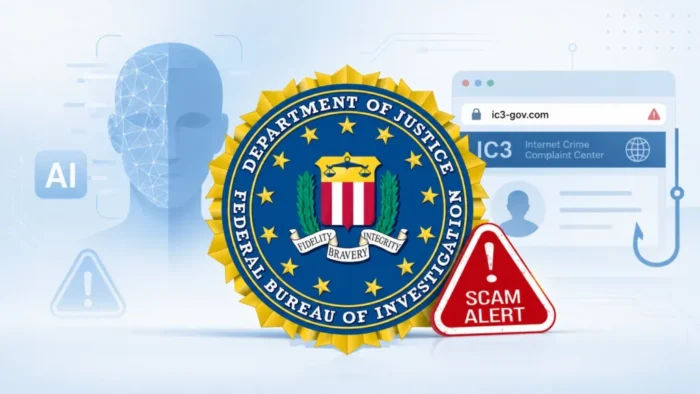
The FBI has warned that scammers are impersonating its Internet Crime Complaint Center to steal more money and personal information from previous fraud victims. The schemes use fake FBI agents, AI-generated videos, spoofed IC3 websites, and fraudulent fund-recovery offers.
The FBI’s July 2026 public warning describes an ongoing campaign that targets people who have already lost money. Scammers falsely claim that they recovered the victim’s funds or can help recover them.

Access content across the globe at the highest speed rate.
🔥 Save 81% + 2 bonus months! 🔥
70% of our readers choose Private Internet Access
70% of our readers choose ExpressVPN
2
Browse the web from multiple devices with industry-standard security protocols.
🔥 Save 73%! 🔥

Faster dedicated servers for specific actions (currently at summer discounts)
🔥 Save 69%! 🔥
IC3 does not charge fees, recover money through social media, or refer victims to paid recovery companies. Anyone offering these services while claiming to represent IC3 is attempting to steal money or sensitive information.
How the Fake IC3 Recovery Scam Works
| Stage | Scammer activity | Risk to the victim |
|---|---|---|
| Target selection | Finds people who reported scams or discussed financial losses online | Victim receives a personalized recovery offer |
| Impersonation | Claims to represent the FBI, IC3, or a recovery organization | Creates false authority and trust |
| Contact | Uses phone calls, email, social media, forums, or messaging apps | Moves the victim into a private conversation |
| Verification | Shares fake credentials, deepfake videos, or spoofed government pages | Makes the false identity appear legitimate |
| Data collection | Requests complaint details, banking data, identification, or account information | Enables identity theft and further fraud |
| Payment demand | Requests fees, cryptocurrency, gift cards, or transfer costs | Causes additional financial losses |
Scammers contact victims through email, phone calls, social media advertisements, online forums, and direct messages. They often claim that law enforcement has identified, frozen, or recovered the stolen money.
The recovery offer creates urgency. The impersonator may say the victim must confirm their identity, update an IC3 report, pay a release fee, or move funds into a supposedly secure account.
The FBI’s April 2025 IC3 impersonation alert documented more than 100 reports between December 2023 and February 2025. The latest warning shows that criminals have expanded the scheme with deepfakes and more convincing websites.
Fake FBI Agents Move Conversations to Telegram
In one example, a victim told the original scammers that they planned to contact the FBI and file an IC3 complaint. Someone claiming to work for the FBI later contacted the victim through Facebook Messenger.
The impersonator moved the conversation between Facebook Messenger and Telegram. The fake agent then sent a link and told the victim to update the IC3 report.
According to the updated FBI advisory, the link may contain malicious code or collect additional financial information. The FBI does not say that every link delivered malware, so recipients should treat any such message as a potential phishing or malware attempt.
- An unsolicited message from a person claiming to handle an IC3 complaint
- A request to continue the conversation on Telegram or another chat app
- A link that supposedly updates or tracks an IC3 complaint
- A demand for banking details, identification documents, or cryptocurrency addresses
- A fee for releasing, processing, or recovering stolen funds
- Pressure to act before a deadline or keep the process confidential
AI Deepfake Videos Promote Spoofed IC3 Websites
A second version uses AI-generated videos that appear to show senior FBI officials. The synthetic videos encourage fraud victims to submit complaints through a website that imitates the real IC3 portal.
The FBI has previously explained how criminals use generative AI in financial fraud. These tools help scammers create realistic videos, cloned voices, fake identification documents, social media profiles, and polished messages.
The deepfake does not need to withstand detailed forensic analysis. It only needs to convince a worried victim long enough to make them click a link, submit information, or contact the impersonator.
Fake IC3 Sites Copy the Government Portal
The spoofed site described by the FBI copies the structure and content of the legitimate IC3 website. However, it provides little real functionality beyond a simplified complaint form.
The fake form requests a name, phone number, email address, scam category, and estimated financial loss. After submission, the website generates a reference number and promises that someone will contact the victim.
An earlier FBI warning about spoofed IC3 websites explained that criminals often use altered spellings or different top-level domains. These sites may collect names, home addresses, phone numbers, email addresses, banking information, and other personal data.
| Legitimate IC3 process | Warning sign of an imitation |
|---|---|
| Uses the official .gov domain | Uses a similar spelling or another domain ending |
| Provides a detailed complaint process | Offers only a short, simplified form |
| Contains working government information and navigation | Returns every menu link to the home page |
| Does not charge a recovery fee | Requests payment before releasing funds |
| Does not operate social media accounts | Uses Facebook, Telegram, or forums as official contact channels |
| Does not promise fund recovery | Guarantees that stolen money has been found |
Why Scammers Target Previous Fraud Victims
Previous victims provide attractive targets because scammers already know they lost money and want to recover it. Criminals may obtain victim details from stolen databases, fake investment platforms, public complaints, social media groups, or information collected during the first scam.
The scammers can refer to the original loss, payment method, or fraudulent company to make the new approach appear informed. They may present themselves as investigators who uncovered the victim’s case while tracking the original criminals.
The FBI’s original IC3 impersonation warning described scammers joining online groups for financial fraud victims. Fake profiles posed as fellow victims before recommending a supposed IC3 official who claimed to have recovered their money.
AI Makes Impersonation More Convincing
AI tools allow scammers to create synthetic video and audio without recording the person they want to impersonate. Public speeches, interviews, photographs, and social media posts can provide source material for a fake presentation.
The FBI’s generative AI fraud guidance warns that criminals also use voice cloning to impersonate relatives, executives, law enforcement officers, and other trusted people.
Visual errors can reveal some deepfakes, but victims should not rely on appearance alone. High-quality synthetic media may avoid obvious flaws, while low-quality legitimate videos can also contain compression artifacts and audio delays.
- Distorted hands, feet, facial features, glasses, or jewelry
- Unnatural movements or inconsistent facial expressions
- Shadows that do not match the subject or background
- Audio that does not match mouth movements
- Unusual pauses or lag during a live video conversation
- Words or tone that differ from the real person’s normal communication
- A video that creates fear or demands immediate action
IC3 Never Charges Victims to Recover Money
IC3 does not maintain social media accounts and does not investigate crimes or recover funds through Facebook, Telegram, public forums, or similar platforms. It also does not ask victims to pay recovery charges.
IC3 does not directly communicate with individuals through phone calls, email, social media, phone apps, online chat, or public forums. Local FBI employees or other law enforcement officers may contact a complainant if an investigation requires more information.
The FBI recommends accessing the official IC3 complaint portal by typing the address directly into the browser. Users should avoid sponsored search results and confirm that the domain ends in .gov before submitting information.
AI-Related Fraud Caused Nearly $893 Million in Losses
The warning comes as artificial intelligence plays a growing role in reported fraud. The FBI recorded 22,364 AI-related complaints during 2025, with reported losses approaching $893 million.
The FBI’s 2025 Internet Crime Report summary says IC3 received more than one million complaints and recorded nearly $21 billion in total cyber-enabled losses. People aged 60 and older reported approximately $7.7 billion in losses.
Recovery scams can deepen these losses because they target people who already face financial and emotional pressure. Some victims may pay repeatedly as scammers invent taxes, legal charges, transfer costs, or account-verification fees.
| 2025 IC3 statistic | Reported figure |
|---|---|
| Total complaints | 1,008,597 |
| Total reported cyber-enabled losses | Nearly $21 billion |
| AI-related complaints | 22,364 |
| AI-related reported losses | Nearly $893 million |
| Losses reported by people aged 60 and older | Approximately $7.7 billion |
How to Avoid Fake FBI and IC3 Messages
People should verify claims through an independently obtained contact method. They should not call a number, visit a website, or reply to an account supplied by the person making the recovery offer.
A professional-looking video, government seal, case number, or caller ID does not prove legitimacy. Scammers can copy logos, spoof caller information, create reference numbers, and generate synthetic videos within minutes.
The FBI’s website spoofing guidance recommends typing the IC3 address directly instead of selecting a search result. It also warns users to avoid sponsored results that imitate government services.
- Stop communicating with anyone who promises to recover stolen money for a fee.
- Do not click links sent through social media, messaging apps, email, or text messages.
- Type the official IC3 address directly into the browser.
- Check that the website uses the correct .gov domain.
- Never send cryptocurrency, gift cards, or money to a supposed IC3 representative.
- Do not provide banking details or identification documents through unsolicited links.
- Search official FBI channels for the name and claims shown in a suspicious video.
- Report fake IC3 profiles to the social media platform.
- Save messages, transaction records, telephone numbers, and website addresses.
- Contact the relevant financial institution quickly if money was transferred.
What Victims Should Include in an IC3 Report
Victims should report the recovery scam even if they did not send additional money. Reports can help investigators connect social media accounts, telephone numbers, payment addresses, and spoofed websites to a wider campaign.
Submit reports through the legitimate IC3 website. People aged 60 or older who need help filing a complaint can contact the Department of Justice Elder Justice Hotline at 1-833-FRAUD-11.
Victims should provide detailed records rather than deleting the conversation immediately. Screenshots and original messages can preserve account names, timestamps, payment instructions, and links that may later disappear.
- Name or alias used by the scammer
- Email addresses and telephone numbers
- Fake social media profile names
- Messaging platforms used during contact
- Addresses of spoofed websites
- Dates, amounts, and methods of payment
- Receiving bank and account information
- Cryptocurrency wallet addresses and transaction identifiers
- Information or documents shared with the scammer
- A description of every interaction and payment request
The FBI’s fraud reporting guidance urges victims to act quickly and document how contact began, where funds went, and what information the scammers requested. Rapid reporting may help financial institutions and investigators trace transactions.
FAQ
No. IC3 does not maintain social media accounts or contact complainants through Facebook, Telegram, online forums, or chat apps. Any account claiming to represent IC3 on those platforms is fraudulent.
No. IC3 never requests payment to recover funds and does not refer victims to companies that charge recovery fees. Requests for taxes, processing charges, cryptocurrency, or gift cards indicate a scam.
Scammers create synthetic videos that appear to show FBI officials endorsing complaint procedures or websites. They use these videos to build trust and direct victims to spoofed IC3 pages.
The legitimate website uses the official ic3.gov domain. Type the address directly into the browser, avoid sponsored search results, and confirm that the domain ends in .gov before submitting information.
IC3 itself does not directly contact complainants by phone, email, social media, or chat. However, employees from a local FBI field office or another law enforcement agency may request more information during an investigation.
Stop communicating with the sender, do not click their links, contact your financial institution if you sent money, preserve all messages and transaction records, and file a report through the official IC3 website.


Read our disclosure page to find out how can you help VPNCentral sustain the editorial team Read more


Improve this guide


User forum
0 messages