
eToro Warns Market Deleveraging Could Fuel Months of Volatility


 10 min. read
  Published on

A broad reduction in leveraged market positions could continue driving sharp swings in technology, semiconductor, and cryptocurrency prices for another three to four months, according to a new eToro market analysis.
The investment platform argues that recent volatility reflects crowded positioning more than a serious deterioration in corporate fundamentals. Hedge funds, leveraged exchange-traded funds, margin accounts, and retail options traders are all reducing risk after building unusually large exposures.

Access content across the globe at the highest speed rate.
70% of our readers choose Private Internet Access
70% of our readers choose ExpressVPN

Browse the web from multiple devices with industry-standard security protocols.

Faster dedicated servers for specific actions (currently at summer discounts)
This distinction matters for investors. Strong earnings still support the longer-term equity outlook, but the unwinding of leveraged positions could produce sudden declines even when companies continue reporting healthy revenue and profit growth.
What is causing the great deleveraging?
Leverage allows investors to control larger positions with borrowed money or derivatives. It can amplify profits when markets rise, but it can also force rapid selling when prices move against those positions.
According to eToro’s Great Deleveraging analysis, the current unwind stretches across hedge funds, leveraged ETFs, retail call options, and margin accounts. The company estimates that the process may require several more months before leverage returns to more typical levels.
Assets held in leveraged ETFs linked to memory-chip stocks have already fallen 34% from their June peak. However, eToro says those positions remain large compared with the underlying market, leaving technology and semiconductor shares vulnerable to further forced selling.
| Positioning indicator | Recent development | Potential market effect |
|---|---|---|
| Leveraged memory-stock ETFs | Assets down 34% from their June peak | More volatility in semiconductor stocks |
| Retail call options | Buying has declined from nearly 14 million contracts | Less speculative support for technology shares |
| Margin accounts | Leverage remains elevated | Risk of forced selling during declines |
| Hedge fund positioning | Risk exposure is being reduced | Pressure on crowded trades |
Strong earnings challenge the bearish market narrative
The volatile market does not currently match the underlying earnings picture. US companies have generally reported stronger revenue and profits than analysts expected during the second-quarter earnings season.
A FactSet earnings update showed that 27% of S&P 500 companies had announced results by July 24. Of those companies, 86% exceeded earnings-per-share estimates, above both the five-year and ten-year averages.
The blended earnings growth rate reached 37.9%, while revenue growth stood at 13.2%. Those headline figures support the argument that market instability has emerged despite resilient business performance rather than because of an earnings collapse.
However, investors should treat the earnings growth figure carefully. Alphabet recorded a $98 billion gain that significantly increased the index-level result. FactSet calculated that S&P 500 earnings growth would have been 25.9% without Alphabet, which still represents strong expansion.
- Twenty-seven percent of S&P 500 companies had reported by July 24.
- Eighty-six percent had beaten earnings estimates.
- Eighty percent had exceeded revenue estimates.
- Ten of the eleven sectors reported year-over-year earnings growth.
- All eleven sectors reported higher revenue.
Market strength now extends beyond technology
Technology remains an important earnings driver, but the recovery has spread across much of the market. Energy, communication services, information technology, and materials have produced some of the strongest profit growth.
Financial companies have also benefited from stronger trading and investment banking activity. This broader growth could support continued investor rotation into banks and other sectors that had previously lagged major technology stocks.
The latest S&P 500 earnings figures showed seven sectors achieving double-digit earnings growth. Healthcare was the only sector reporting a year-over-year earnings decline at that stage of the season.
European earnings are showing signs of recovery
European markets have attracted less attention than US technology shares, but improving corporate results could create selective opportunities. eToro said European companies that had reported produced earnings growth of approximately 22%.
Profit growth remained around 9% after excluding energy companies. Eurozone earnings revisions also reportedly caught up with US revisions for the first time since early 2025.
The improvement suggests that global earnings growth has become less dependent on a small number of American technology companies. However, European businesses still face risks from energy prices, regional growth conditions, and geopolitical uncertainty.
| Market | Positive signal | Main risk |
|---|---|---|
| United States | High earnings and revenue beat rates | Crowded technology positioning |
| Europe | Improving earnings revisions | Energy and growth pressures |
| Semiconductors | Long-term AI infrastructure demand | Leveraged ETF unwinding |
| Financials | Strong trading and banking revenue | Interest-rate and credit uncertainty |
Alphabet shows how investors are judging AI spending
Investors increasingly want evidence that large artificial intelligence investments are producing revenue. Companies that announce higher capital expenditure without corresponding commercial growth may face a more negative market reaction.
Alphabet provided a strong example during its second-quarter results. Google Cloud revenue increased 82% year over year, while total Alphabet revenue grew 24%, according to CEO Sundar Pichai’s earnings remarks.
Google Cloud’s backlog reached $514 billion, while the company reported broader adoption of its AI infrastructure and Gemini products. Nearly 90% of Fortune 100 companies now use Gemini Enterprise, according to Alphabet.
These results strengthen the commercial case for AI spending. They also show why investors may increasingly separate companies converting AI investment into revenue from those relying mainly on future promises.
Retail investors remain an important source of demand
Retail investors continue to provide substantial buying support despite the deleveraging cycle. eToro estimates that equity inflows from individual investors are running at an annualized pace above $1 trillion.
After accounting for institutional selling and new stock issuance, the market could still receive approximately $200 billion in net equity demand during the second half of 2026, based on the consensus estimate cited in eToro’s market outlook.
Retail demand may help prevent positioning-related declines from becoming a broader bear market. It does not eliminate the risk of rapid corrections, especially in heavily traded AI, semiconductor, and high-growth stocks.
The Federal Reserve keeps rates unchanged
The macroeconomic backdrop remains difficult because higher oil prices could keep inflation elevated. This reduces the likelihood of rapid interest-rate cuts and raises financing costs for companies and investors.
The Federal Reserve held its benchmark rate at 3.50% to 3.75% on July 29. Three policymakers voted for a quarter-point increase, highlighting concern about inflation and creating an unusually divided decision, according to coverage of the Federal Reserve meeting.
The decision removed one immediate source of uncertainty, but it did not provide a clear path toward lower rates. Investors must now watch inflation, energy prices, employment data, Treasury yields, and the US dollar for clues about the September meeting.
- The federal funds target range remains at 3.50% to 3.75%.
- Three FOMC members preferred a quarter-point rate increase.
- Energy-related inflation remains a key concern.
- The September policy decision will depend on incoming data.
Amazon and Apple face major earnings tests
Amazon and Apple will report earnings after US markets close on July 30. Their results could influence sentiment toward consumer demand, cloud computing, AI investment, and the wider technology sector.
Amazon scheduled its second-quarter results for Thursday, with investors likely to focus on Amazon Web Services growth, AI infrastructure expenditure, retail margins, and management’s outlook.
Amazon entered the report after struggling to sustain a move above its recent resistance area. A strong earnings release could improve the short-term picture, while disappointing cloud growth or heavier spending could add to the pressure created by market deleveraging.
Apple’s investor calendar also confirms that the company will discuss its fiscal third-quarter results on July 30. Investors will watch iPhone demand, services growth, margins, AI plans, and guidance for the next quarter.
| Company | Key areas to watch |
|---|---|
| Amazon | AWS growth, AI spending, retail margins, and guidance |
| Apple | iPhone demand, services, margins, and AI strategy |
| Alphabet | Cloud growth and returns from AI investment |
| Microsoft | Azure demand and data center capacity |
Amazon’s long-term trend faces short-term pressure
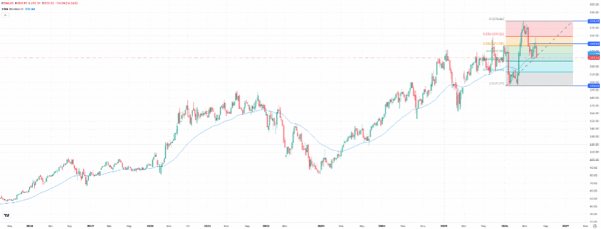
eToro’s technical analysis identified $250 as an important resistance area for Amazon. The stock had failed to sustain a breakout above that level three times before the company’s earnings announcement.
The longer-term trend could remain constructive while the February low near $196 holds. However, technical levels alone cannot predict how investors will react to earnings, spending plans, or forward guidance.
The company’s official earnings event will provide the next major fundamental test. Large post-earnings moves could become more pronounced while leveraged investors continue reducing exposure.
Apple approaches earnings after a strong rally
Apple entered earnings with a stronger technical trend than Amazon, according to eToro. Buyers had quickly responded to a recent decline, keeping the stock near its record levels.
That strength may also increase expectations. Investors buying after an extended rally face the risk that solid results will not prove strong enough to justify the share price.
The Apple earnings presentation will show whether hardware demand and services growth can support the rally. Management’s comments about AI products and future investment could carry particular importance.
Bitcoin sentiment improves, but confirmation remains limited
Cryptocurrency markets face the same conflict between improving positioning and an uncertain macroeconomic environment. Bitcoin has outperformed the Nasdaq during parts of July, suggesting demand specific to digital assets.
Options positioning has also become less defensive. A declining put-to-call ratio indicates that traders have reduced some downside protection, while call options account for a larger share of activity.
However, low spot volumes and subdued blockchain activity make it difficult to confirm a durable recovery. Improving derivatives sentiment can precede a rally, but it can also reverse quickly without stronger buying in the spot market.
- Bitcoin performance relative to the Nasdaq
- Spot Bitcoin ETF inflows and outflows
- Spot Ethereum ETF demand
- Bitcoin spot trading volume
- Options volatility and put-to-call ratios
- Treasury yields and the US dollar
What the deleveraging cycle means for investors
Market volatility may remain elevated even if earnings stay healthy. Forced selling, reduced options activity, and leveraged ETF rebalancing can temporarily overpower company-specific fundamentals.
This environment rewards closer attention to balance sheets, cash flow, valuation, and evidence of commercial returns from AI spending. It also increases the risk of relying exclusively on short-term price momentum.
Alphabet’s strong cloud performance shows that AI investment can generate meaningful growth. The challenge for the wider market is determining which companies can produce similar results and which valuations already assume too much future success.
Market outlook
The great deleveraging does not necessarily signal the end of the equity bull market. Strong earnings, broad sector growth, and continued retail demand provide meaningful support.
Near-term risks remain substantial. High oil prices, persistent inflation, restrictive interest rates, crowded technology positions, and reduced leverage can continue producing sudden market swings.
The Federal Reserve’s divided decision reinforces that uncertainty. As the July policy outcome showed, officials remain concerned enough about inflation that several preferred another rate increase.
Investors now need confirmation from Amazon, Apple, future inflation data, and stronger crypto spot demand. Until that evidence arrives, market volatility may say more about positioning than the health of the economy or the long-term AI investment cycle.
FAQ
The great deleveraging describes investors reducing positions funded with borrowed money or derivatives. It currently affects hedge funds, leveraged ETFs, options trading, and margin accounts.
eToro estimates that the current process could require another three to four months before leverage returns to more typical levels.
Current data does not show a broad earnings collapse. Most S&P 500 companies that had reported by July 24 exceeded profit and revenue expectations.
The Federal Reserve held its benchmark interest-rate range at 3.50% to 3.75% on July 29, 2026. Three policymakers voted for a quarter-point increase.
Important indicators include company earnings, retail flows, leveraged ETF assets, options activity, oil prices, Treasury yields, the US dollar, and cryptocurrency ETF flows.


Read our disclosure page to find out how can you help VPNCentral sustain the editorial team Read more


Improve this guide



User forum
0 messages