
Guardian AI Penetration Testing Framework Launches with Multi-LLM Agent Architecture


 3 min. read
  Published on
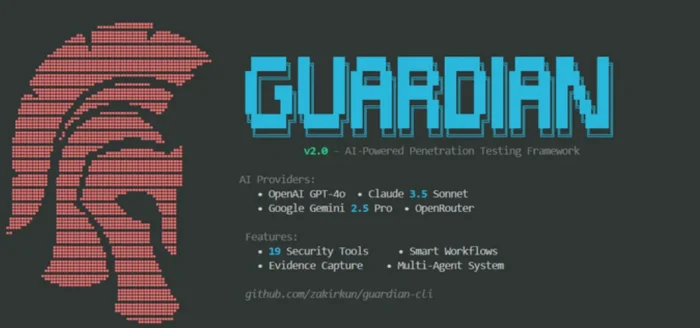
Guardian delivers enterprise-grade AI penetration testing automation. The open-source framework orchestrates GPT-4, Claude, Gemini, and OpenRouter across 19 security tools. Four specialized agents handle planning, tool selection, analysis, and reporting for adaptive assessments.
Zakir Kun developed Guardian to replace manual pentesting workflows. Agents collaborate like human teams. Planner sets strategy. Tool Selector picks optimal tools. Analyst filters false positives. Reporter generates executive documentation. Evidence chains every finding to raw outputs.

Access content across the globe at the highest speed rate.
70% of our readers choose Private Internet Access
70% of our readers choose ExpressVPN

Browse the web from multiple devices with industry-standard security protocols.

Faster dedicated servers for specific actions (currently at summer discounts)
The framework adapts dynamically to discovered vulnerabilities. Asynchronous execution runs three tools parallel by default. YAML workflows customize Recon, Web, Network, and Autonomous modes. Reports export Markdown, HTML, or JSON with 2000-character evidence snippets.
Agent Architecture
Four agents execute coordinated workflows.
| Agent | Role | Key Functions |
|---|---|---|
| Planner | Strategy | Scope analysis, attack path planning, phase sequencing |
| Tool Selector | Execution | Tool selection from 19 options, parameter optimization |
| Analyst | Intelligence | False positive suppression, risk prioritization, chaining |
| Reporter | Documentation | Executive summaries, evidence linking, remediation |
Pipeline simulates senior pentester decision-making. Each agent specializes while sharing context.
19-Tool Arsenal
Comprehensive coverage across security domains.
Network Scanning
- Nmap: Service detection, OS fingerprinting
- Masscan: Large-scale port discovery
Web Reconnaissance
- httpx: HTTP probing, status analysis
- WhatWeb: Technology fingerprinting
- Wafw00f: Firewall detection
Subdomain Discovery
- Subfinder: Passive enumeration
- Amass: Active/passive mapping
- DNSRecon: DNS brute force, zone transfers
Vulnerability Scanning
- Nuclei: Template-based scanning
- Nikto: Web server checks
- SQLMap: SQL injection automation
- WPScan: WordPress enumeration
SSL/TLS Analysis
- TestSSL: Cipher suite grading
- SSLyze: Protocol configuration
Content Discovery
- Gobuster: Directory brute force
- FFuf: Advanced fuzzing
- Arjun: Parameter discovery
Advanced Analysis
- XSStrike: XSS detection
- GitLeaks: Secret scanning
- CMSeeK: CMS identification
Workflow Customization
YAML priority hierarchy enables parallel engagements.
Workflow YAML > Global config > Tool defaults

Predefined modes:- Recon: Passive mapping + subdomain enum
- Web: App scanning + parameter fuzzing
- Network: Port scanning + service enum
- Autonomous: Full-chain adaptive testing
Safety and Compliance
Built-in controls prevent unauthorized use.
- RFC-1918 blacklisting: No private network scanning
- Safe mode default: Blocks destructive operations
- Human-in-loop prompts: Sensitive action confirmation
- Audit logging: Complete AI decision trace
- Scope validation: Automatic target validation
Technical Requirements
Cross-platform deployment with minimal dependencies.
Python 3.11+
1+ AI provider API key
Subset of 19 tools (adapts to availability)
Linux/macOS/Windows
Environment variable key management. Version 2.0.0 ships with parallel execution.
Performance Optimization
Asynchronous tool execution cuts assessment time.
- Default: 3 parallel tools
- Configurable concurrency limits
- Intelligent tool chaining
- False positive suppression accelerates analysis
Reporting Capabilities
Multi-format outputs with full provenance.
| Format | Use Case | Features |
|---|---|---|
| Markdown | Technical teams | Syntax highlighting, evidence snippets |
| HTML | Executives | Visual dashboards, risk heatmaps |
| JSON | Automation | SIEM integration, API consumption |
Every finding links to originating command with 2000-character context.
Roadmap Priorities
Version 3.0 development targets enterprise scale.
- Web dashboard visualization
- PostgreSQL multi-session tracking
- MITRE ATT&CK mapping
- CI/CD pipeline integration
- Plugin architecture
- Llama/Mistral model support
Enterprise Integration
Security teams gain immediate operational impact.
Immediate deployment:
1. Clone GitHub repository
2. Configure AI provider keys
3. Select target workflow
4. Install available tools
5. Execute assessment
Production hardening:
- Centralized API key vault
- Results database aggregation
- Custom workflow library
- Team access controls
Strategic Value Proposition
Guardian compresses weeks of manual testing into hours. Multi-LLM approach mitigates single-provider risks. Evidence capture satisfies compliance audits. Adaptive workflows handle diverse targets.
Key differentiators:
- Agent specialization vs monolithic prompts
- 19-tool coverage vs single-tool wrappers
- Evidence provenance vs black-box outputs
- Safety controls vs unrestricted agents
Discord Community: discord.gg/guardian-ai
FAQ
Four specialized agents + 19-tool orchestration + evidence capture.
GPT-4, Claude, Gemini, OpenRouter. Llama/Mistral roadmap.
Adapts to available tools. Runs with subset installed.
RFC-1918 blocking, safe mode, human prompts, audit logs.
Markdown, HTML, JSON with full evidence provenance.
Linux, macOS, Windows. Python 3.11+ required.
Web UI, PostgreSQL backend, CI/CD integration, plugins.


Read our disclosure page to find out how can you help VPNCentral sustain the editorial team Read more


Improve this guide




User forum
0 messages