
Tycoon2FA phishing platform rebounds days after major March takedown


 6 min. read
  Published on
Tycoon2FA, the phishing-as-a-service platform disrupted in a March 4 international operation, has already returned to roughly the same activity levels seen before the takedown, according to CrowdStrike. The company said it saw a brief drop in Tycoon2FA-related campaign volume on March 4 and March 5, but activity then climbed back to early 2026 levels within days.
That rebound shows how hard it is to keep a large phishing service offline when operators can quickly replace infrastructure. On March 4, Microsoft, Europol, and partners announced the seizure of 330 domains tied to Tycoon2FA’s core infrastructure, including phishing pages and control panels. Microsoft said the platform had become one of the biggest drivers of identity-focused phishing, while Europol described it as a global phishing service used at scale against Microsoft 365 and Gmail users.

Access content across the globe at the highest speed rate.
70% of our readers choose Private Internet Access
70% of our readers choose ExpressVPN

Browse the web from multiple devices with industry-standard security protocols.

Faster dedicated servers for specific actions (currently at summer discounts)
Microsoft said that by mid-2025, Tycoon2FA accounted for about 62% of all phishing attempts it blocked, including more than 30 million phishing emails in a single month. The company also said the service reached over 500,000 organizations each month and linked it to an estimated 96,000 phishing victims since 2023, including more than 55,000 Microsoft customers.
Why Tycoon2FA remains a serious threat
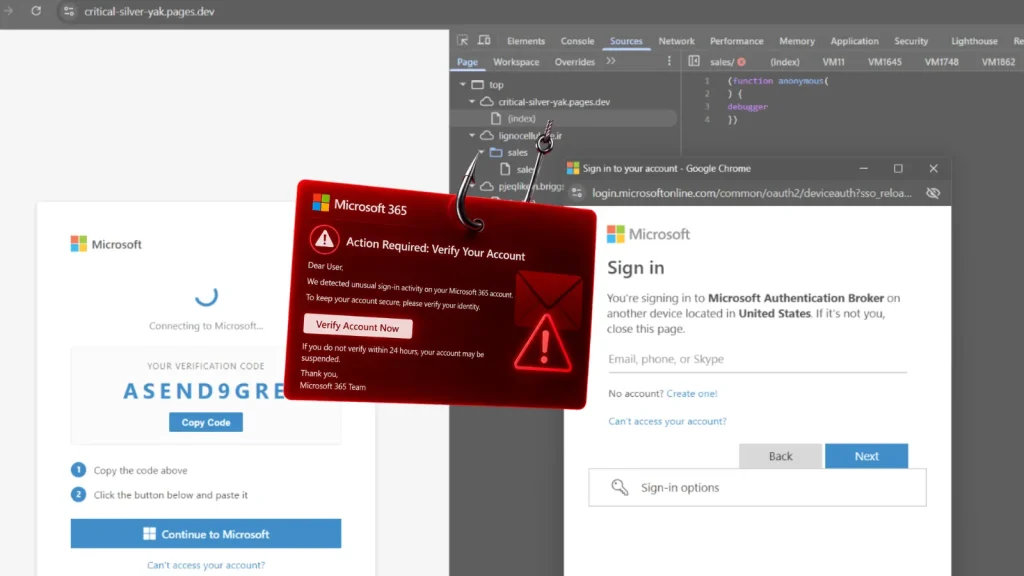
Tycoon2FA is not a basic phishing kit. Microsoft describes it as a leading adversary-in-the-middle platform that can capture credentials and active session cookies in real time, allowing criminals to bypass multifactor authentication and log in as the victim without needing the password reset to fail. The platform imitates Microsoft 365, Outlook, OneDrive, SharePoint, and Gmail sign-in pages, then relays authentication steps through attacker-controlled proxy infrastructure.
Microsoft also said Tycoon2FA used anti-bot screening, browser fingerprinting, custom JavaScript, self-hosted CAPTCHAs, heavy obfuscation, and dynamic decoy pages to stay effective and harder to detect. Those features helped the service scale as a commercial phishing platform rather than a one-off campaign toolkit.
CrowdStrike said the post-disruption campaigns it observed relied on largely unchanged tactics, techniques, and procedures. According to the company, the service still supported business email compromise, email thread hijacking, cloud account takeovers, and malicious SharePoint link abuse, which suggests the March operation disrupted infrastructure but did not meaningfully alter how the service operates.
What changed after the takedown
CrowdStrike said the immediate effect of the operation was real but short-lived. It observed daily volumes on March 4 and March 5 drop to 25% of pre-disruption levels, followed by a return to normal operational volume. It also said active cloud compromise remediations tied to Tycoon2FA returned to early 2026 levels soon after.
The company added that some old infrastructure appeared to remain active while fresh phishing domains and IP addresses came online quickly after the disruption. That suggests the takedown imposed friction, but not enough to stop experienced operators from rebuilding. CrowdStrike’s conclusion lines up with Microsoft’s broader view that cybercrime services now function like resilient businesses, with infrastructure, support, and replacement capacity built in.
Source: CrowdStrike
What the March operation actually achieved
The March 4 action still mattered. Microsoft said the disruption targeted Tycoon2FA’s backbone infrastructure and cut off a major channel for account takeovers and follow-on attacks such as data theft, ransomware, business email compromise, and financial fraud. Europol said the operation brought together public and private partners, with actions taken across several countries, including Latvia, Lithuania, Portugal, Poland, Spain, and the United Kingdom.
Microsoft also framed the action as part of a wider pressure campaign against identity-focused cybercrime services. The company said previous disruptions had already weakened related infrastructure providers and that sustained pressure raises the cost of operating these criminal ecosystems, even when one specific service returns. That is an important distinction. A rebound does not mean the takedown failed, but it does show that infrastructure seizures alone rarely finish the job.
Key details at a glance
| Item | What the sources say |
|---|---|
| Platform | Tycoon2FA phishing-as-a-service |
| Main targets | Microsoft 365, Outlook, OneDrive, SharePoint, and Gmail users |
| Takedown date | March 4, 2026 |
| Domains seized | 330 |
| Immediate effect | Activity dropped to 25% of pre-disruption levels on March 4 and 5 |
| Current status | CrowdStrike says activity returned to pre-disruption levels within days |
| Core technique | Adversary-in-the-middle phishing that captures credentials and session cookies |
| Main risks | BEC, thread hijacking, cloud takeover, malicious SharePoint link abuse |
What defenders should watch for
- Sign-in pages that closely mimic Microsoft 365 or Gmail and sit behind unexpected redirects.
- Phishing emails carrying HTML, SVG, PDF, or DOCX attachments with QR codes or embedded scripts.
- Post-compromise behavior such as inbox rule creation, hidden folders, session hijacking, and attempts to stage business email compromise.
- Login events that remain valid even after a password change, which can indicate stolen session tokens rather than just stolen passwords.
What organizations should do now
- Use phishing-resistant MFA where possible, because Tycoon2FA specifically targets traditional MFA flows.
- Revoke active sessions and tokens after suspected compromise, not just passwords. Microsoft says Tycoon2FA can keep access through stolen session cookies if defenders only reset credentials.
- Train users to treat QR-code lures, shortened links, and fake cloud sign-in pages as high risk.
- Monitor for business email compromise staging activity, including new inbox rules and hidden mail folders.
- Treat future takedown announcements as a chance to harden defenses, not as a sign that the threat has ended. CrowdStrike’s findings show operators can recover fast when arrests or deeper seizures do not follow.
FAQ
Tycoon2FA is a phishing-as-a-service platform that uses adversary-in-the-middle techniques to steal credentials and active session cookies, allowing attackers to bypass multifactor authentication on services such as Microsoft 365 and Gmail.
Yes, but only for a short period. Microsoft and Europol seized 330 domains, and CrowdStrike said campaign volume briefly dropped to 25% of normal levels before returning to earlier activity levels within days.
Based on CrowdStrike’s observations, the operators quickly replaced or reused infrastructure and resumed familiar tactics. Microsoft’s own write-up suggests these services operate as resilient criminal businesses with strong support ecosystems.
Because it does not just steal passwords. Microsoft says it can also steal session cookies in real time, which lets attackers access accounts even after a password reset unless defenders also revoke sessions and tokens.


Read our disclosure page to find out how can you help VPNCentral sustain the editorial team Read more


Improve this guide



User forum
0 messages