
Actively exploited nginx-ui flaw can give attackers full control of Nginx servers


 4 min. read
  Published on
A critical vulnerability in nginx-ui is under active exploitation and can let attackers take over affected Nginx servers without authentication. The flaw, tracked as CVE-2026-33032, carries a CVSS score of 9.8 and affects the tool’s Model Context Protocol, or MCP, integration.
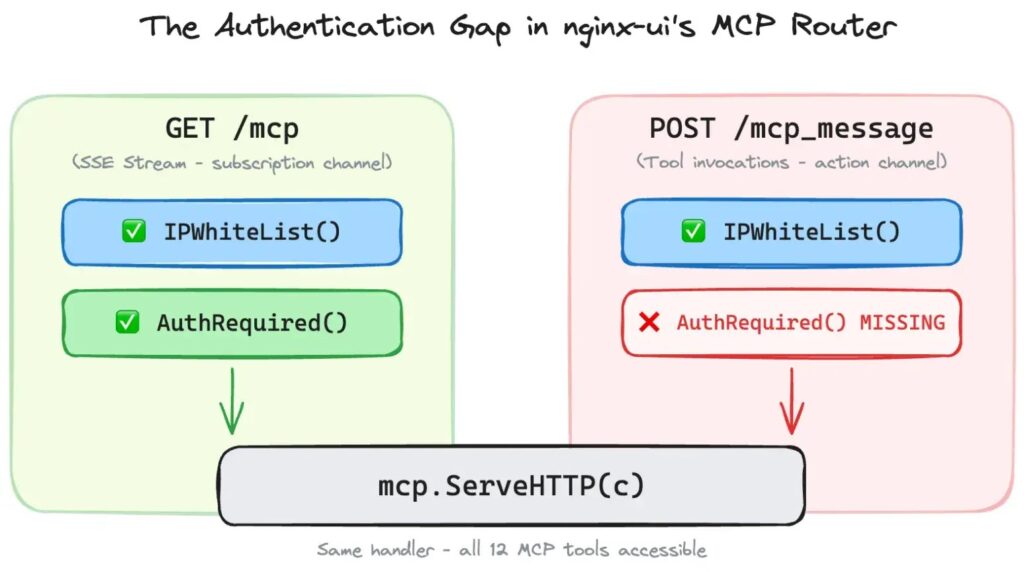
The core problem sits in the /mcp_message endpoint. The nginx-ui project’s GitHub security advisory says /mcp enforces both IP whitelisting and authentication, but /mcp_message only applies IP whitelisting. By default, that whitelist is empty, and the middleware treats an empty list as allow-all.

Access content across the globe at the highest speed rate.
70% of our readers choose Private Internet Access
70% of our readers choose ExpressVPN

Browse the web from multiple devices with industry-standard security protocols.

Faster dedicated servers for specific actions (currently at summer discounts)
That means an attacker who reaches the exposed management interface can invoke privileged MCP tools without logging in. Those tools can restart Nginx, reload its configuration, create or modify config files, list and read existing configs, and change the layout of the configuration directory.
Why this bug is so dangerous
This is not a small admin-panel bug. The GitHub advisory says an attacker can rewrite Nginx configuration files and trigger an immediate reload, which opens the door to traffic interception, credential harvesting, service disruption, and full control of how requests move through the server.
Pluto Security, which discovered the issue and calls it MCPwn, says the flaw came from a one-line authentication gap in the MCP routing logic. The firm also said it has seen active exploitation in the wild.
Public exposure adds to the risk. Pluto Security said Shodan showed roughly 2,689 publicly exposed nginx-ui instances when it published its write-up, which suggests a broad attack surface for opportunistic scanning and mass exploitation.
Active exploitation is already underway
Multiple sources say attackers are already using this flaw. Recorded Future’s Insikt Group included CVE-2026-33032 in a list of 31 vulnerabilities actively exploited in March 2026, and Rapid7 says exploitation in the wild has begun.
There is also public exploit code. eSentire says a proof of concept is publicly available, which lowers the barrier for copycat attacks and makes delayed patching more risky.
One important detail needs care. Sources disagree on the exact affected version range. Pluto Security and eSentire say the flaw was fixed in nginx-ui 2.3.4, while the current NVD entry says versions 2.3.5 and prior are affected. Rapid7 explicitly notes this versioning mismatch, so admins should follow the latest upstream project guidance and not assume older patch claims are enough.
What attackers can do with CVE-2026-33032
| Capability | Why it matters |
|---|---|
| Modify or add Nginx configs | Attackers can redirect or intercept traffic |
| Reload or restart Nginx | Changes take effect immediately |
| Read existing configs | Exposes backend layout, cert paths, and service details |
| Break config files | Can knock services offline |
| Inject logging rules | Can capture headers and admin activity |
The GitHub advisory says the available MCP tools include config creation, modification, listing, reading, renaming, directory creation, and service reload or restart functions. That gives attackers broad control over the web server layer, not just read-only access.
In some attack chains, CVE-2026-33032 may pair with CVE-2026-27944, an nginx-ui information leak flaw. Pluto Security and Rapid7 say that separate issue can expose data such as the node_secret, which can help attackers establish an MCP session and then abuse /mcp_message for takeover.
What defenders should do now
- Update nginx-ui immediately and confirm your installed version against the latest upstream guidance.
- Disable MCP if you do not need it. Pluto Security recommends this as an interim measure.
- Restrict network access to the nginx-ui management interface so it is not reachable from untrusted networks. Rapid7 says tight access control reduces exposure to both this flaw and future nginx-ui bugs.
- Set a strict IP allowlist instead of leaving it empty. The default fail-open behavior is a big part of the exposure.
- Review Nginx configs, access logs, and nginx-ui activity for unexpected changes or reloads that could signal compromise. This follows directly from the attack paths described in the advisory.
FAQ
It is a critical missing-authentication flaw in nginx-ui’s MCP integration. It can let attackers access privileged server-management functions without logging in.
Yes. Pluto Security, Rapid7, and Recorded Future reporting all indicate active exploitation.
The clearest supported claim is full takeover of Nginx service management, including config changes, traffic interception, and server disruption. Some coverage frames this as full server takeover, but the strongest primary source language focuses on full control of the Nginx service and its configuration.
That point is currently inconsistent across sources. Pluto Security and eSentire point to version 2.3.4 as the fix, while the NVD entry says versions 2.3.5 and prior are affected. Admins should verify against the latest upstream project guidance before assuming they are safe.


Read our disclosure page to find out how can you help VPNCentral sustain the editorial team Read more


Improve this guide



User forum
0 messages