
New DDoS botnet abuses exposed Jenkins servers to attack online game servers


 6 min. read
  Published on

A newly documented DDoS botnet is abusing exposed Jenkins servers to launch attacks against online game infrastructure, including servers that use Valve’s Source Engine.
Darktrace researchers found the malware after an attacker targeted one of the company’s Jenkins honeypots on March 18, 2026. The campaign uses Jenkins access to deploy a multi-platform payload, then waits for commands to flood selected targets.

Access content across the globe at the highest speed rate.
70% of our readers choose Private Internet Access
70% of our readers choose ExpressVPN

Browse the web from multiple devices with industry-standard security protocols.

Faster dedicated servers for specific actions (currently at summer discounts)
The botnet stands out because it includes game-specific attack functions. One method sends Source Engine query traffic that can force targeted game servers to respond with larger amounts of data, putting extra pressure on server resources.
What happened
Darktrace operates a global honeypot network called CloudyPots to observe real-world attacker behavior. One of those honeypots ran Jenkins, a popular continuous integration system used by developers to build, test, and automate software workflows.
The Jenkins instance used a weak password by design, allowing researchers to watch how attackers attempted to abuse the service. In this case, the attacker used Jenkins to run a malicious Groovy script and deploy a DDoS botnet payload.
The issue does not mean Jenkins is unsafe by default. It shows the risk of leaving powerful administration tools exposed to the internet with weak access controls.
At a glance
| Category | Details |
|---|---|
| Threat type | DDoS botnet |
| Initial access | Exposed Jenkins instance with weak authentication |
| Observed by | Darktrace CloudyPots honeypot network |
| Date observed | March 18, 2026 |
| Main targets | Online game servers, including Valve Source Engine servers |
| Supported systems | Windows and Linux |
| Main attack types | UDP floods, TCP push attacks, HTTP request floods, and Source Engine query attacks |
| Known C2 port | TCP 5444 |
How the Jenkins abuse works
Jenkins includes a Groovy script console for administration and troubleshooting. When properly secured, this feature helps administrators manage Jenkins systems.
If attackers gain access to it, they can run commands inside the Jenkins environment. Darktrace said the attacker abused the scriptText endpoint to send a malicious Groovy script to the honeypot.
The script checked the operating system and then used different installation steps for Windows and Linux. This helped the attacker deploy the botnet across more than one type of server.
Windows and Linux payloads
On Windows, the script downloaded a payload and saved it under a name that looked like a system update file. It then renamed the file and added a firewall rule for the port used by the botnet’s command-and-control traffic.
On Linux, the script downloaded a payload into a temporary directory and executed it. The same attacker-controlled IP address handled payload delivery and command-and-control activity.
Darktrace noted that this is unusual. Many malware operators separate delivery infrastructure from command-and-control systems so they can keep infected devices active if one server gets taken down.
Why game servers are a target
Game servers are sensitive to latency, downtime, and packet floods. A short disruption can make a multiplayer match unplayable and push players away from a server or platform.
The malware includes a function designed around Valve Source Engine server queries. Source Engine powers games such as Counter-Strike and Team Fortress 2, making the attack relevant to server operators in those communities.
The Source Engine query method can be effective because the attacker sends small requests that cause the target server to send larger responses. Repeating that process can drain server capacity and create service disruption.
DDoS methods used by the botnet
| Attack method | Purpose |
|---|---|
| UDP flood | Sends large volumes of random UDP traffic to consume bandwidth. |
| UDP packets-per-second flood | Sends smaller packets at high speed to overwhelm packet handling. |
| TCP push attack | Rapidly opens connections and sends data to pressure the target. |
| HTTP request flood | Sends repeated HTTP requests to exhaust application resources. |
| Source Engine query attack | Targets Valve Source Engine game servers with repeated query packets. |
| Special UDP modes | Targets services such as DNS, NTP, and Source Engine ports. |
How the malware hides on Linux
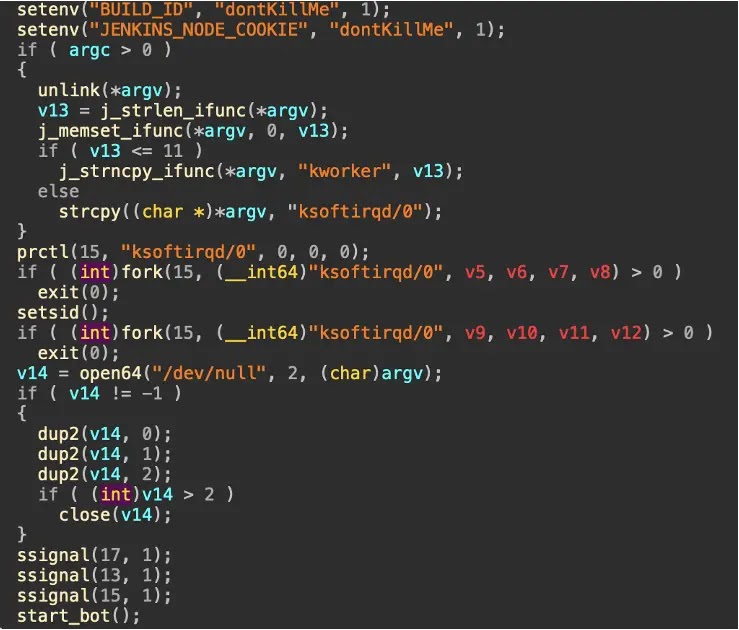
After landing on a Linux system, the malware tries to stay active and avoid easy removal. It sets Jenkins-related environment variables so Jenkins does not automatically kill the long-running process.
It then removes its original file from disk and renames itself to look like a normal Linux kernel process. Darktrace said the malware used names such as ksoftirqd/0 and kworker.
The payload also runs in the background, redirects output to /dev/null, and ignores common termination signals. These behaviors make it harder for administrators to notice and stop the process through normal checks.
Command-and-control behavior
Once active, the malware connects to its command-and-control server and reports the system architecture. After that, it waits for instructions.
Darktrace found utility commands for keep-alive checks, stopping the malware, and updating the payload. The attack commands take a target IP address, port, and duration.
This structure gives the operator a simple way to turn compromised servers into DDoS nodes. Even low-value exposed servers can become useful when attackers add them to a larger botnet.
Why this matters for Jenkins administrators
Jenkins is widely used in development and DevOps environments. A compromised Jenkins server can create more risk than a single infected machine because it may connect to code repositories, build pipelines, credentials, scripts, and deployment systems.
In this case, the attacker used Jenkins as a path into the host system. The campaign shows why internet-facing Jenkins instances need strict authentication, limited network exposure, patching, and continuous monitoring.
Administrators should also treat unexpected outbound traffic from build servers as suspicious. CI systems often have broad access, so attackers may use them for malware delivery, cryptomining, data theft, or DDoS activity.
Recommended defenses
- Do not expose Jenkins directly to the public internet unless it is necessary.
- Use strong authentication and remove weak or shared passwords.
- Restrict Jenkins administration access to trusted networks or VPNs.
- Review access to the Jenkins script console and related endpoints.
- Monitor Jenkins for unusual Groovy script execution.
- Block suspicious outbound traffic from CI and build servers.
- Watch for unexpected traffic to TCP port 5444.
- Review systems for processes pretending to be ksoftirqd/0 or kworker.
- Investigate outbound communication with 103.177.110.202.
- Use DDoS protection for public-facing game infrastructure.
Indicators for defenders
| Indicator | Type |
|---|---|
| 103.177.110.202 | Attacker and command-and-control IP address |
| TCP 5444 | Command-and-control port |
| F79d05065a2ba7937b8781e69b5859d78d5f65f01fb291ae27d28277a5e37f9b | Linux payload hash |
| ksoftirqd/0 | Possible fake process name used by malware |
| kworker | Possible fake process name used by malware |
FAQ
It is a DDoS botnet observed by Darktrace that abuses exposed Jenkins access to install malware on Windows and Linux systems.
The public analysis points to abuse of exposed Jenkins access and weak authentication, not a newly disclosed Jenkins software flaw.
Source Engine game servers can respond to specific query packets with larger replies. Attackers can abuse this behavior to put pressure on the target server.
The technique is relevant to servers running Valve Source Engine games, including Counter-Strike and Team Fortress 2.


Read our disclosure page to find out how can you help VPNCentral sustain the editorial team Read more


Improve this guide

User forum
0 messages