
Nintendo Says Employee Survey Data Was Stolen Through TinyPulse Breach


 7 min. read
  Published on

Nintendo of America has confirmed that some internal employee survey data was stolen through TinyPulse, a third-party employee feedback platform owned by WebMD Health Services. The company said its own systems were not compromised and that no customer or financial data was accessed.
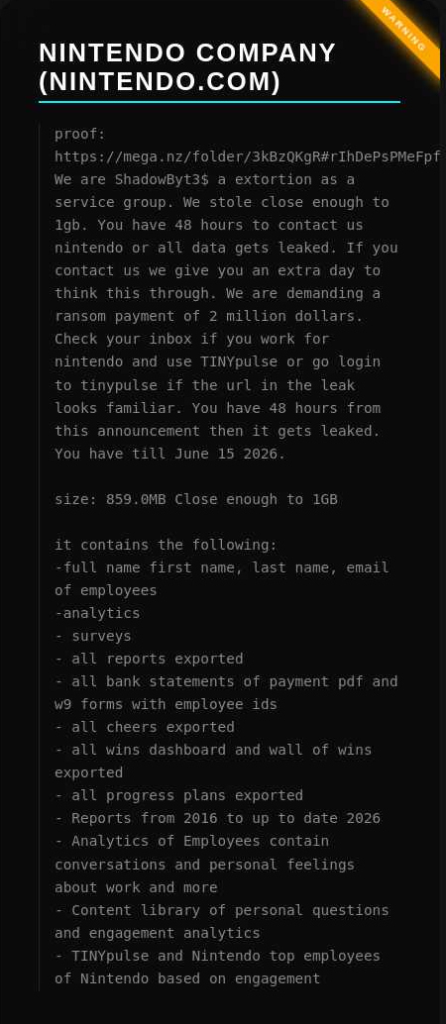
The confirmation followed claims from the Shadowbyt3$ extortion group, which said it had obtained data linked to Nintendo of America employees and demanded a $2 million ransom. According to BleepingComputer, Nintendo described the exposed information as internal survey content affecting a small subset of employees, with most of the data dating back several years.

Access content across the globe at the highest speed rate.
70% of our readers choose Private Internet Access
70% of our readers choose ExpressVPN

Browse the web from multiple devices with industry-standard security protocols.

Faster dedicated servers for specific actions (currently at summer discounts)
The breach did not affect Nintendo gaming systems, Nintendo accounts, Switch users, or customer payment information, based on the company’s statement. Nintendo said it is working with the service provider to address the issue.
What Data Was Exposed In The Nintendo TinyPulse Incident
TinyPulse is used by companies to collect employee feedback, run engagement surveys, and measure workplace culture. WebMD Health Services describes TINYpulse by WebMD Health Services as an employee feedback and engagement platform designed to help organizations understand workplace culture and employee sentiment.
Nintendo has confirmed that the affected data was tied to internal survey content. The company has not said that its own corporate network was breached, and it has not confirmed the broader data categories claimed by the attackers.
Shadowbyt3$ claimed that the stolen dataset included names, email addresses, survey data, analytics, bank statements, W-9 forms, employee IDs, progress plans, and reports from 2016 to 2026. An early Hackmanac alert said the group claimed to have stolen about 859 MB of data from TinyPulse systems, but those claims should still be treated as attacker statements rather than verified facts.
| Category | Status |
|---|---|
| Nintendo systems | Nintendo says they were not compromised |
| Customer personal data | Nintendo says it was not accessed |
| Customer financial data | Nintendo says it was not accessed |
| Internal employee survey content | Nintendo confirmed this was involved |
| Bank statements and W-9 forms | Claimed by the threat actor, not publicly verified |
Shadowbyt3$ Demanded $2 Million
Shadowbyt3$ describes itself as an extortion-as-a-service operation. In this case, the group claimed it had stolen nearly 1GB of Nintendo-linked data and gave the company a short deadline to start negotiations before leaking information.
The group later claimed that the incident did not affect Nintendo gaming operations and instead involved a small number of employees who had used TinyPulse. That aligns with Nintendo’s statement that the issue involved a third-party survey service rather than Nintendo’s own systems.
BleepingComputer reported that the attackers later posted a link to data allegedly containing employee messages and conversations. The outlet said it did not download the leaked data and could not confirm its authenticity.
- Nintendo confirmed a third-party TinyPulse issue involving employee survey data.
- The company said Nintendo systems were not compromised.
- The company said no customer personal or financial data was accessed.
- Shadowbyt3$ demanded $2 million and threatened to leak the data.
- Claims about financial documents remain unverified publicly.
Why TinyPulse Matters In This Breach
This incident highlights the risk companies face when sensitive workplace information sits inside third-party HR and survey platforms. Even if a company’s own network remains secure, a vendor breach can still expose internal records, feedback, communications, and employee-related material.
The exposure may also create a different kind of risk from a consumer data breach. Employee survey content can include workplace concerns, feedback about managers, internal team issues, and personal opinions that staff expected to remain private or anonymized.
That makes the TinyPulse connection important. WebMD Health Services markets the platform around employee engagement, feedback, recognition, and culture measurement, which means organizations may use it to store sensitive internal sentiment data even when the tool does not handle customer accounts.
Should Nintendo Customers Do Anything?
Nintendo customers do not appear to need any action based on the information currently available. Nintendo said customer personal data and customer financial data were not accessed, and the incident did not involve Nintendo’s gaming systems.
That means Nintendo Account users do not need to reset passwords because of this incident alone. However, users should still keep two-factor authentication enabled, avoid reusing passwords, and watch for phishing messages that misuse Nintendo’s name.
The people most likely to face direct risk are employees whose data may have appeared in TinyPulse records. If the attacker claims prove accurate, affected staff may need identity protection, phishing monitoring, credential resets, or tax-related fraud precautions.
| Group | Recommended Response |
|---|---|
| Nintendo customers | No special action needed based on Nintendo’s current statement |
| Nintendo employees using TinyPulse | Watch for phishing, identity theft attempts, and suspicious financial activity |
| Companies using employee survey tools | Review vendor access, data retention, breach notification terms, and export logs |
| Security teams | Treat HR SaaS tools as sensitive systems, not low-risk business apps |
Why Paying The Ransom Remains Risky
Extortion groups often promise to delete stolen data if a victim pays. Security agencies warn that such promises cannot be trusted because criminals may still keep copies, resell records, or target the victim again later.
The FBI ransomware guidance says paying a ransom does not guarantee data recovery and can encourage attackers to target more victims. The same logic applies to data-theft extortion, where the victim has no reliable way to prove that stolen files were deleted.
For companies, the better response is to investigate the scope of the breach, notify affected people where required, rotate exposed credentials, monitor for misuse, and improve vendor controls. The initial public claim around this incident shows how quickly a third-party breach can become a reputational and employee-trust issue.
Third-Party HR Tools Are A Growing Security Concern
HR, benefits, payroll, and employee engagement platforms can hold sensitive data even when they do not connect directly to customer systems. Attackers know this, which makes vendors that store employee records an attractive target.
The Nintendo case also shows why companies need strict data retention rules. Nintendo said most of the exposed survey content dates back several years, which raises a practical question for many organizations: how long should employee feedback data remain stored inside third-party systems?
Companies using workplace survey tools should review what data they collect, how long they keep it, who can export it, and how quickly vendors must report suspicious activity. They should also check whether survey data that employees believed was anonymous can still be linked to names, emails, teams, or other identifiers.
- Limit the employee data stored in third-party survey platforms.
- Review vendor breach notification and incident response terms.
- Reduce long-term retention of old survey exports and reports.
- Check whether survey responses can be connected to employee identities.
- Train employees to spot phishing attempts after vendor incidents.
- Follow FBI guidance and avoid relying on attacker promises after an extortion demand.
FAQ
Nintendo says its own systems were not compromised. The incident involved TinyPulse, a third-party employee survey service used internally by Nintendo of America.
Nintendo said the exposed data was limited to internal survey content involving a small subset of employees, and that most of the information dates back several years.
Nintendo said no personal customer data or customer financial data was accessed. Based on the company’s statement, Nintendo Account users do not need to take special action because of this incident.
Shadowbyt3$ is an extortion group that claimed responsibility for the Nintendo-linked TinyPulse data theft. The group demanded $2 million and threatened to leak stolen data if Nintendo did not engage.
TinyPulse is an employee engagement and feedback platform owned by WebMD Health Services. Companies use it for internal surveys, workplace feedback, engagement analytics, and culture measurement.


Read our disclosure page to find out how can you help VPNCentral sustain the editorial team Read more


Improve this guide




User forum
0 messages