
Prinz Eugen Ransomware Targets Recent Files And Skips Ransom Notes


 8 min. read
  Published on

A new ransomware family called Prinz Eugen is drawing attention because it encrypts recently modified files first and does not leave a ransom note on infected systems. The design appears intended to hit the files a business is most likely to need immediately, such as current documents, active projects, fresh backups, databases, and shared work folders.
The malware was detailed by ThreatDown, the Malwarebytes business unit focused on managed detection and response. Researchers said the ransomware is written in Go, uses a hands-on-keyboard intrusion style, and relies on out-of-band extortion instead of dropping a traditional note on the victim’s desktop.

Access content across the globe at the highest speed rate.
🔥 Save 81% + 2 bonus months! 🔥
70% of our readers choose Private Internet Access
70% of our readers choose ExpressVPN
2
Browse the web from multiple devices with industry-standard security protocols.
🔥 Save 73%! 🔥

Faster dedicated servers for specific actions (currently at summer discounts)
🔥 Save 69%! 🔥
BleepingComputer reported that Prinz Eugen does not currently appear to operate as ransomware-as-a-service and is not openly recruiting affiliates. That makes it different from many larger ransomware brands that rely on affiliate programs to scale attacks.
How Prinz Eugen Gets Into Networks
Researchers believe initial access likely starts with stolen Remote Desktop Protocol credentials. In one investigated incident, the attackers used RemotePC remote monitoring and management software and created a backdoor administrator account for persistence.
The main payload observed in the attack was named servertool.exe. ThreatDown said the attackers manually downloaded and executed the encryptor after gaining access, which points to an interactive intrusion rather than a fully automated malware spread.
This approach matters because it gives attackers time to inspect the environment, pick valuable folders, and decide where to run encryption. It also makes exposed RDP, weak passwords, reused credentials, and unmanaged remote access tools especially dangerous for organizations.
| Prinz Eugen Detail | What Researchers Observed |
|---|---|
| Likely initial access | Stolen RDP credentials |
| Remote access tool | RemotePC observed in one investigated case |
| Main payload | servertool.exe |
| Encrypted file extension | .prinzeugen |
| Ransom note | No on-disk ransom note observed |
| Business model | No clear ransomware-as-a-service recruitment model at this stage |
Why Recently Modified Files Come First
Prinz Eugen’s file-ordering strategy is the most unusual part of the malware. Instead of encrypting files in a simple directory order, it prioritizes files with the most recent modification timestamps.
If several files share the same timestamp, the ransomware processes them alphabetically. The goal appears practical: encrypt the data most likely to be active, important, and not yet fully protected by a recent offline backup.
The tactic can increase pressure on a victim because the first files hit may include current financial spreadsheets, customer work, project files, email archives, shared-drive material, and cloud-synced folders. A company may discover the attack only after its newest work becomes unusable.
- Prinz Eugen targets recent files before older files.
- Files with the same timestamp are processed alphabetically.
- The encryptor scans directories recursively with no depth limit.
- The malware avoids files already ending in .prinzeugen.
- The strategy can damage active business data early in the attack.
The Encryption Routine Shows Technical Care
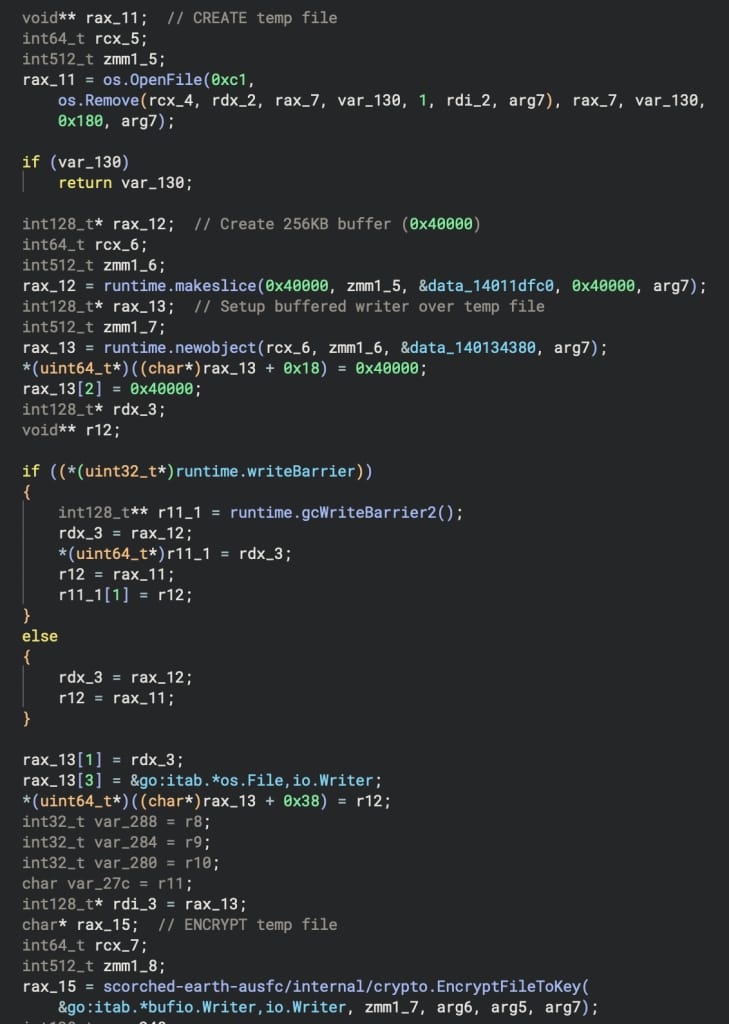
Prinz Eugen uses ChaCha20-Poly1305 encryption, a 32-byte master key, and a random initialization vector for each file. It also uses Argon2id, SHA-256, and HKDF-SHA256 in its key derivation process.
The malware encrypts files in 1 MB chunks and checks integrity with SHA-256. When the –delete flag is used, the malware verifies that the encrypted file can be decrypted before deleting the original copy.
After encryption, the ransomware overwrites key material with zeroes, forces garbage collection, and deletes itself from disk. These steps are designed to reduce recovery opportunities and leave fewer forensic traces for responders.
| Technical Feature | Purpose |
|---|---|
| Go programming language | Portable and increasingly common in modern malware development |
| ChaCha20-Poly1305 | Encrypts files and provides integrity protection |
| Argon2id, SHA-256, HKDF-SHA256 | Supports key derivation and integrity checks |
| 1 MB encryption chunks | Processes files in controlled blocks |
| Key wiping and self-deletion | Reduces forensic recovery options |
No Ransom Note Means Fewer Obvious Clues
Most ransomware leaves a text file, wallpaper message, or HTML note telling victims how to contact the attackers. Prinz Eugen does not appear to do that.
The absence of a ransom note can make detection harder because many security tools and response playbooks look for the sudden creation of ransom-note files. Prinz Eugen instead appears to push victims toward direct contact through email, phone, or a dark-web leak portal.
That method also fits a broader ransomware trend. Kaspersky reported that ransomware groups in 2026 continue to adapt their tactics, with some shifting toward data leaks, initial access markets, and more deliberate attack methods.
Victims And Extortion Activity
ThreatDown said it identified at least five victims connected to Prinz Eugen activity. The group’s leak site publicly listed only a smaller number of victims at the time researchers published their analysis.
One of the most notable cases involves Standard Bank Group. A Standard Bank update in April said the bank had identified unauthorized access to select data and had contacted affected clients. ThreatDown said the Prinz Eugen actor later demanded 1 BTC and was refused.
BleepingComputer noted that Prinz Eugen’s leak site showed victims tied to data encryption, data exfiltration, or both. That means the group appears to use double extortion, even if it does not always leave a ransom note on disk.
| Victim Type | Risk From Prinz Eugen |
|---|---|
| Financial organizations | High-value data, regulatory pressure, and reputational risk |
| Businesses with exposed RDP | Higher risk of credential-based intrusion |
| Companies using unmanaged RMM tools | Attackers may blend into legitimate remote administration activity |
| Organizations without offline backups | Greater pressure if recent files are encrypted first |
Why Prinz Eugen Is Different From Larger Ransomware Brands
Prinz Eugen does not yet look like a large affiliate-driven ransomware operation. There is no clear sign that the developers are openly recruiting partners or running a broad ransomware-as-a-service program.
That does not make it less dangerous. Smaller ransomware groups can still cause serious disruption if they gain hands-on access to a network and choose high-value folders before launching encryption.
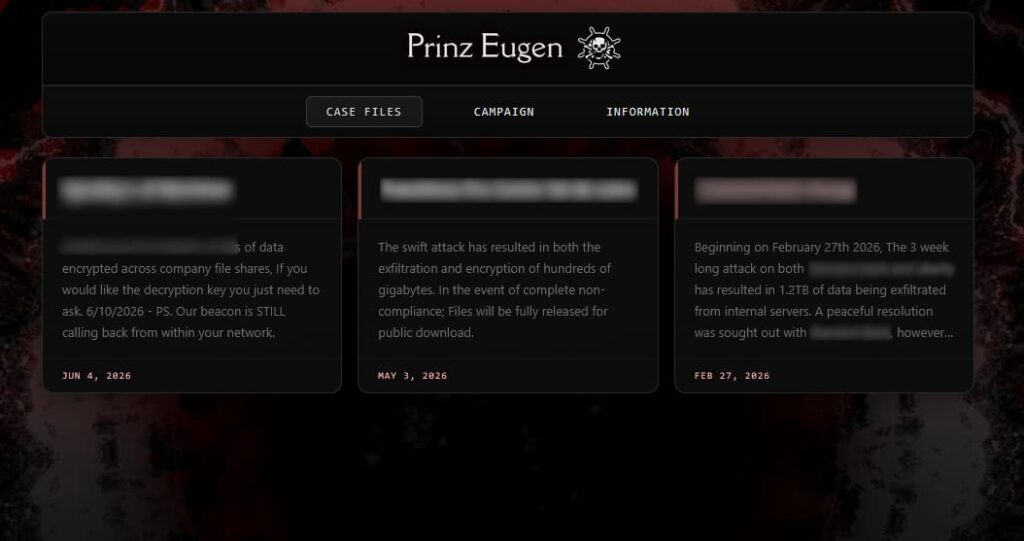
The ThreatDown report also links the operation to German-themed naming and out-of-band extortion behavior. The technical choices suggest the malware was built to reduce obvious artifacts and increase pressure on victims quickly.
What Security Teams Should Watch For
Organizations should watch for signs of stolen-credential access before encryption begins. Suspicious RDP logins, unexpected RemotePC use, newly created administrator accounts, and unusual command-line execution can all indicate early-stage activity.
Security teams should also monitor for servertool.exe, the .prinzeugen file extension, rapid file modification in recently changed folders, and deletion behavior after encryption. Because the malware can avoid ransom-note creation, defenders should not rely on ransom-note detection alone.
The Kaspersky ransomware report also highlights the wider rise of deliberate ransomware tradecraft, including defense evasion, initial access markets, and pressure tactics that go beyond simple file encryption.
- Investigate unexpected RDP logins from unusual locations.
- Audit RemotePC and other RMM tools across the network.
- Disable or tightly restrict exposed RDP access.
- Alert on new local administrator accounts.
- Search for servertool.exe and the .prinzeugen extension.
- Monitor recent-file encryption patterns in shared folders.
- Check for suspicious deletion activity after file changes.
How Organizations Can Reduce The Risk
The strongest defenses start before ransomware runs. Organizations should enforce multi-factor authentication for remote access, restrict RDP behind VPN or zero-trust access controls, and monitor all remote administration tools.
CISA recommends a proactive ransomware defense strategy that includes secure backups, patching, user awareness, strong authentication, and incident response planning. Those controls are especially important for threats that rely on stolen credentials and manual operator activity.
Backups also need special attention. Because Prinz Eugen prioritizes recently modified files, organizations should test whether their backup strategy protects the newest business data and whether backups remain isolated from accounts that attackers might compromise.
- Require MFA for RDP, VPN, administrator portals, and RMM tools.
- Remove direct internet exposure for RDP wherever possible.
- Review all remote access tools and disable unused products.
- Maintain offline or immutable backups.
- Test backup restoration for recent business files.
- Log and alert on new administrator accounts.
- Keep an incident response plan ready before an encryption event.
Prinz Eugen Shows Where Ransomware Is Heading
Prinz Eugen is still a newer operation, but its behavior reflects a wider shift in ransomware. Attackers are becoming more selective, more manual, and more careful about what artifacts they leave behind.
The group’s focus on recent files shows a practical understanding of business pressure. The lack of a ransom note reduces obvious detection points. The use of RMM tools and stolen credentials makes the early intrusion look more like normal administration unless teams monitor remote access closely.
The Standard Bank incident update shows how ransomware-related data incidents can move beyond encryption into disclosure, client notification, and reputational damage. The StopRansomware guidance remains relevant for defenders because prevention, recovery planning, and tested backups still decide how much leverage ransomware operators gain.
FAQ
Prinz Eugen is a newer ransomware family written in Go. It prioritizes recently modified files for encryption, adds the .prinzeugen extension to encrypted files, and does not appear to leave a ransom note on infected systems.
Researchers believe Prinz Eugen encrypts recently modified files first to maximize pressure on victims. Recent files are more likely to contain active business work, current projects, databases, and other data that organizations need immediately.
ThreatDown researchers believe initial access likely comes through stolen RDP credentials. In one investigated case, attackers also used RemotePC remote management software and created a backdoor administrator account for persistence.
No traditional ransom note was observed in the analyzed sample. Researchers believe the attackers may use out-of-band communication through email, phone contact, or dark-web victim portals instead.
Organizations should restrict RDP, enforce MFA, monitor remote access tools, audit administrator accounts, maintain offline or immutable backups, test recovery of recent files, and investigate indicators such as servertool.exe or the .prinzeugen extension.


Read our disclosure page to find out how can you help VPNCentral sustain the editorial team Read more


Improve this guide

User forum
0 messages