
16-Year-Old Linux KVM Flaw Lets Malicious Guests Corrupt Host Kernel Memory


 8 min. read
  Published on
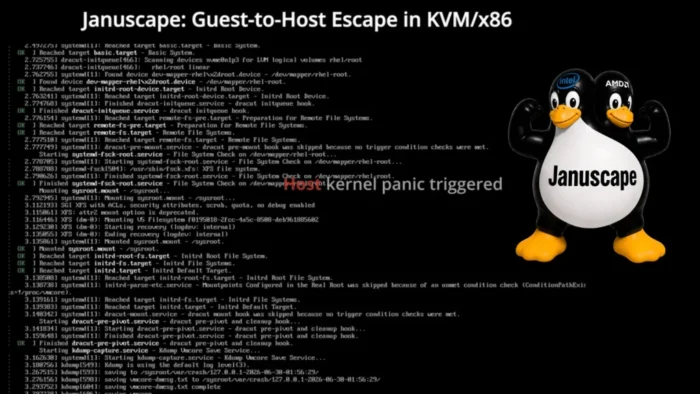
A long-standing Linux KVM vulnerability can let a malicious guest virtual machine corrupt host kernel memory, breaking one of the core security promises of virtualization.
The flaw is tracked as CVE-2026-53359 and has been named Januscape. The oss-security disclosure describes it as a KVM/x86 guest-to-host escape issue affecting both Intel and AMD hosts when untrusted guests can use nested virtualization.

Access content across the globe at the highest speed rate.
70% of our readers choose Private Internet Access
70% of our readers choose ExpressVPN

Browse the web from multiple devices with industry-standard security protocols.

Faster dedicated servers for specific actions (currently at summer discounts)
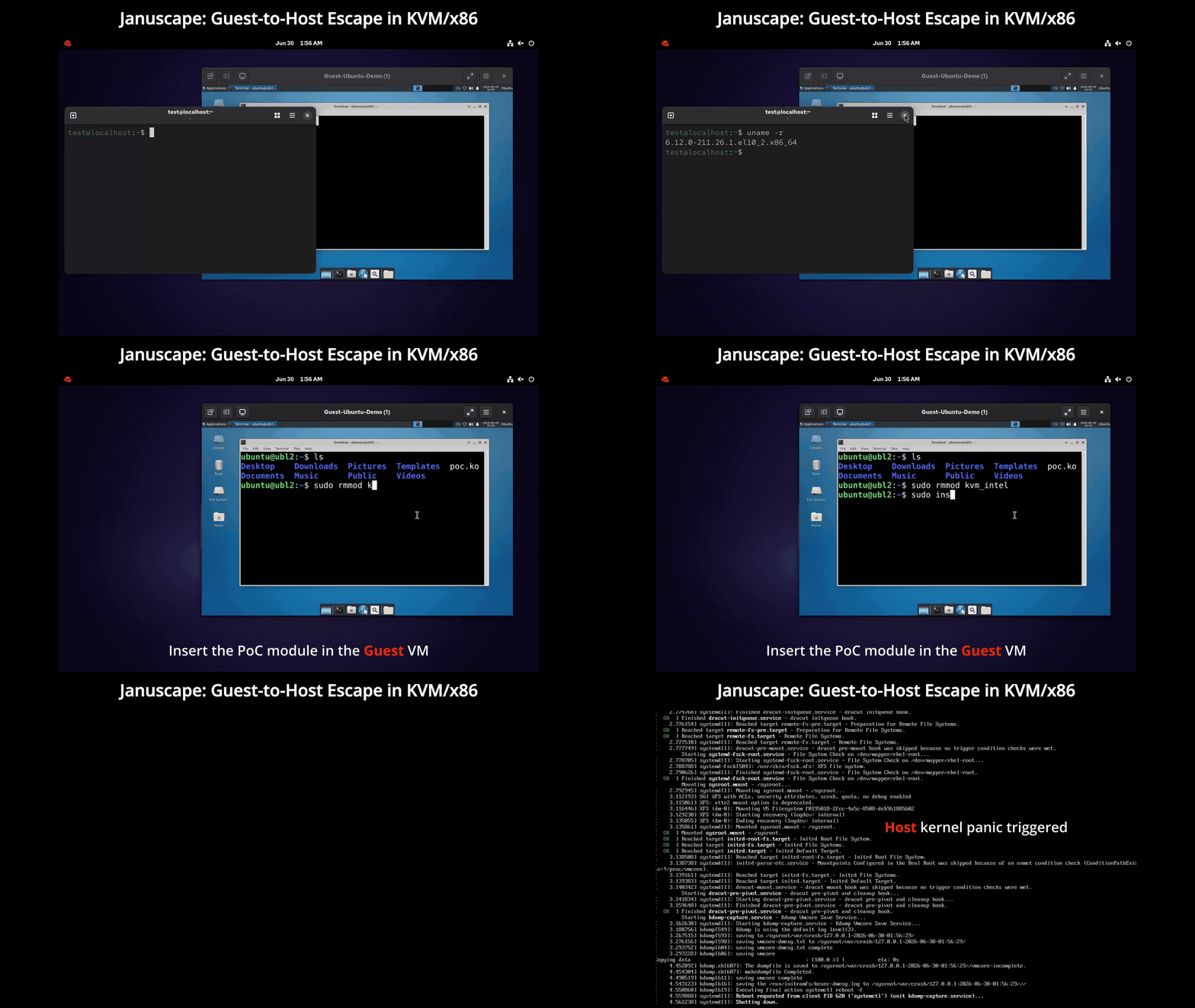
The public proof of concept demonstrates a host denial-of-service condition by triggering a kernel panic. The researcher’s Januscape technical write-up also says a full escape exploit exists in a controlled environment, but that exploit has not been released publicly.
What is Januscape?
Januscape is a use-after-free vulnerability in KVM’s x86 shadow MMU emulation. KVM is the Linux kernel’s virtualization subsystem, and the shadow MMU code helps manage guest memory translations in specific virtualization paths.
The issue became especially important because of nested virtualization. Even when modern systems normally rely on Intel EPT or AMD NPT hardware-assisted paging, nested virtualization can push KVM into legacy shadow paging logic.
The NVD entry says the vulnerable code reuses a shadow page after comparing the guest frame number, but without comparing the page role. That mismatch leaves stale reverse-map entries behind and can lead to a use-after-free when KVM later walks the affected memory.
| Item | Details |
|---|---|
| CVE | CVE-2026-53359 |
| Name | Januscape |
| Component | Linux KVM/x86 shadow MMU |
| Bug class | Use-after-free caused by shadow page role confusion |
| Architectures | Intel VMX/EPT and AMD SVM/NPT hosts |
| Main risk | Guest-to-host memory corruption, host crash, and potential host escape |
| Public exploit status | DoS proof of concept is public, full escape exploit is not public |
How the KVM bug corrupts host memory
The root problem is a shadow-page reuse mistake. KVM can reuse an existing shadow page when it sees a matching guest frame number, but the vulnerable logic did not also confirm that the page role matched the new translation context.
That matters because shadow pages can represent different mapping types. A page used for a direct large-page mapping does not have the same meaning as a page used for a smaller page-table shadow.
The CVE-2026-53359 record explains that KVM can leave an rmap entry behind after the shadow page is freed. Later operations such as dirty logging or MMU notifier invalidation may dereference a pointer into freed memory, causing host kernel memory corruption.
- A guest triggers a nested virtualization memory-translation path.
- KVM finds an existing shadow page with a matching guest frame number.
- The vulnerable code fails to verify the shadow page role.
- KVM reuses a page in the wrong translation context.
- Reverse-map cleanup misses an entry that should have been removed.
- Later KVM activity dereferences freed memory and corrupts host kernel state.
Why nested virtualization increases risk
Januscape is most dangerous for x86 KVM hosts that run untrusted guests and expose nested virtualization. That includes cloud, hosting, lab, and CI environments where a customer-controlled VM can run another guest inside it.
The researcher’s GitHub repository says the issue threatens KVM/x86 hosts that accept untrusted guests and expose nested virtualization, particularly multi-tenant public cloud environments.
The exploit path also does not require a QEMU bug. The issue lives in in-kernel KVM code, which makes it relevant even for platforms that use their own virtualization stack on top of KVM.
| Environment | Risk level | Reason |
|---|---|---|
| Multi-tenant KVM cloud with nested virtualization enabled | High | Untrusted guests may trigger the vulnerable path |
| Private KVM host with trusted VMs only | Lower | The attack requires control inside a guest |
| KVM host with nested virtualization disabled | Reduced | The documented attack path depends on nested virtualization |
| arm64 KVM hosts | Not affected by Januscape | The issue affects KVM/x86, not arm64 |
Public PoC crashes the host, full escape is not public
The public proof of concept is designed to crash the host. It runs inside a guest and can trigger a kernel panic by racing the KVM shadow MMU path.
The public oss-security post says Januscape was successfully used as a zero-day exploit in Google kvmCTF. It also states that the bug can threaten guest-host isolation on x86 KVM hosts with untrusted guests and nested virtualization.
That distinction is important for defenders. The public code demonstrates denial of service, while the more severe guest-to-host code execution path remains described but unreleased.
The flaw dates back to 2010
Januscape remained in KVM for about 16 years. The researcher says the vulnerable range starts with a Linux kernel commit from August 1, 2010 and ends with the fix merged on June 16, 2026.
The upstream Linux kernel fix addresses the unexpected-role issue by preventing KVM from reusing a shadow page unless the role matches the requested mapping context.
CloudLinux said in its Januscape mitigation advisory that fixing the issue requires the CVE-2026-53359 patch and the related CVE-2026-46113 frame-number fix. Administrators should rely on their distribution’s security updates rather than manually picking one patch in isolation.
Why the vulnerability matters for cloud providers
Virtualization security depends on strong separation between guest and host. If a malicious guest can corrupt host kernel memory, the attacker may affect other virtual machines on the same physical server.
A reliable host crash can take down every guest on that host. A working guest-to-host escape could give an attacker root-level control on the host, which would create a much broader compromise.
The Google kvmCTF announcement explains that Google created kvmCTF to strengthen KVM because it underpins parts of Android and Google Cloud. Januscape’s reported use in kvmCTF highlights why cloud-grade hypervisor bugs attract close attention.
- Guest root access is enough in common cloud scenarios where customers control their own VM.
- Nested virtualization exposes the vulnerable KVM/x86 shadow MMU path.
- A host crash can disrupt multiple tenants on the same physical system.
- A full escape path could compromise the host and other workloads.
- The issue affects both Intel and AMD x86 hosts.
Patch status and mitigation
The main fix has already landed upstream, and Linux distributions are expected to ship backported fixes through their normal kernel update channels.
The kernel commit changes the shadow-page reuse logic so KVM verifies the role before reusing a child shadow page. This removes the role-confusion path that leads to stale reverse-map entries.
Until patches are applied, disabling nested virtualization reduces exposure for hosts that run untrusted VMs. The CloudLinux guidance recommends applying mitigation while platform-specific kernel updates and live patches move through release channels.
- Identify all x86 KVM hosts that expose nested virtualization to guests.
- Prioritize multi-tenant and customer-controlled VM environments.
- Apply vendor kernel updates as soon as they become available.
- Confirm that both the Januscape fix and related shadow-paging fixes are included.
- Disable nested virtualization where it is not required.
- Monitor for unexpected host kernel panics involving KVM MMU code.
- Review whether /dev/kvm permissions expose additional local privilege risk.
What administrators should check now
KVM operators should not wait for a public full escape exploit before acting. The available denial-of-service proof of concept already shows that a guest can reach and destabilize host kernel state.
Administrators should inventory nested virtualization usage, review kernel package status, and schedule emergency updates for exposed hosts. Cloud and hosting providers should also assess whether customer workloads can load guest kernel modules or otherwise gain guest root privileges.
The broader lesson is that rarely used legacy paths can still sit inside critical infrastructure for years. Januscape shows how a small validation gap in memory-management code can undermine host isolation when the right virtualization feature exposes that path.
FAQ
Januscape is a Linux KVM/x86 use-after-free vulnerability in the shadow MMU code. It can let a malicious guest corrupt host kernel memory when nested virtualization is exposed.
Yes. Public research says Januscape affects KVM/x86 hosts on both Intel VMX/EPT and AMD SVM/NPT systems. The issue is in shared x86 KVM shadow MMU logic.
A public proof of concept demonstrates a host denial-of-service attack that can trigger a kernel panic. The researcher says a full guest-to-host escape exploit exists in a controlled environment, but it has not been publicly released.
Administrators should apply vendor kernel updates, confirm the relevant KVM shadow MMU fixes are included, and disable nested virtualization on hosts that do not need it. Multi-tenant x86 KVM hosts should receive priority.
No. Januscape affects KVM/x86 hosts. arm64 KVM hosts are not affected by this specific vulnerability, although they may need separate fixes for unrelated KVM issues.


Read our disclosure page to find out how can you help VPNCentral sustain the editorial team Read more


Improve this guide



User forum
0 messages