
Cavern Manticore Abuses SysAid and WinDirStat DLL Sideloading to Deploy Cavern C2 Framework


 8 min. read
  Published on
Iran-linked threat actor Cavern Manticore has been using trusted IT administration tools and DLL sideloading to deploy a modular command-and-control framework called Cavern against Israeli organizations.
The campaign, documented by Check Point Research, focuses on Israeli government and IT-sector targets. Researchers said the actor abused existing remote monitoring and management access inside victim environments, then used software deployment workflows to move malware across trusted systems.

Access content across the globe at the highest speed rate.
🔥 Save 81% + 2 bonus months! 🔥
70% of our readers choose Private Internet Access
70% of our readers choose Private Internet Access
2
Browse the web from multiple devices with industry-standard security protocols.
🔥 Save 73%! 🔥

Faster dedicated servers for specific actions (currently discounted)
🔥 Save 69%! 🔥
A key finding is that SysAid itself was not compromised and no SysAid vulnerability was involved. Instead, the attacker had already gained access and abused legitimate deployment functionality connected to SysAid remote support to deliver a malicious WinDirStat package.
How the Cavern Manticore attack works
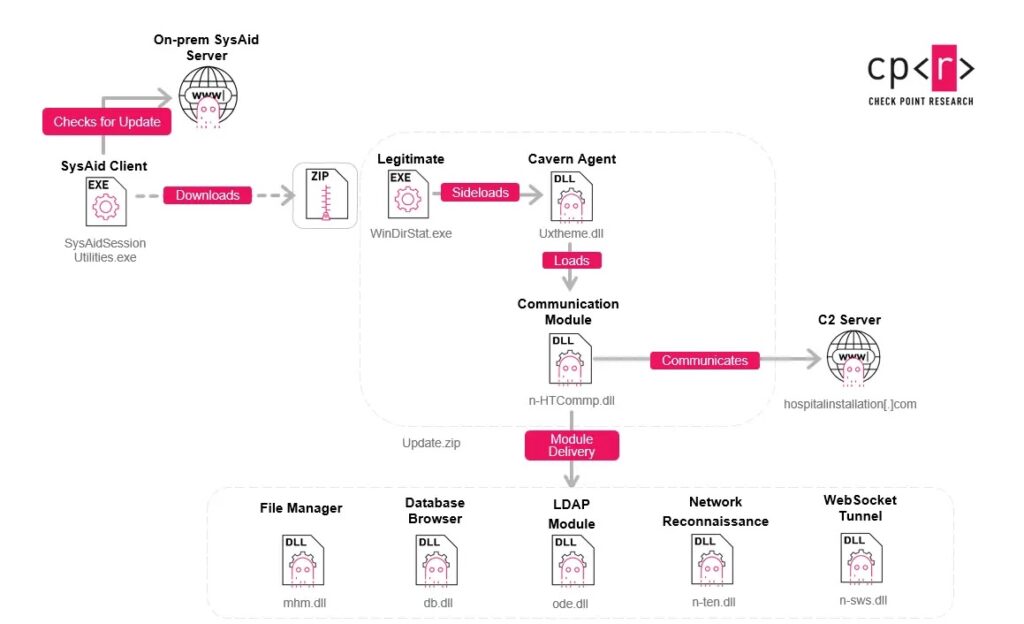
The observed execution chain starts with a software update mechanism that pushes a bundle containing WinDirStat, a legitimate Windows disk usage utility. The bundle also contains a malicious DLL named uxtheme.dll.
When the legitimate WinDirStat executable runs, it loads the attacker’s uxtheme.dll file instead of the expected legitimate library. That trojanized DLL acts as the Cavern Agent, which then loads a separate communication module named n-HTCommp.dll.
This is a classic sideloading pattern. MITRE ATT&CK describes DLL side-loading as a technique where attackers place a malicious DLL where a legitimate program will load it, causing the trusted application to execute the attacker’s payload.
| Stage | Component | Purpose |
|---|---|---|
| Initial access | Existing RMM access | Gives attackers a trusted administrative channel |
| Deployment | SysAid software update feature | Delivers the malicious WinDirStat package |
| Execution | WinDirStat.exe | Runs as a legitimate application |
| Sideloading | uxtheme.dll | Loads the Cavern Agent backdoor |
| Communication | n-HTCommp.dll | Handles C2 traffic over HTTPS or WebSocket |
| Post-exploitation | Cavern modules | Provides file, database, LDAP, network, and tunneling functions |
Cavern is built as a modular C2 framework
Cavern is not a single-purpose backdoor. It is a modular post-exploitation framework built on .NET, with a core agent and separate mission-specific modules.
According to the Check Point report, the framework separates communication from operational tasks. The Cavern Agent coordinates activity, while additional modules can browse files, query databases, enumerate Active Directory data, scan networks, or create tunnels.
The Hacker News also reported that the framework has been linked to attacks on Israeli organizations and attributed to a cluster that shares tactical overlaps with Iranian threat groups such as MuddyWater and Lyceum.
- mhm.dll handles file operations, enumeration, recursive search, archive handling, and file transfer.
- db.dll supports SQL database browsing, query execution, export, and manipulation.
- ode.dll supports LDAP and Active Directory reconnaissance.
- n-ten.dll provides network reconnaissance, port scanning, share enumeration, and SMB brute-force capabilities.
- n-sws.dll provides SOCKS5 proxy and WebSocket tunneling functions.
Why the WinDirStat sideloading chain matters
The attack works because defenders and users generally expect known IT utilities to behave normally. WinDirStat is a legitimate open-source disk usage analyzer for Windows, not malware.
The malicious behavior comes from the surrounding deployment chain and the trojanized DLL placed beside the legitimate executable. This lets attackers hide behind the credibility of the WinDirStat utility while running their own code through a trusted process.
For defenders, that means detection cannot rely only on program names. Process lineage, file paths, recently created folders, unsigned DLLs, and unusual DLL loads matter just as much as the executable itself.
| Legitimate element | How attackers abused it | Defensive focus |
|---|---|---|
| RMM access | Used as a trusted path to deploy malware | Review administrative actions and deployment logs |
| Software update workflow | Delivered files that looked like an update package | Validate package sources and approval chains |
| WinDirStat.exe | Loaded a malicious DLL during execution | Monitor suspicious DLL placement and load events |
| uxtheme.dll | Masqueraded as a legitimate Windows library | Flag unexpected uxtheme.dll copies outside normal Windows paths |
| HTTPS or WebSocket traffic | Used for C2 communication | Inspect unusual outbound traffic from admin tools |
Anti-analysis choices slow down defenders
Cavern uses three different .NET compilation formats across its components: .NET Framework, Mixed-Mode C++/CLI, and .NET 8 NativeAOT. That forces malware analysts to switch between different reverse-engineering workflows.
Some modules keep readable .NET metadata, while others compile into native-only binaries with stripped symbols and runtime-resolved capabilities. This does not make analysis impossible, but it slows down triage and complicates quick incident response.
The campaign also uses per-module AppDomain isolation and removes modules from memory after execution. That cleanup reduces the amount of evidence available after a module finishes its task.
Targets include Israeli IT and government organizations
Cavern Manticore appears focused on Israeli targets, especially organizations in government and IT services. IT providers matter because they often hold trusted access to other customers and partner environments.
Researchers said they observed cases where the actor moved from an initially compromised IT provider to a second-hop provider before reaching the intended target. This makes the campaign a supply-chain risk as much as a malware story.
The Hacker News report notes that the actor’s use of trusted provider relationships matches the broader value attackers see in software supply chains and managed service environments.
SysAid abuse does not mean SysAid was hacked
The most important operational distinction is that the campaign did not exploit a SysAid vulnerability. The attacker abused access and functionality that already existed in the victim environment.
SysAid’s remote control documentation describes remote support software as a way for IT teams to connect to devices, provide support, and manage sessions. Those same administrative workflows become risky when attackers obtain privileged access or compromise an IT provider.
Security teams should not respond by assuming every RMM product is malicious. They should instead harden access, review who can deploy software, require approvals for high-risk changes, and monitor unusual remote sessions.
- Review recent RMM software deployment activity, especially updates pushed from IT-provider accounts.
- Search for unexpected WinDirStat folders or binaries under C:\ProgramData and other writable locations.
- Flag uxtheme.dll files outside expected Windows system directories.
- Investigate WinDirStat.exe loading DLLs from the same folder as the executable.
- Review outbound connections to suspicious domains tied to hospitalinstallation[.]com and related infrastructure.
- Limit remote access privileges and enforce separate approval for software deployment.
Indicators defenders should prioritize
Static indicators are useful for hunting, but Check Point warns that defenders should also focus on behavior. The actor can change hashes, file names, and infrastructure, while the operational pattern remains more stable.
MITRE ATT&CK’s DLL side-loading technique is the right behavioral lens for this case because the attack depends on a legitimate application loading a malicious DLL from an attacker-controlled location.
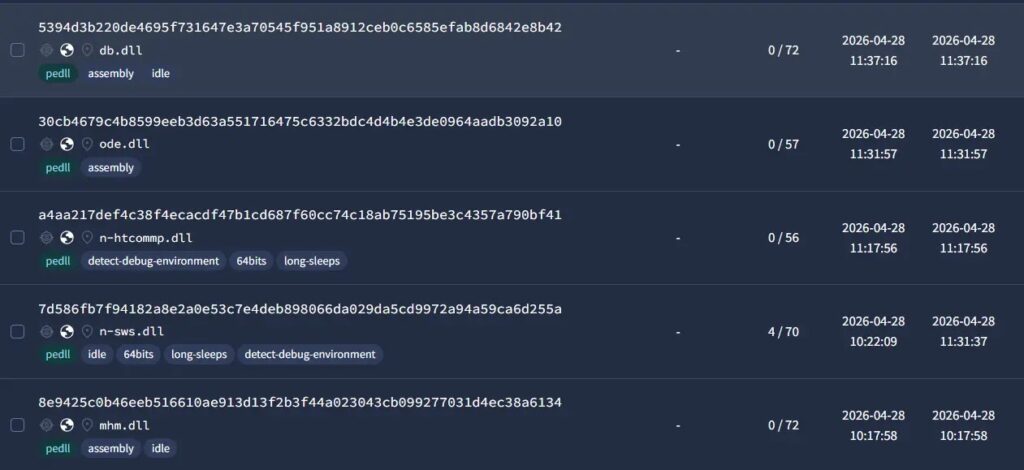
Useful hunting points include unexpected uxtheme.dll placement, WinDirStat execution from unusual directories, NativeAOT-style modules, RMM-initiated software deployment, and C2 traffic over HTTPS or WebSocket from systems that normally should not initiate those connections.
| Type | Indicator | Description |
|---|---|---|
| SHA-256 | 37e123bd7998af4eae32718ce254776f36365a80ba56952593dab46f536d4066 | uxtheme.dll Cavern Agent build 02 |
| SHA-256 | 92cae0ad7f98f51a14bcc0ee05e372ebdc29ea96ea7bd161bd3f55198767603b | uxtheme.dll Cavern Agent build 04 |
| SHA-256 | 5dc08bda6919a57a85e5f38b857985fa71529ca39c8299868d5a49a987e19b18 | Older uxtheme.dll Cavern Agent build |
| SHA-256 | a4aa217def4c38f4ecacdf47b1cd687f60cc74c18ab75195be3c4357a790bf41 | n-HTCommp.dll communication module |
| SHA-256 | b630c96d3763182533d4fb9b614134382bd644cb02c6c1c3ade848b6ecc31e86 | n-HTCommp.dll communication module |
| Domain | hospitalinstallation[.]com | Parent C2 infrastructure domain |
| Domain | auth.hospitalinstallation[.]com | C2 domain used by older Cavern Agent builds |
| Domain | google.com.hospitalinstallation[.]com | C2 domain used by newer Cavern Agent builds |
| File | uxtheme.dll | Trojanized DLL sideloaded by WinDirStat.exe |
| File | n-HTCommp.dll | Native communication module used for C2 traffic |
| Mutex | MYMUTEX123HELLP, MYMUTEX123HELLP02, MYMUTEX123HELLP04 | Mutex names observed across Cavern Agent builds |
What organizations should do now
Organizations that use RMM platforms should review access controls, deployment permissions, and audit logs. The main risk comes from attackers abusing trusted administrative channels after they already have access.
Teams should also build detections around behavior rather than only hashes. A legitimate executable running from an unusual directory and loading a suspicious DLL should trigger investigation, especially when it follows an RMM deployment event.
Cavern Manticore’s campaign shows how attackers can combine trusted IT tools, supply-chain relationships, and custom malware to move quietly. The best defense is strict control over administrative access, fast review of unusual software deployments, and monitoring that connects RMM activity with endpoint behavior.
FAQ
Cavern Manticore is an Iran-nexus threat actor tracked by Check Point Research. The group has targeted Israeli organizations, especially in government and IT services, and uses a modular C2 framework called Cavern.
No. Check Point says SysAid was not compromised and no SysAid vulnerability was involved. The attacker had already gained access to the victim environment and abused a legitimate software deployment feature.
The attacker deployed a package containing the legitimate WinDirStat executable and a malicious uxtheme.dll file. When WinDirStat.exe ran, it loaded the malicious DLL, which launched the Cavern Agent backdoor.
Cavern can load modules for file operations, SQL database browsing, LDAP and Active Directory reconnaissance, network scanning, SMB brute-force attempts, SOCKS5 proxying, and WebSocket tunneling.
Defenders should monitor RMM deployment logs, unusual WinDirStat execution, suspicious uxtheme.dll files outside normal Windows paths, NativeAOT-style modules, and outbound HTTPS or WebSocket traffic to unfamiliar infrastructure.


Read our disclosure page to find out how can you help VPNCentral sustain the editorial team Read more


Improve this guide



User forum
0 messages