
GhostLock Linux Kernel Flaw Enables Root Access and Container Escape on Unpatched Systems


 8 min. read
  Published on
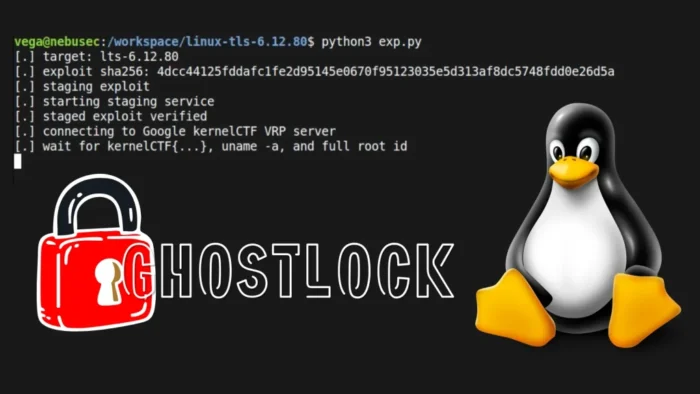
A 15-year-old Linux kernel flaw called GhostLock can let a low-privileged local attacker gain root access on unpatched systems.
The vulnerability is tracked as CVE-2026-43499 and affects the Linux kernel’s real-time mutex and futex handling. In its GhostLock research, Nebula Security says the bug has existed across major Linux distributions since 2011 and can support privilege escalation and container escape.

Access content across the globe at the highest speed rate.
🔥 Save 81% + 2 bonus months! 🔥
70% of our readers choose Private Internet Access
70% of our readers choose ExpressVPN
2
Browse the web from multiple devices with industry-standard security protocols.
🔥 Save 73%! 🔥

Faster dedicated servers for specific actions (currently at summer discounts)
🔥 Save 69%! 🔥
The flaw does not allow a remote attacker to compromise a server from the internet by itself. It becomes dangerous when an attacker already has local code execution, a shell account, a compromised web app, or code running inside a container on a vulnerable host.
What is GhostLock?
GhostLock is a use-after-free vulnerability in the Linux kernel’s rtmutex and priority-inheritance futex logic. That subsystem helps the kernel manage locking between tasks, including cases where priority rules matter.
The NVD entry for CVE-2026-43499 says the bug exists because remove_waiter() can operate on the current task during proxy-lock rollback even when the real waiter task is different.
That mistake leaves stale internal state behind. In practical terms, a task can keep a dangling pointer to stack memory that no longer belongs to it, creating a path toward kernel memory corruption.
| Item | Details |
|---|---|
| CVE | CVE-2026-43499 |
| Name | GhostLock |
| Component | Linux kernel rtmutex and futex priority-inheritance handling |
| Weakness | Use-after-free, CWE-416 |
| Severity | High, CVSS 7.8 from kernel.org CNA |
| Attack type | Local privilege escalation |
| Main impact | Root access and possible container escape on unpatched systems |
| Fix | Update to a kernel release that includes the remove_waiter() correction |
Why the flaw matters
GhostLock matters because many real compromises start with low privileges. An attacker may first exploit a vulnerable website, steal an SSH credential, compromise a developer account, or gain code execution inside a container.
From there, a local kernel privilege escalation can turn limited access into full host control. On shared servers, hosting systems, and Kubernetes nodes, that can put other workloads at risk.
CloudLinux warned that the bug is especially serious for multi-tenant hosting, where a compromised site or low-trust shell account could become a route to root on the underlying server.
How GhostLock works at a high level
The bug sits in kernel logic that cleans up waiters during certain futex operations. In one rollback path, the kernel uses the currently running task where it should use the task associated with the waiter object.
The result can leave a dangling pointer that later points into freed kernel stack memory. Nebula’s writeup says the exploit can reclaim that memory, influence internal kernel structures, and gain a limited write primitive that can support control-flow hijacking.
This article does not reproduce the exploit chain, proof-of-concept code, or step-by-step exploitation sequence. The defensive takeaway is that the flaw turns local code execution into a much larger host compromise risk.
Nebula says the exploit was highly reliable
Nebula Security says VEGA, its automated vulnerability research agent, found the flaw. The company also says it built a 97% stable privilege escalation and container escape exploit and received a $92,337 reward through Google’s kernelCTF program.
The Nebula writeup says GhostLock was introduced with Linux 2.6.39 and fixed in Linux 7.1. It also says the affected range runs from v2.6.39-rc1 to v7.1-rc1, with CONFIG_FUTEX_PI=y as the relevant requirement.
The long lifetime of the bug shows how deeply buried kernel logic errors can survive for years. Synchronization code is difficult to audit because rare timing, rollback, and cleanup paths may not appear during normal testing.
NVD lists the issue as high severity
The NVD record lists the kernel.org CNA score as CVSS 7.8. The vector is local attack, low attack complexity, low privileges required, no user interaction, and high confidentiality, integrity, and availability impact.
That score explains the risk clearly. GhostLock is not a remote unauthenticated server takeover bug, but it can be severe after an attacker reaches the system through another path.
For cloud and hosting providers, the container escape angle raises the stakes. Container boundaries depend on the host kernel, so a kernel-level exploit can undermine isolation between workloads.
Patch status varies by distribution
Administrators should not assume that a kernel is safe only because it looks recent. Distribution backports, vendor kernel branches, cloud kernels, real-time kernels, and hardware-specific builds can all have different patch timelines.
The Ubuntu CVE tracker shows mixed status across different Ubuntu kernel packages, with some fixed, some vulnerable, and some marked not in release or ignored depending on package and release support.
An oss-security post also points to the upstream fix committed on April 21, 2026 and notes that there is no module to block as a mitigation. The kernel needs to be updated.
Who should prioritize updates first?
All Linux administrators should track the issue, but some environments should treat it as urgent. The highest-risk systems are those where untrusted or semi-trusted users can run code.
That includes shared hosting servers, CI runners, developer workstations, container platforms, university clusters, build farms, cloud workloads, and systems that expose shell access to many users.
CloudLinux said the practical risk is worst for multi-tenant environments, because one compromised customer workload or account can threaten the host and other customers on the same machine.
- Shared hosting providers should patch host kernels quickly.
- Kubernetes operators should update worker nodes and plan rolling reboots.
- CI and build platform owners should patch runners that execute untrusted jobs.
- Linux desktop users should install distribution kernel updates and reboot.
- Organizations should review older long-term systems that do not receive regular kernel updates.
- Teams should check vendor status pages rather than relying only on kernel version numbers.
How to reduce exposure
The main mitigation is a patched kernel. Because this flaw lives inside kernel synchronization logic, normal application-layer controls cannot fully neutralize it once an attacker can run local code.
Administrators should use their distribution’s security tracker, install updated kernel packages, and reboot systems into the fixed kernel. For Ubuntu environments, the Ubuntu tracker is one place to confirm package status before maintenance windows.
Security teams should also review exposure to untrusted code. Reducing who can run local processes, tightening container admission controls, and isolating high-risk workloads can limit the paths attackers use before privilege escalation.
- Inventory Linux servers, desktops, cloud instances, and container hosts.
- Check each distribution’s CVE tracker for CVE-2026-43499.
- Install the fixed kernel package from the vendor repository.
- Reboot into the patched kernel and verify the active version.
- Prioritize hosts that run containers, shared accounts, CI jobs, or untrusted workloads.
- Review logs for suspicious local privilege escalation attempts where local compromise is suspected.
Why this is difficult to detect after exploitation
Kernel privilege escalation can leave fewer obvious network indicators than remote exploitation. The attacker may already be on the system and may only need a short local execution window to gain root.
Defenders should look for suspicious transitions from low-privileged accounts to root, unusual crashes, unexpected kernel warnings, abnormal container behavior, and new persistence after local user activity.
The oss-security discussion noted that one tester reproduced at least a crash or hang on an Ubuntu 7.0.0-14 LTS kernel, while other tested kernels were not vulnerable, reinforcing the need to check exact vendor status.
Bottom line
GhostLock is a high-severity local privilege escalation bug, not a remote internet worm. Its impact still matters because attackers often gain limited local execution before trying to become root.
The most important action is to patch and reboot Linux systems, especially shared servers, container hosts, CI systems, and developer machines. Teams that manage multi-tenant systems should move fastest because a single low-privileged foothold can threaten the whole host.
The safer long-term lesson is that kernel patching needs the same urgency as application patching. When a flaw breaks the boundary between ordinary users, containers, and root, delayed maintenance can turn a small compromise into full system control.
FAQ
GhostLock is the name given to CVE-2026-43499, a Linux kernel use-after-free vulnerability in rtmutex and futex priority-inheritance handling. It can let a low-privileged local attacker gain root on unpatched systems.
GhostLock is a local privilege escalation flaw. An attacker needs local code execution or a low-privileged account first, but after that the vulnerability can allow root access on a vulnerable host.
Nebula Security says its exploit demonstrated container escape. Because containers share the host kernel, a kernel-level privilege escalation can undermine container isolation on unpatched hosts.
Install the fixed kernel package from your Linux distribution or vendor, then reboot into the patched kernel. Administrators should verify the active kernel version after reboot and prioritize multi-tenant or container hosts.


Read our disclosure page to find out how can you help VPNCentral sustain the editorial team Read more


Improve this guide




User forum
0 messages