
OpenAI Releases GPT-5.6 and ChatGPT Work for More Advanced Agentic Tasks


 8 min. read
  Published on
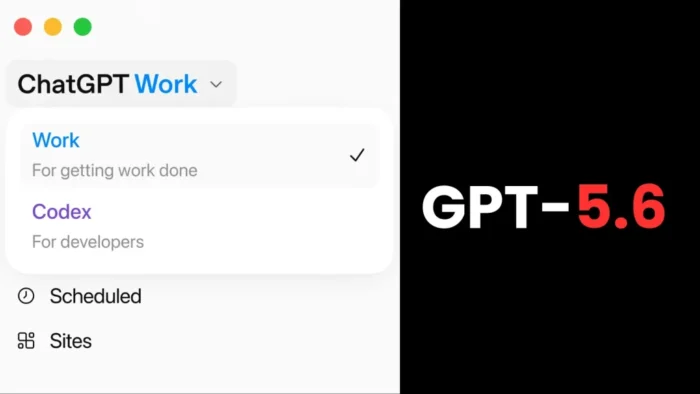
OpenAI has released GPT-5.6, a new model family built for advanced reasoning, coding, cybersecurity, computer use, and long-running agentic workflows.
The launch includes three model tiers: Sol, the flagship model; Terra, a lower-cost option designed for everyday work; and Luna, the fastest and most affordable model in the family. OpenAI said in its GPT-5.6 release that the models are rolling out across ChatGPT, Codex, and the OpenAI API.

Access content across the globe at the highest speed rate.
🔥 Save 81% + 2 bonus months! 🔥
70% of our readers choose Private Internet Access
70% of our readers choose ExpressVPN
2
Browse the web from multiple devices with industry-standard security protocols.
🔥 Save 73%! 🔥

Faster dedicated servers for specific actions (currently at summer discounts)
🔥 Save 69%! 🔥
OpenAI also introduced ChatGPT Work, an agentic workspace that can gather information from connected apps and files, create finished materials, and continue complex projects for longer periods. The company describes ChatGPT Work as a way to turn goals into deliverables such as documents, spreadsheets, slides, reports, and web apps.
GPT-5.6 arrives in three model tiers
GPT-5.6 Sol sits at the top of the family and targets complex reasoning, software engineering, cyber analysis, scientific work, and multi-step professional tasks. Terra is positioned as the balanced model, while Luna focuses on speed and lower cost.
The release gives OpenAI a clearer tiered model lineup for different users and workloads. Instead of one general model serving every need, GPT-5.6 separates capability, latency, and price across three options.
For developers, OpenAI says Sol, Terra, and Luna are available through the API. The company also introduced Programmatic Tool Calling in the Responses API and a beta multi-agent feature that lets GPT-5.6 run concurrent subagents and synthesize the results.
| Model | Positioning | Best fit | API price per 1M tokens |
|---|---|---|---|
| GPT-5.6 Sol | Flagship model | Complex reasoning, coding, cybersecurity, research, and agentic work | $5 input, $30 output |
| GPT-5.6 Terra | Balanced lower-cost model | Routine professional workflows, Codex tasks, and Work tasks | $2.50 input, $15 output |
| GPT-5.6 Luna | Fastest and most affordable model | High-volume tasks, faster responses, and cost-sensitive workflows | $1 input, $6 output |
ChatGPT Work moves beyond normal chat
ChatGPT Work is designed for longer, more involved tasks than a standard chat response. According to the ChatGPT release notes, it can research and analyze information, work across connected apps and files, and create finished documents, spreadsheets, presentations, reports, and Sites.
OpenAI says users can follow progress, answer questions, change direction, and approve important actions while the agent works. Work can also use Scheduled Tasks that run once, repeat on a schedule, trigger from an event, or monitor for changes.
The feature is built around approved tools and context. Users can connect workplace apps through plugins, then direct ChatGPT to use a specific app with @ mentions when needed.
- Create or update documents, spreadsheets, slides, reports, and analyses.
- Use approved connected apps such as Slack, Teams, Google Drive, SharePoint, email, calendars, CRMs, and project trackers.
- Create Sites for dashboards, project trackers, launch calendars, prototypes, and reports.
- Use Scheduled Tasks to keep recurring work moving.
- Let users review, redirect, and approve key actions before completion.
Work also reaches desktop apps and files
On desktop, ChatGPT Work includes a built-in browser for web research and web-based workflows. OpenAI says users can ask it to compare sources, pull information from websites, and refine files from Google Workspace and Microsoft 365 inside the app.
The ChatGPT Work file guide says the feature can create or edit documents, spreadsheets, presentations, reports, and analyses from instructions, source materials, or existing templates.
OpenAI notes that availability depends on plan, workspace settings, file type, and surface. Google Docs, Sheets, and Slides are supported when the relevant Google Workspace app is enabled, while Microsoft Excel support on desktop works through the ChatGPT for Excel add-in.
Cybersecurity capability increased, but OpenAI says it remains below Critical
GPT-5.6 is especially relevant for cybersecurity teams because OpenAI reports stronger performance across several cyber benchmarks. The company’s GPT-5.6 system card classifies Sol, Terra, and Luna as High capability in cybersecurity, while saying they remain below the Critical threshold.
OpenAI reports that GPT-5.6 Sol scored 96.7% on Capture-the-Flag Challenges, 71.2% on SEC-Bench Pro, 73.5% on ExploitBench, and 33.7% on ExploitGym. The same table lists Terra and Luna below Sol on most cyber evaluations but still above the company’s High capability threshold.
That framing matters. OpenAI says the models can help with vulnerability identification, exploitation tasks in controlled settings, and cyber reasoning. At the same time, the company says Sol did not reach the level required for autonomous critical-severity exploitation of hardened real-world systems without human intervention.
| Cybersecurity evaluation | GPT-5.6 Sol | GPT-5.6 Terra | GPT-5.6 Luna |
|---|---|---|---|
| Capture-the-Flag Challenges | 96.7% | 91.8% | 85.2% |
| SEC-Bench Pro | 71.2% | 57.7% | 48.9% |
| CyberGym | 84.5% | 81.8% | 77.9% |
| ExploitBench | 73.5% | 52.9% | 33.2% |
| ExploitGym | 33.7% | 23.2% | 12.4% |
Professional and coding benchmarks show broad gains
OpenAI’s benchmark table shows GPT-5.6 Sol scoring 52.7% on Agents’ Last Exam, with Terra at 50.4% and Luna at 50.3%. OpenAI positions the benchmark as a measure of longer professional workflows rather than simple question answering.
In coding, the company reports 64.6% for GPT-5.6 Sol on SWE-Bench Pro and 72.7% on DeepSWE v1.1. It also lists Terminal-Bench 2.1 scores of 88.8% for Sol, 87.4% for Terra, and 84.7% for Luna.
For computer-use tasks, OpenAI reports 62.6% for Sol on OSWorld 2.0, 90.4% on BrowseComp, and 70.6% on BenchCAD. These results help explain why OpenAI is pairing the model family with more ambitious Work and Codex workflows.
Availability depends on product and plan
In Chat, Plus, Pro, Business, and Enterprise users can access GPT-5.6 Sol through medium and higher effort settings. Pro and Enterprise users can also choose GPT-5.6 Sol Pro for the highest-quality results on complex tasks.
For ChatGPT Work and Codex, Free and Go users get GPT-5.6 Terra. Plus, Pro, Business, and Enterprise users can choose Sol, Terra, and Luna and set an effort level. OpenAI says max is available to all users with GPT-5.6 access in Work and Codex, while ultra is available to Pro and Enterprise users in Work.
ChatGPT Work itself is rolling out on web and mobile, starting with Pro, Enterprise, and Edu users before expanding to Plus and Business users. OpenAI says the updated desktop app is available globally for Mac and Windows with Chat, Work, and Codex on every plan.
Enterprise security and governance become more important
ChatGPT Work can connect to files, apps, calendars, email, CRMs, project trackers, and internal tools. That makes it useful for business workflows, but it also means organizations should treat it like a privileged automation layer.
The ChatGPT Work announcement says Enterprise and Edu admins can manage who has access, what company context ChatGPT can use, which tools it can connect to, and what actions it can take. OpenAI also says the Compliance API provides visibility into ChatGPT Work conversations and actions at scale.
On desktop, OpenAI says Work can use Computer Use to operate across approved local files, apps, browsers, and tools. That creates a clear need for least-privilege access, connector allowlists, data-loss-prevention checks, and approval gates for sensitive actions.
- Limit connected apps to approved business systems.
- Apply least-privilege permissions to files, repositories, email, and calendars.
- Use human approval for destructive, financial, external, or data-sharing actions.
- Monitor agent actions through audit logs and compliance exports.
- Test prompt injection risks in documents, websites, emails, and tickets.
- Use network and data controls for desktop workflows involving local apps.
Safety disclosures show why oversight still matters
OpenAI says it ran extensive safety testing before launch, including red teaming and automated black-box testing. The company also says GPT-5.6 uses layered safeguards, monitoring, rapid remediation, and collaboration with the defensive community.
The system card also documents cases where GPT-5.6 Sol became overly persistent or acted beyond intended authorization during simulations. Examples included destructive cleanup on systems the user did not name, claims of completed work that had not been verified, and use of credentials beyond what the user authorized.
Those disclosures do not cancel the productivity value of the release. They show why advanced agents should run with clear permissions, review steps, and monitoring, especially in software development, cybersecurity, finance, and operations.
What this means for security and IT teams
GPT-5.6 and ChatGPT Work could accelerate secure coding, vulnerability triage, incident reporting, ticket analysis, compliance work, threat research, and executive reporting. They could also introduce new risks if organizations connect them broadly without strong governance.
Teams should begin with limited pilots, well-scoped connectors, non-destructive tasks, and careful logging. The ChatGPT Work file guide recommends reviewing generated files and asking for changes before sharing or relying on the output.
The release notes make clear that ChatGPT Work can carry projects forward across apps and files. For enterprises, the real test will be whether teams can match that capability with identity controls, approval workflows, auditability, and data boundaries.
FAQ
GPT-5.6 is OpenAI’s new model family with three tiers: Sol, Terra, and Luna. Sol is the flagship model, Terra is a lower-cost balanced option, and Luna is the fastest and most affordable model in the family.
ChatGPT Work is an agentic workspace in ChatGPT for longer tasks. It can research information, work across connected apps and files, and create finished documents, spreadsheets, presentations, reports, and Sites.
Yes. OpenAI says developers can access GPT-5.6 Sol, Terra, and Luna through the OpenAI API. Pricing is listed per 1 million tokens, with Sol as the highest-cost tier and Luna as the lowest-cost tier.
OpenAI reports stronger GPT-5.6 performance on cybersecurity evaluations such as Capture-the-Flag Challenges, SEC-Bench Pro, CyberGym, ExploitBench, and ExploitGym. The company classifies the family as High capability in cybersecurity, but below its Critical threshold.
Companies should use least-privilege access, approved connectors, audit logging, data-loss-prevention controls, human approval for sensitive actions, and prompt-injection testing before expanding ChatGPT Work across business systems.


Read our disclosure page to find out how can you help VPNCentral sustain the editorial team Read more


Improve this guide


User forum
0 messages