
Xalgorix Uses AI and a 22-Phase Methodology for Automated Penetration Testing


 10 min. read
  Published on
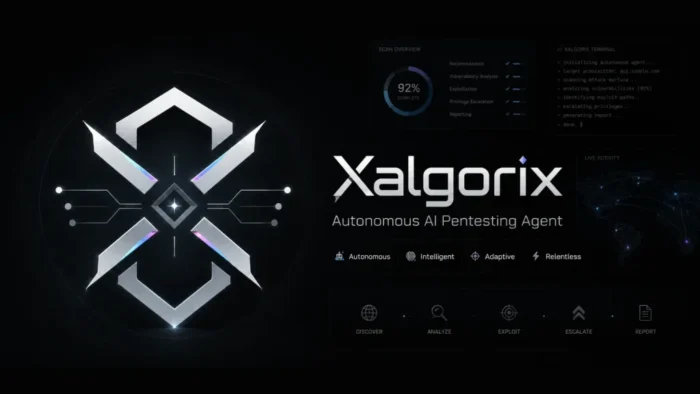
Xalgorix is an open-source, self-hosted penetration testing platform that uses an AI agent to discover vulnerabilities and a separate verification process to test whether each finding can be reproduced.
The platform follows a 22-phase methodology covering reconnaissance, authentication, injection flaws, access control, APIs, cloud infrastructure, exploit verification, and report generation.

Access content across the globe at the highest speed rate.
70% of our readers choose Private Internet Access
70% of our readers choose ExpressVPN

Browse the web from multiple devices with industry-standard security protocols.

Faster dedicated servers for specific actions (currently at summer discounts)
Its main selling point is a verification-first workflow. Xalgorix attempts to reproduce suspected vulnerabilities before marking them as confirmed, although organizations should still require human review before acting on automated findings.
Xalgorix separates vulnerability discovery from verification
Most automated scanners identify patterns that may indicate a vulnerability. Security teams must then determine whether the finding represents a real and exploitable weakness.
Xalgorix uses an autonomous LLM agent for discovery and a separate verifier for exploitation checks. A candidate issue must pass this second stage before the platform labels it as confirmed.
This approach follows a central principle in the OWASP Web Security Testing Guide: security testing should combine structured checks with evidence that demonstrates the actual impact of a weakness.
| Stage | Purpose | Expected output |
|---|---|---|
| Discovery | Identify possible vulnerabilities and attack paths | Candidate findings |
| Analysis | Review context, application behavior, and possible impact | Prioritized test cases |
| Verification | Attempt to reproduce the suspected weakness independently | Proof-of-concept evidence or a manual-review flag |
| Reporting | Document confirmed issues and remediation guidance | Structured penetration testing report |
The platform follows a 22-phase testing methodology
Xalgorix divides an engagement into 22 phases designed to resemble the workflow of a human penetration tester.
Teams can reportedly run the full methodology or select only the phases relevant to the authorized scope. This can help separate web application testing from infrastructure, API, or source-code assessments.
The methodology covers common vulnerability classes included in the OWASP testing framework, along with cloud, WebSocket, CMS, and business logic checks.
| Phase range | Primary focus |
|---|---|
| 1 to 5 | Reconnaissance, file discovery, CORS, cookies, authentication, and session security |
| 6 to 12 | Injection, SSRF, access control, APIs, file uploads, deserialization, RCE, and business logic |
| 13 to 19 | Subdomains, redirects, email security, cloud infrastructure, WebSockets, CMS testing, and broken links |
| 20 | Independent exploit verification |
| 21 | Novel or previously undocumented vulnerability research |
| 22 | Final report generation |
Early phases map the target and its attack surface
The first stages focus on understanding the target before aggressive testing begins.
Reconnaissance may include identifying hosts, technologies, endpoints, directories, files, cookies, cross-origin policies, and authentication flows.
This information gives the AI agent context for later decisions. An endpoint that appears harmless in isolation may become important when combined with a weak session control or an exposed administrative function.
- Domain and subdomain discovery
- Service and port enumeration
- Technology identification
- Directory and file discovery
- Cookie attribute analysis
- Cross-origin resource sharing checks
- Authentication and session mapping
The platform reportedly orchestrates established tools instead of replacing every scanner with an LLM-generated request.
Testing covers injection and server-side flaws
Later phases examine SQL injection, command injection, server-side request forgery, unsafe deserialization, and remote code execution.
These tests require careful controls because successful exploitation can alter data, disrupt services, or provide access to internal systems.
Xalgorix reportedly uses tools such as Nuclei and sqlmap while allowing the AI agent to interpret results and choose follow-up actions. The Nuclei documentation describes its template-based approach to detecting known security conditions.
| Test category | Example risk |
|---|---|
| SQL injection | Unauthorized database access or modification |
| Command injection | Operating system command execution |
| SSRF | Access to internal services or cloud metadata |
| Unsafe deserialization | Code execution or object manipulation |
| File upload | Web shell placement or stored malicious content |
| Remote code execution | Control of the affected application or server |
Xalgorix also looks for access-control failures
Signature-based scans often struggle with business logic and authorization problems because these weaknesses depend on user roles and application context.
Xalgorix claims to reason through insecure direct object references, broken object-level authorization, role boundaries, and multi-step workflows.
An AI agent may compare requests from separate user accounts, modify resource identifiers, and determine whether one user can access another user’s records.
- IDOR and BOLA testing
- Horizontal privilege escalation
- Vertical privilege escalation
- Role and permission comparisons
- Session token handling
- Multi-step business process abuse
- Race condition testing
These checks still require well-defined test accounts and authorization. An automated agent cannot safely infer which user data it may access without an engagement scope.
API and GraphQL testing forms a dedicated stage
Modern applications often expose REST, GraphQL, and internal APIs that carry sensitive business data.
Xalgorix includes API discovery and testing within its methodology. It can reportedly examine authentication, object authorization, input validation, excessive data exposure, and undocumented operations.
The platform may combine crawling with tools such as httpx and Katana to identify reachable endpoints. Nuclei can then apply known checks through the ProjectDiscovery scanning engine.
| API area | Potential weakness |
|---|---|
| Authentication | Missing, weak, or reusable credentials |
| Object authorization | Access to another user’s records |
| GraphQL schema | Exposed types, fields, or administrative operations |
| Rate limits | Brute-force or resource-consumption attacks |
| Input validation | Injection and malformed request handling |
| Response data | Excessive exposure of sensitive information |
Phase 20 verifies candidate vulnerabilities
Phase 20 provides the main distinction between Xalgorix and a conventional scanning pipeline.
The platform sends candidate findings to an independent exploit verifier. The verifier attempts to reproduce the issue without relying only on the discovery agent’s conclusion.
If the verifier succeeds, Xalgorix can include request details, responses, affected endpoints, and proof-of-concept evidence in the report.
- The discovery agent identifies suspicious behavior.
- It records the target, parameters, evidence, and expected impact.
- A separate verifier receives the candidate finding.
- The verifier attempts to reproduce the result.
- Successful tests become confirmed findings.
- Unreproduced results receive a manual-review status.
Verification can reduce false positives, but it cannot guarantee complete accuracy. Timing, permissions, application state, and defensive controls can change test results.
Novel vulnerability discovery remains an ambitious claim
Phase 21 focuses on new or previously undocumented vulnerabilities that do not match existing scanner signatures.
The AI agent may explore unexpected parameter combinations, state transitions, chained weaknesses, and application-specific logic.
However, users should distinguish automated anomaly discovery from confirmation of a zero-day vulnerability. A finding needs technical reproduction, impact analysis, vendor coordination, and independent review before receiving that label.
- Unexpected workflow transitions
- Chained low-severity weaknesses
- Unusual trust relationships
- Application-specific authorization failures
- Input combinations missing from scanner templates
- Inconsistent behavior between similar endpoints
The platform bundles common security tools
Xalgorix is reportedly built with Go and TypeScript and distributed as a standalone binary or Docker image.
Its toolset includes established reconnaissance, crawling, fuzzing, network scanning, and exploitation utilities.
| Tool | Primary use |
|---|---|
| nmap | Network and service discovery |
| masscan | High-speed port scanning |
| subfinder | Passive subdomain discovery |
| httpx | HTTP service probing |
| Katana | Web crawling and endpoint discovery |
| ffuf | Web fuzzing and content discovery |
| Gobuster | Directory, DNS, and virtual-host enumeration |
| Nuclei | Template-based vulnerability checks |
| sqlmap | SQL injection testing |
Bundling the platform inside a container can simplify deployment. Docker notes that containers isolate processes but still require secure configuration, image updates, and controlled access to host resources in its Docker Engine security guidance.
Users can connect their preferred language model
Xalgorix describes a bring-your-own-model architecture rather than tying the platform to one AI provider.
The listed options include OpenAI, Anthropic, Google Gemini, DeepSeek, Groq, Ollama, and MiniMax. Local-model support can help organizations keep prompts and target data inside their own environment.
Self-hosting does not automatically guarantee that no information leaves the network. A cloud-based model provider will still receive prompts sent through its API unless the deployment uses a local model.
| Deployment approach | Data consideration |
|---|---|
| Local model through Ollama | Model prompts can remain inside the organization |
| Cloud LLM API | Prompts and scan context may reach the selected provider |
| Self-hosted Xalgorix with cloud model | Tool data remains local until the platform sends model requests |
| Fully local deployment | Gateway, tools, model, and reports remain under local control |
Organizations should inspect model-provider retention settings, regional processing, contracts, and privacy controls before sending proprietary source code or vulnerability data.
A local dashboard displays testing activity
Xalgorix reportedly provides a web dashboard on local port 9137.
The interface displays scan progress, tool calls, agent decisions, and findings through live WebSocket updates.
Administrators should avoid exposing this interface directly to the internet. Dashboards containing target details, commands, credentials, and vulnerability evidence require authentication and network restrictions.
- Bind the dashboard to localhost or a private management network.
- Require authentication before allowing remote access.
- Place remote access behind a VPN or secured reverse proxy.
- Protect scan logs and proof-of-concept evidence.
- Do not expose port 9137 through a public cloud security group.
Xalgorix supports several testing modes
The platform can reportedly test one application, wildcard scopes, multiple targets, source repositories, and locally provisioned applications.
Wildcard mode can help red teams map a broad attack surface. Source mode examines a repository without requiring a running application.
Provision mode builds and starts an application locally before testing the live instance. This could help development teams validate exploitable weaknesses before deployment.
| Mode | Use case |
|---|---|
| Single target | Test one approved application or host |
| Multi-target | Assess several authorized systems in one engagement |
| Wildcard | Map subdomains and broader attack surfaces |
| Source | Review a code repository directly |
| Provision | Build an application and test the local running instance |
Automated exploitation requires strict safety controls
A tool that attempts to verify vulnerabilities can change data, create accounts, trigger external requests, or interrupt services.
Organizations should use Xalgorix only on systems they own or have explicit permission to test. The testing scope should define approved hosts, accounts, hours, techniques, and data-handling rules.
Container isolation can reduce some operational risks, but it does not protect the target from destructive commands. The Docker security documentation also warns that powerful container privileges and host mounts can weaken isolation.
- Obtain written authorization before starting a scan.
- Define approved IP addresses, domains, and repositories.
- Exclude production actions that may cause damage.
- Use dedicated test accounts and non-production data.
- Set request limits and concurrency controls.
- Review exploit attempts before enabling aggressive phases.
- Preserve logs for audit and incident investigation.
Reports include evidence and remediation guidance
Xalgorix compiles findings into branded PDF reports containing severity details, proof-of-concept evidence, and remediation recommendations.
The project also claims support for CVSS scoring. A score can help with prioritization, but teams must also consider asset importance, exposure, exploitability, and existing controls.
Optional Discord, Telegram, and AgentMail integrations can deliver alerts or reports. Organizations should ensure these channels do not expose credentials, source code, or exploit details to unauthorized recipients.
- Confirmed vulnerability description
- Affected endpoint or component
- Proof-of-concept request and response
- Technical impact
- CVSS severity assessment
- Remediation guidance
- Manual-review findings
Human review remains necessary
Independent verification can reduce false positives, but automated exploitation does not replace an experienced penetration tester.
An AI agent may misunderstand business intent, miss hidden dependencies, use unsafe test inputs, or overstate the impact of a successful response.
Human testers should review confirmed findings, validate business impact, remove sensitive data from reports, and decide whether further testing remains safe.
| Automated platform strength | Human responsibility |
|---|---|
| Rapid reconnaissance | Confirm that every discovered asset belongs to the approved scope |
| Repeated test execution | Assess whether the test may damage production systems |
| Exploit reproduction | Validate business impact and rule out environmental artifacts |
| Report generation | Review accuracy, clarity, and sensitive evidence |
| Suggested remediation | Adapt fixes to the organization’s architecture and risk model |
Xalgorix needs independent evaluation
Xalgorix presents a useful model for automated security testing by separating discovery from exploit verification.
However, organizations need independent benchmarks covering vulnerability coverage, false positives, false negatives, cost, scan duration, and operational safety.
Comparisons with OWASP ZAP, Nuclei, commercial DAST products, and human penetration testers should use the same targets and ground truth. Until such results appear, teams should treat the platform as an additional testing tool rather than a replacement for established security assessments.
FAQ
Xalgorix is a self-hosted, open-source penetration testing platform that uses an AI agent to discover potential vulnerabilities and a separate verifier to reproduce candidate findings.
The methodology covers reconnaissance, authentication, injection testing, access control, APIs, cloud infrastructure, exploit verification, novel vulnerability research, and final reporting across 22 stages.
Xalgorix claims to send candidate findings to a separate exploit verifier. Findings that cannot be reproduced should receive a manual-review status, but human validation remains necessary.
The project describes support for bring-your-own-model deployments, including local models through Ollama. A fully local setup can keep prompts and scan data within the organization’s infrastructure.
Automated exploit verification may modify data or disrupt services. Organizations should use strict scopes, written authorization, test accounts, request limits, and human approval before running aggressive phases against production systems.


Read our disclosure page to find out how can you help VPNCentral sustain the editorial team Read more


Improve this guide


User forum
0 messages