
Apple Sues OpenAI and Former Employees Over Alleged Trade Secret Theft


 8 min. read
  Published on
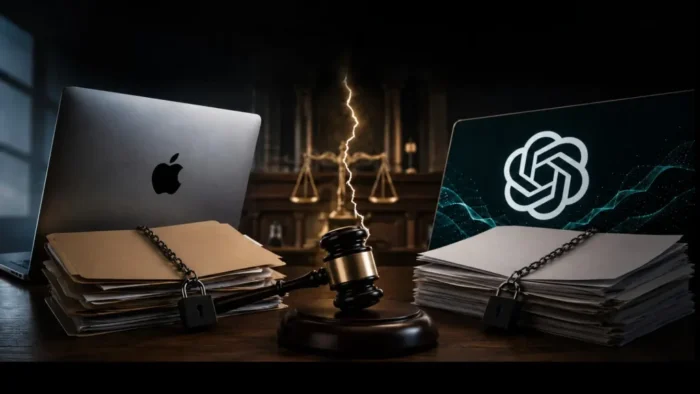
Apple has sued OpenAI and two former employees, accusing them of taking confidential hardware information to support OpenAI’s expansion into consumer devices.
The lawsuit was filed on July 10, 2026, in the U.S. District Court for the Northern District of California. Apple names former employees Tang Yew Tan and Chang Liu alongside OpenAI Foundation, OpenAI Group PBC, and io Products.

Access content across the globe at the highest speed rate.
70% of our readers choose Private Internet Access
70% of our readers choose ExpressVPN

Browse the web from multiple devices with industry-standard security protocols.

Faster dedicated servers for specific actions (currently at summer discounts)
Apple claims OpenAI encouraged a coordinated effort to obtain information about unreleased products, hardware designs, manufacturing methods, testing procedures, and suppliers. OpenAI has denied the allegations, which have not yet been proven in court.
What Apple alleges in the OpenAI lawsuit
Apple’s 41-page federal complaint alleges that OpenAI used recruitment, former employees, and supplier contacts to collect confidential information for its hardware program.
The case is Apple Inc. v. Liu et al., case number 5:26-cv-07078. The court docket lists trade secret misappropriation and breach of contract among Apple’s claims.
Apple argues that the alleged conduct reached multiple levels of OpenAI’s hardware organization. The company says the incidents formed part of an institutional effort rather than a small number of unrelated employee actions.
| Defendant | Position or relationship | Apple’s main allegation |
|---|---|---|
| OpenAI Foundation and OpenAI Group PBC | OpenAI entities | Encouraged or benefited from the alleged collection of Apple trade secrets |
| io Products | Consumer hardware company acquired by OpenAI | Used confidential Apple information while developing new hardware |
| Tang Yew Tan | OpenAI chief hardware officer and former Apple executive | Used Apple knowledge during recruiting and supplier discussions |
| Chang Liu | Former Apple hardware engineer | Retained access and downloaded confidential engineering materials |
Apple’s claims against Tang Yew Tan
Tan worked at Apple for about 24 years before joining io Products and later becoming OpenAI’s chief hardware officer. He previously served as an Apple vice president involved in product design for the iPhone and Apple Watch.
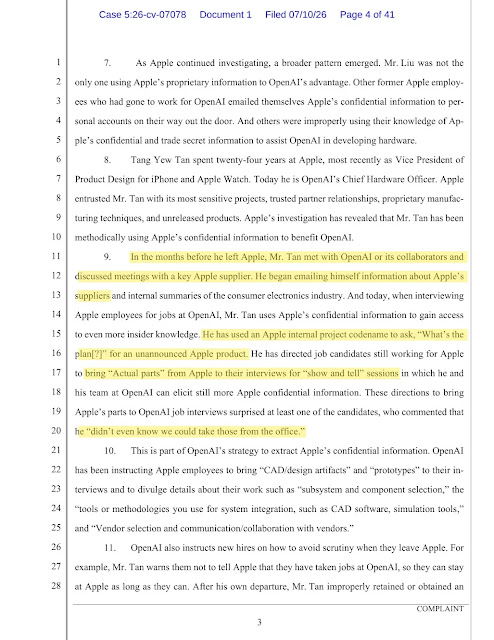
Apple alleges that Tan used internal project names while interviewing current Apple employees. According to the complaint, he asked candidates about unreleased projects and sought details they would have known from their work.
The filing also claims Tan encouraged some candidates to bring physical Apple components to interviews for informal demonstrations. Apple says at least one candidate expressed surprise at the suggestion because employees could not remove those parts from Apple facilities.
Internal security document allegedly reached OpenAI
Apple also accuses Tan of possessing and distributing an internal document that described the company’s departure and security procedures.
The document allegedly explained the checks Apple performs when employees leave, including reviews of company devices and activity involving sensitive data. Apple argues that advance knowledge could help departing workers avoid detection.
According to Reuters’ report on the lawsuit, Apple says OpenAI employs more than 400 former Apple workers. However, the complaint does not accuse every former employee of misconduct.
Former engineer allegedly retained access to Apple systems
The allegations against Chang Liu focus on his handling of Apple data before and after he left the company for OpenAI in January 2026.
Apple claims Liu kept an Apple-issued laptop after his employment ended and continued accessing internal systems. The company says he discovered an authentication weakness that allowed access to network storage.
Rather than reporting the problem, Liu allegedly used it to download confidential files. Apple says the material included hardware engineering records, manufacturing documents, and testing procedures.
Files allegedly included more than 1,000 pages
The complaint says Liu obtained dozens of confidential files, including a compilation exceeding 1,000 pages. Apple describes the material as a detailed record of engineering work conducted inside its hardware organization.
Another presentation allegedly covered manufacturing and testing methods for multilayer main logic boards. These boards contain critical components that control the operation of devices such as smartphones and computers.
Apple also cites messages in which Liu allegedly reacted to his continued access with “LOL” and described the situation as funny. Those messages could become important evidence if the case moves into discovery or trial.
Apple alleges coaching before OpenAI interviews
Apple claims Liu helped another employee prepare for an OpenAI interview by identifying confidential materials to review. He also allegedly discussed ways to remove information without triggering Apple’s security controls.
The company argues that such conduct supports its broader claim that OpenAI’s hiring process encouraged candidates to use knowledge and materials belonging to Apple.
The Associated Press reported that Apple raised concerns with OpenAI before filing the lawsuit. According to the report, OpenAI rejected the suggestion that it wanted Apple’s confidential information.
Supplier relationships form another part of the case
Apple’s allegations extend beyond former employees. The company says OpenAI approached businesses in Apple’s supply chain while developing its planned consumer hardware.
One allegation involves a longtime manufacturing partner and a proprietary metal-finishing technique. Apple claims OpenAI persuaded the supplier to perform the process without authorization.
Apple also alleges that OpenAI contacted a battery and power supplier using terminology learned through former employees. The company says the questions sought details about components developed for Apple products.
- Confidential product and hardware designs
- Manufacturing and metal-finishing techniques
- Main logic board production and testing procedures
- Battery, power, and supplier information
- Internal employee departure and security processes
- Unannounced product plans and project codenames
OpenAI denies seeking Apple’s trade secrets
OpenAI has rejected Apple’s central accusations. The company said it has no interest in using Apple’s trade secrets and plans to defend itself against the lawsuit.
The denial means the court will need to examine whether the former employees took protected information, whether OpenAI knew about it, and whether the information influenced its hardware work.
As the Reuters coverage notes, the dispute represents a major escalation between two companies that previously worked together on ChatGPT integration in Apple products.
OpenAI’s consumer hardware plans raise the stakes
OpenAI has expanded beyond software by acquiring io Products, the hardware company associated with former Apple design chief Jony Ive. The business is developing AI-focused consumer devices.
That expansion puts OpenAI closer to Apple’s core market. Apple argues that the alleged information could reduce development time and help OpenAI recreate processes built through years of research and supplier investment.
The Associated Press report describes the case as a sharp breakdown in a relationship that began when Apple introduced ChatGPT integration in 2024.
What Apple wants from the court
Apple seeks financial damages and a court order preventing the defendants from using or disclosing its confidential information. It also wants relief aimed at stopping any continuing misappropriation.
The Apple complaint includes claims under the federal Defend Trade Secrets Act, California trade secret law, and employment agreements signed by the former workers.
The company has requested a jury trial. The defendants will have an opportunity to respond to each claim, challenge Apple’s evidence, and argue that the disputed information does not qualify as a protected trade secret.
Why the lawsuit matters
The case could shape how technology companies manage employee movement during the competition to build AI devices. Engineers frequently move between major companies, but they cannot take protected documents or disclose former employers’ trade secrets.
Apple must identify the specific information it considers secret and show that it took reasonable steps to protect it. It must also connect the alleged conduct to OpenAI rather than relying only on actions attributed to individual employees.
OpenAI, meanwhile, may argue that its hardware work relies on independent development, general employee experience, or information that does not legally qualify as a trade secret.
What happens next
The defendants will likely file formal responses or ask the court to dismiss some of Apple’s claims. The case may then move into discovery, where both sides can request documents, messages, technical records, and testimony.
Apple may seek forensic evidence showing which files the former employees accessed and whether those files reached OpenAI systems. OpenAI may request evidence explaining how Apple defines and protects each claimed secret.
The Apple Inc. v. Liu docket had only the initial filings when the lawsuit became public. No court has ruled on the accuracy of Apple’s allegations.
FAQ
Apple alleges that OpenAI and two former Apple employees misappropriated confidential hardware, manufacturing, supplier, and security information to support OpenAI’s consumer hardware plans.
Apple named OpenAI Foundation, OpenAI Group PBC, io Products, former Apple executive Tang Yew Tan, and former Apple engineer Chang Liu as defendants.
Apple alleges that trade secret theft occurred, but the claims have not been proven in court. OpenAI denies seeking or using Apple’s confidential information.
Apple alleges that Liu retained an Apple laptop, continued accessing internal storage through an authentication weakness, and downloaded confidential engineering and manufacturing documents.
Apple claims Tan used knowledge of internal projects during recruitment, requested confidential details and hardware components, and shared information about Apple’s employee departure checks.
Apple seeks damages, a jury trial, and court orders preventing the defendants from using or disclosing its alleged trade secrets.


Read our disclosure page to find out how can you help VPNCentral sustain the editorial team Read more


Improve this guide

User forum
0 messages