
KittySploit Combines Local AI Agents, Zig Payloads, and Smart Proxy Tools for Penetration Testing


 6 min. read
  Published on
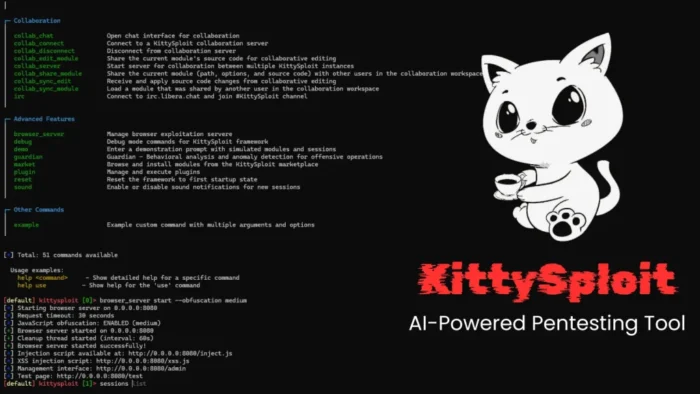
KittySploit is an open-source penetration testing framework that combines AI-assisted attack planning, web traffic analysis, exploitation modules, payload tooling, and post-exploitation features in one platform.
The framework lets security professionals connect a locally running large language model through Ollama. Its autonomous agent can gather reconnaissance data, evaluate available tools, and suggest possible testing paths for an authorized target.

Access content across the globe at the highest speed rate.
70% of our readers choose Private Internet Access
70% of our readers choose ExpressVPN

Browse the web from multiple devices with industry-standard security protocols.

Faster dedicated servers for specific actions (currently at summer discounts)
KittySploit uses a Python-based framework alongside Zig-compiled payload components. It also includes KittyProxy for web traffic inspection, KittyCollab for shared exploit development, and a marketplace for installing additional extensions.
What is KittySploit?
KittySploit describes itself as a next-generation exploitation engine for modern red teams. The KittySploit GitHub repository lists capabilities covering reconnaissance, exploitation, proxy interception, session management, payload generation, pivoting, and post-exploitation activity.
The project follows a modular architecture. Operators can select modules, configure their options, run them against approved systems, and manage resulting sessions through an interactive command-line interface.
Its developers position the framework as a unified alternative to workflows that require separate tools for web testing, payload creation, collaboration, and attack-path planning.
KittySploit’s main capabilities
The framework brings several offensive security components into one environment. Some features belong to the open-source Community edition, while advanced collaboration and hosted services require paid plans.
| Component | Purpose | Availability |
|---|---|---|
| Autonomous agent | Uses a local LLM to organize reconnaissance and suggest testing paths | Open-source framework |
| KittyProxy | Intercepts HTTP and HTTPS traffic, detects technologies, and launches modules | Community and Pro features |
| KittyCollab | Supports collaborative exploit writing and shared workspaces | Primarily Pro and SaaS |
| Zig payload tooling | Builds compact payload and encoder components | Open-source framework |
| Extension marketplace | Distributes community and commercial extensions | Community and paid accounts |
| Web interface | Provides graphical access to proxy, collaboration, and platform functions | Depends on deployment and plan |
Local AI agents can plan penetration testing workflows
KittySploit’s autonomous agent can connect to a local model through Ollama. An operator supplies a target, chooses a compatible model, and allows the agent to assist with reconnaissance and planning.
Running the model locally can reduce the need to send engagement data to an external AI provider. However, organizations still need to review model configurations, logs, prompts, and storage before using the feature with sensitive client information.
Ollama tool support allows compatible models to call functions and interact with external tools. KittySploit uses this type of integration to connect language-model reasoning with security-testing actions.
AI suggestions still require human validation
The agent does not remove the need for experienced penetration testers. Language models can misunderstand evidence, recommend unsuitable modules, or create inaccurate conclusions about a target.
Operators should treat the AI layer as a planning assistant rather than an independent source of verified findings. Every proposed action should remain within the approved scope and receive human review before execution.
The framework’s own development roadmap describes KittySploit 1.x as groundwork for a broader 2.0 platform. This indicates that stability, coverage, and workflow integration remain active development goals.
KittyProxy connects traffic inspection with exploitation modules
KittyProxy acts as an interception and analysis layer for web assessments. The official KittySploit platform page says the proxy can capture HTTP and HTTPS requests, modify and replay traffic, detect technologies, and suggest relevant modules.
The project also advertises support for identifying REST APIs, GraphQL services, and WebSocket connections. These capabilities can help testers map applications that rely heavily on background API traffic.
Operators can launch compatible modules from the proxy interface instead of manually moving request data between unrelated tools. Paid KittyProxy features include AI-assisted request analysis, collaboration, and out-of-band testing support.
Python and Zig serve different roles
Python provides the main framework, module system, interfaces, and orchestration layer. Zig supports selected payload and encoding components where compact binaries and limited dependencies can offer operational advantages.
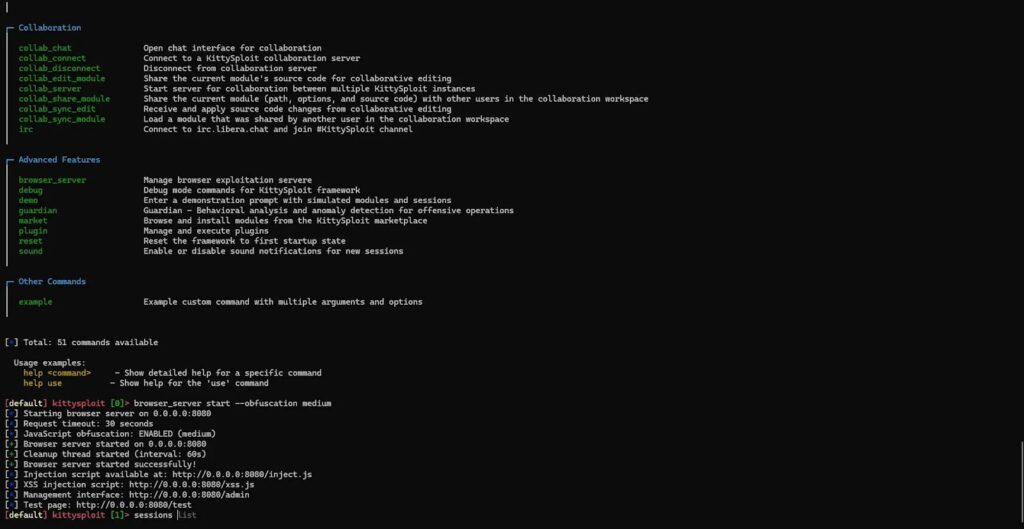
The project says it uses an integrated Zig 0.16 toolchain and provides dependency-free x64 polymorphic encoders. It also advertises obfuscation and multi-protocol session handling intended for testing defensive controls.
These are developer claims rather than evidence that generated payloads will consistently bypass endpoint detection and response products or web application firewalls. Results will vary across targets, security configurations, payloads, and detection systems.
Collaboration and marketplace features
KittyCollab supports shared exploit development through collaborative editing, private repositories, public contributions, team workspaces, and access controls.
The extension marketplace lets users download additional components or publish their own. The project says its team manually reviews marketplace submissions before publication, although users should still inspect third-party code before installation.
The KittySploit pricing and platform information separates the free framework from commercial services. The Community plan includes the GitHub framework and community proxy, while Pro and Enterprise plans add hosted collaboration, reports, integrations, and other platform features.
Open-source licensing and installation
The core KittySploit framework uses the MIT License. The repository provides installation options for Linux, macOS, and Windows.
Users can install the project through its published installation scripts or clone the repository and run the platform locally. Security teams should review installation scripts, dependencies, configuration files, and network permissions before deployment.
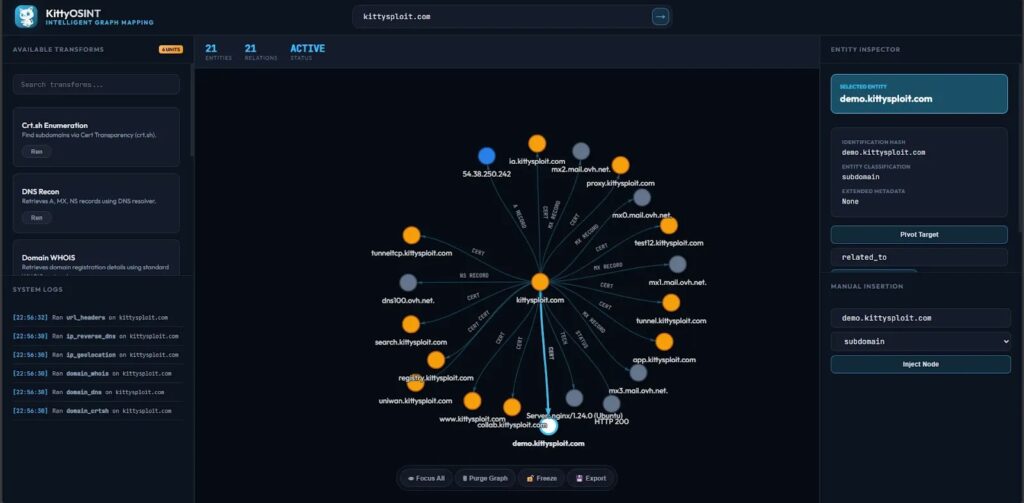
A safe evaluation should take place inside an isolated laboratory or an explicitly authorized testing environment. The framework includes exploitation and post-exploitation functions that can disrupt systems or expose sensitive data when misused.
What security teams should consider
KittySploit combines features that security teams often find across several separate products. Its local AI option, modular structure, smart proxy, and Zig tooling make it an ambitious addition to the open-source penetration testing ecosystem.
Teams evaluating the framework should focus on practical controls rather than feature claims alone. Important checks include:
- Confirm that every target appears in the written testing scope.
- Review AI-generated plans before running any module.
- Restrict the framework to isolated and access-controlled systems.
- Inspect marketplace extensions and installation scripts.
- Record commands, payloads, findings, and operator decisions.
- Test whether local model logs retain sensitive engagement data.
- Validate findings manually before adding them to a client report.
Local models can help preserve data control, but they do not guarantee confidentiality by themselves. Ollama endpoints, model files, prompts, caches, and framework logs still need appropriate protection.
Ollama’s function-calling capabilities also mean connected models can trigger external actions. Administrators should limit available tools and avoid exposing the Ollama service to untrusted networks.
FAQ
KittySploit is an open-source penetration testing framework that combines exploitation modules, local AI-assisted planning, web traffic interception, payload tooling, collaboration features, and post-exploitation workflows.
Yes. KittySploit can connect to locally hosted language models through Ollama. Its agent can assist with reconnaissance, organize results, and suggest possible penetration testing paths.
The core framework is open source under the MIT License. However, some hosted, collaborative, proxy, marketplace, and enterprise features require a paid Pro or Enterprise plan.
The project has a modular architecture and supports additional marketplace extensions. Its current official repository and website do not provide a clearly verifiable total of more than 1,150 modules.
KittyProxy is KittySploit’s web traffic interception component. It can inspect HTTP and HTTPS requests, replay traffic, identify technologies, suggest modules, and launch compatible testing actions from the proxy interface.
Yes. The framework supports local models through Ollama. Local processing can reduce external data sharing, but teams must still secure prompts, logs, caches, model files, and the Ollama endpoint.


Read our disclosure page to find out how can you help VPNCentral sustain the editorial team Read more


Improve this guide


User forum
0 messages