
YubiKey 5.8 Expands Passkeys to Secure AI Workflow Approvals


 7 min. read
  Published on
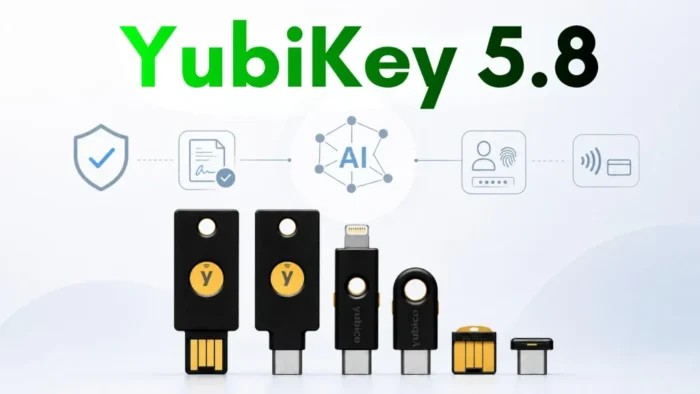
Yubico has launched YubiKey 5.8, extending hardware-backed passkeys beyond account login into digital signatures, enterprise approvals, identity wallets, and payment workflows.
The company announced the firmware on July 21, 2026, describing it as a way to verify both a person’s identity and their approval of a particular action. According to the YubiKey 5.8 announcement, these capabilities could help organizations protect sensitive actions initiated by employees, applications, and autonomous AI agents.

Access content across the globe at the highest speed rate.
70% of our readers choose Private Internet Access
70% of our readers choose ExpressVPN

Browse the web from multiple devices with industry-standard security protocols.

Faster dedicated servers for specific actions (currently at summer discounts)
For example, a company could require an employee to touch a physical YubiKey before an AI agent changes a production database, approves a financial transaction, or completes another high-risk task. The key provides cryptographic evidence tied to a physical device under the authorized user’s control.
YubiKey 5.8 targets verified actions, not only logins
Traditional multi-factor authentication usually confirms identity when someone signs in. It does not always prove that the same person reviewed and approved every sensitive action performed later in the session.
YubiKey 5.8 addresses that gap by supporting hardware-backed authorization inside business workflows. Yubico’s YubiKey 5.8 product overview identifies document approvals, financial transactions, digital identity systems, and human approval of autonomous AI actions as potential uses.
The firmware does not allow a YubiKey to judge whether an AI-generated action is safe. Instead, developers can build workflows that pause selected actions until an authorized person reviews and physically confirms them.
| Capability | Purpose | Possible enterprise use |
|---|---|---|
| Hardware-backed signing | Links approval to a physical security key | Document and workflow authorization |
| Human-in-the-loop confirmation | Requires a person to approve a sensitive action | AI agent and automation controls |
| Enterprise Attestation | Helps organizations identify managed keys | Device enrollment across multiple environments |
| Persistent PIN and UV tokens | Reduces repeated PIN entry for supported operations | Passkey discovery and credential management |
| Secure Payment Confirmation | Provides evidence that a user confirmed payment details | Web payment authorization |
CTAP 2.3 and WebAuthn signing support
YubiKey 5.8 adds support for FIDO CTAP 2.3, the protocol that allows external authenticators to communicate with browsers, operating systems, and applications. The standard includes interoperability, credential-management, and user-experience refinements for modern authenticators.
The firmware also includes preview support for the emerging WebAuthn signing extension. Yubico says this could let developers request digital signatures from a hardware key through familiar web authentication patterns instead of building a separate signing system around custom cryptographic infrastructure.
However, developers should treat this capability as experimental. The Yubico SDK documentation labels the related previewSign and Asynchronous Remote Key Generation code as experimental and warns that its examples do not provide production cryptographic guidance.
How YubiKey 5.8 could control AI agent actions
Organizations increasingly use AI agents to handle operational tasks, analyse records, prepare transactions, and make changes across connected systems. These tools can act faster than conventional approval processes, which creates additional risk when an action affects money, infrastructure, or sensitive data.
Developers could use YubiKey 5.8 to add a mandatory human checkpoint before an agent completes selected actions. The process may require a user to review the request and touch the security key, producing hardware-backed confirmation that the approval came from an authorized person.
The official release lists AI-driven workflow approvals alongside document signing and digital wallets. Actual protection will still depend on how each organization designs its approval policy, displays transaction details, and validates the resulting signature.
- Approve a production database or infrastructure change proposed by an AI agent.
- Confirm a high-value payment before financial software submits it.
- Authorize access to regulated medical, financial, or government records.
- Sign a document after reviewing its contents and intended recipient.
- Confirm an identity-wallet or verifiable-credential operation.
Enterprise Attestation expands to 16 RP IDs
YubiKey 5.8 increases Enterprise Attestation support to 16 Relying Party IDs on one key. A Relying Party ID identifies the website or service associated with a WebAuthn credential.
The higher limit can help large organizations identify and manage the same physical key across development, testing, staging, and production systems. It can also support businesses that operate several identity providers or separate authentication domains.
Yubico says the expanded capacity supports device-level identification across approved services while retaining privacy boundaries outside those environments. The company’s firmware overview positions this change as an enterprise deployment and lifecycle-management improvement.
Persistent tokens aim to reduce repeated PIN prompts
Another addition involves Persistent PIN/User Verification Auth Tokens, commonly called PPUATs. Supported applications can use these longer-lived tokens for certain credential-discovery and read-only management operations.
This can make passkeys stored on a security key easier to find alongside software passkeys. It may also reduce repeated PIN requests when users move between supported applications during the same workflow.
The feature does not remove verification from sensitive operations. Deleting a passkey or authenticating with one can still require a PIN, biometric check, or physical interaction, depending on the application and its security policy. The Yubico SDK release notes also show that platforms and applications need compatible software to use individual firmware capabilities.
Digital wallets and secure web payments
YubiKey 5.8 also supports development around digital identity wallets, verifiable credentials, and privacy-preserving cryptography. These technologies could let users prove selected facts about themselves without exposing more personal information than a transaction requires.
For payments, Yubico highlights Secure Payment Confirmation. The W3C specification defines SPC as a web API designed to provide cryptographic evidence that a user confirmed specific transaction details.
SPC remains a developing web standard, and browser support will influence where organizations can deploy it. The current Secure Payment Confirmation document carries Candidate Recommendation Draft status, so developers should check implementation support before planning a production rollout.
Existing YubiKeys cannot receive the new firmware
YubiKey 5.8 is shipping on newly manufactured devices across the YubiKey 5 Series, YubiKey Bio Series, and Security Key Series. The FIPS Series and Common Criteria Netherlands Series remain on firmware 5.7.4 while certification work continues.
Existing YubiKeys cannot download or install firmware 5.8. Yubico programs firmware at its facilities, and its firmware documentation states that the company cannot alter or remove the firmware after programming a key.
Customers who need the new authorization, signing, or credential-discovery features must obtain a key manufactured with version 5.8. Buyers should therefore verify the firmware version before ordering, especially when purchasing through resellers holding older inventory.
What enterprises should evaluate before deployment
YubiKey 5.8 gives security teams additional tools for protecting high-risk digital actions, but the firmware does not create a complete approval system by itself. Applications must support the relevant protocols and clearly show users what they are authorizing.
Organizations should also decide which actions require physical confirmation, how they will register backup keys, and how administrators will recover access after a lost or damaged device. Logging and policy enforcement remain important for investigating unauthorized or disputed actions.
Finally, security teams should distinguish established authentication functions from preview signing capabilities. Yubico’s technical manual can help organizations compare firmware-dependent features, supported form factors, and deployment requirements before purchasing new keys.
FAQ
YubiKey 5.8 is new firmware installed on recently manufactured YubiKeys. It adds CTAP 2.3 support, preview WebAuthn signing capabilities, expanded Enterprise Attestation, and improvements for passkey discovery and authorization workflows.
No. Yubico does not allow firmware upgrades on existing YubiKeys. Customers need a newly manufactured key that already contains firmware 5.8.
Developers can build workflows that require an authorized person to review and physically confirm a sensitive action initiated by an AI agent. The YubiKey provides hardware-backed cryptographic evidence of that confirmation.
Yubico currently presents the WebAuthn signing extension and related ARKG functionality as developer previews. Organizations should evaluate them experimentally and avoid treating example code as production cryptographic guidance.
Yubico is shipping firmware 5.8 across the YubiKey 5 Series, YubiKey Bio Series, and Security Key Series. The FIPS and CCN product lines remain on firmware 5.7.4 during certification work.


Read our disclosure page to find out how can you help VPNCentral sustain the editorial team Read more


Improve this guide
User forum
0 messages