
Private Internet Access VPN Review: Customizable, Private, and Open Source


 18 min. read
  Published on
Private Internet Access is a highly customizable VPN with unlimited device connections, open-source apps, RAM-only servers, and a no-logs policy reviewed three times by Deloitte.
PIA works especially well for users who want control over VPN protocols, encryption, ports, DNS, split tunneling, automation, and connection routing. Beginners can ignore most of these settings and connect with one click.

Access content across the globe at the highest speed rate.
70% of our readers choose Private Internet Access
70% of our readers choose ExpressVPN

Browse the web from multiple devices with industry-standard security protocols.

Faster dedicated servers for specific actions (currently at summer discounts)
Its main disadvantages include US jurisdiction, no permanent free plan, and an interface that can feel technical. However, its privacy evidence, advanced tools, and competitive long-term pricing make it one of the strongest VPNs for experienced users.
Private Internet Access review summary
Private Internet Access, commonly known as PIA, launched in 2010. It now supports Windows, macOS, Linux, Android, iPhone, iPad, browsers, smart televisions, and compatible routers.
One subscription covers unlimited devices. Users also receive WireGuard and OpenVPN support, two kill-switch modes, split tunneling, proxy-based multi-hop, port forwarding, automation rules, and the MACE ad and tracker blocker.
The official PIA feature list confirms that the standard subscription includes the full VPN network and its main privacy features rather than reserving them for a more expensive tier.
| Category | Private Internet Access details |
|---|---|
| Best for | Advanced users, large households, torrenting, and customizable privacy |
| Device limit | Unlimited simultaneous connections |
| Server coverage | 91 countries and more than 140 locations |
| US coverage | Servers in all 50 states |
| Protocols | WireGuard and OpenVPN, plus IKEv2 on iOS |
| Server infrastructure | RAM-only servers with 10 Gbps connections |
| Open-source software | Publicly available app source code |
| Jurisdiction | United States |
| Parent company | Kape Technologies |
| Money-back guarantee | 30 days for eligible new subscriptions |
What we like about PIA
PIA gives users more technical control than most consumer VPN services. You can modify encryption, protocol, port, packet size, DNS, proxy, automation, and routing settings.
Unlimited simultaneous connections also provide excellent value for households with many phones, computers, tablets, streaming devices, and smart televisions.
The service supports its privacy claims with independent assessments, open-source apps, transparency reports, RAM-only infrastructure, and previous court cases in which it said it had no activity logs to provide.
- Unlimited simultaneous connections
- Open-source desktop and mobile apps
- Three Deloitte no-logs assessments
- RAM-only VPN servers
- Advanced split tunneling
- Standard and advanced kill switches
- WireGuard and configurable OpenVPN support
- Port forwarding on supported locations
- Cryptocurrency and gift-card payment options
What we do not like about PIA
PIA operates from the United States, a member of the Five Eyes intelligence-sharing alliance. Some privacy-conscious customers prefer a provider based outside this group.
The company says it cannot provide VPN activity records because it does not collect them. Its independent assessments support that claim, but legal jurisdiction still remains a valid consideration.
PIA’s large number of settings may also overwhelm beginners. The default configuration works without adjustment, but several competitors provide cleaner and more approachable interfaces.
- No permanent free plan
- US legal jurisdiction
- Advanced settings may confuse beginners
- MACE cannot block every type of advertisement
- Dedicated IP and antivirus cost extra
- Some server locations use virtual placement
- Port forwarding is unavailable on some servers
How much does Private Internet Access cost?
PIA offers monthly, annual, and multi-year subscriptions. Every plan includes the same VPN features, unlimited device connections, and access to the complete server network.
The monthly plan costs $11.95. The current annual offer costs $3.33 per month, billed at $39.95 for the first year. PIA’s long-term promotion costs $2.03 per month for three years plus three extra months.
The current PIA plans state that the multi-year subscription renews at $79 every three years. Promotional offers can change, so customers should check the total payment and renewal terms before subscribing.
| Subscription | Current advertised price | Renewal |
|---|---|---|
| One month | $11.95 per month | $11.95 each month |
| One year | $3.33 per month, billed at $39.95 | Current renewal amount shown during checkout |
| Three years plus three months | $2.03 per month | $79 every three years |
All eligible new subscriptions include a 30-day money-back guarantee. Purchases made through an app store may follow Apple or Google’s separate refund rules.
Optional dedicated IP and antivirus
PIA sells dedicated IP addresses and antivirus protection separately. Customers do not need either add-on to use the main VPN service.
A dedicated IP assigns one VPN address to a single customer. It may reduce CAPTCHAs and verification prompts, but it offers less crowd-based anonymity than a shared address used by many subscribers.
PIA Antivirus provides malware protection for compatible Windows devices. Customers who already use another reputable security suite may not need the additional subscription.
Unlimited simultaneous device connections
PIA allows unlimited personal devices to connect at the same time. You do not need to disconnect a phone before protecting a laptop, tablet, television, or another computer.
This policy makes PIA attractive for large households. A single subscription can protect devices belonging to several family members without imposing a numerical connection limit.
Unlimited connections remain subject to PIA’s terms of service. The company provides them for personal use rather than account resale or large commercial deployments.
PIA server network and locations
PIA currently says its server network covers 91 countries and more than 140 locations. It also operates locations in every US state.
The provider does not publish a dependable total server count. This is not necessarily a disadvantage because companies count physical servers, virtual machines, and available IP addresses differently.
Its server network information confirms that PIA uses RAM-only infrastructure and 10 Gbps server connections.
| Server feature | What it means |
|---|---|
| 91-country coverage | Users can obtain IP addresses across major global regions |
| More than 140 locations | Some countries provide several regional choices |
| All 50 US states | US users can choose a nearby state-level location |
| RAM-only servers | Servers do not depend on hard drives for persistent VPN data |
| 10 Gbps connections | Server infrastructure supports substantial aggregate traffic |
| Virtual locations | Some IP locations differ from the physical server location |
Are PIA servers RAM-only?
PIA says its VPN network runs on RAM-only servers. These machines do not store operational VPN information on traditional hard drives.
RAM loses its contents when a server shuts down or restarts. This design limits the amount of information that could survive on an individual machine.
RAM-only infrastructure still requires secure configuration, access controls, monitoring, and software management. It supports a no-logs policy but does not replace other security measures.
Physical and virtual server locations
A physical location means the VPN hardware sits in the country shown in the app. A virtual location provides an IP address associated with one country while the server operates elsewhere.
Virtual locations allow PIA to provide IP coverage in countries where operating physical hardware would create legal, security, or infrastructure problems.
PIA identifies these locations in its applications. Users who need a specific physical route should check the location indicator before connecting.
PIA speed and performance
PIA can provide fast connections, especially when users select a nearby WireGuard server. Performance depends on server distance, local internet quality, network demand, protocol, and device hardware.
Every VPN adds encryption and routing overhead. Users should expect at least a small reduction compared with their normal internet speed.
Distant servers usually increase latency because traffic must travel farther. The nearest server or the app’s automatic selection offers the best starting point for browsing, gaming, video calls, and downloads.
Can PIA improve internet speed?
A VPN does not normally make an internet connection faster. Encryption and additional routing usually reduce speed or increase latency.
PIA may help when an internet provider selectively throttles a recognisable category of traffic. VPN encryption can make it harder for the provider to classify the activity.
It cannot remove a data cap, repair weak Wi-Fi, improve a damaged line, or overcome congestion affecting the entire internet connection.
Is PIA good for gaming?
PIA can hide a player’s public IP address and reduce exposure to direct denial-of-service attacks. It may also provide access to servers in another region where the game permits it.
A VPN rarely lowers latency below a good direct connection. It only improves ping when the VPN route avoids an inefficient path used by the internet provider.
- Select the closest PIA server.
- Use WireGuard for lower protocol overhead.
- Avoid multi-hop while gaming.
- Close downloads and background updates.
- Compare latency with and without the VPN.
- Follow the game publisher’s regional rules.
WireGuard and OpenVPN support
PIA uses WireGuard and OpenVPN as its primary protocols. Its iOS application also supports IKEv2.
WireGuard provides fast connection establishment, modern cryptography, and efficient performance. It suits everyday browsing, streaming, gaming, and large downloads.
OpenVPN offers more configuration options. Users can choose between TCP and UDP, adjust encryption, and select ports that may work better on restrictive networks.
| Protocol | Main strength | Recommended use |
|---|---|---|
| WireGuard | Speed and efficiency | Browsing, streaming, gaming, and downloads |
| OpenVPN UDP | Security with good performance | General privacy and everyday use |
| OpenVPN TCP | Connection reliability | Networks that block or disrupt VPN traffic |
| IKEv2 | Fast reconnection | Supported iPhone and iPad connections |
Adjustable OpenVPN encryption
PIA lets advanced users adjust OpenVPN encryption and authentication settings. Options include AES-128 and AES-256 configurations.
AES-128 requires less processing and remains secure for general VPN use. AES-256 provides a wider security margin but may create slightly more overhead on older devices.
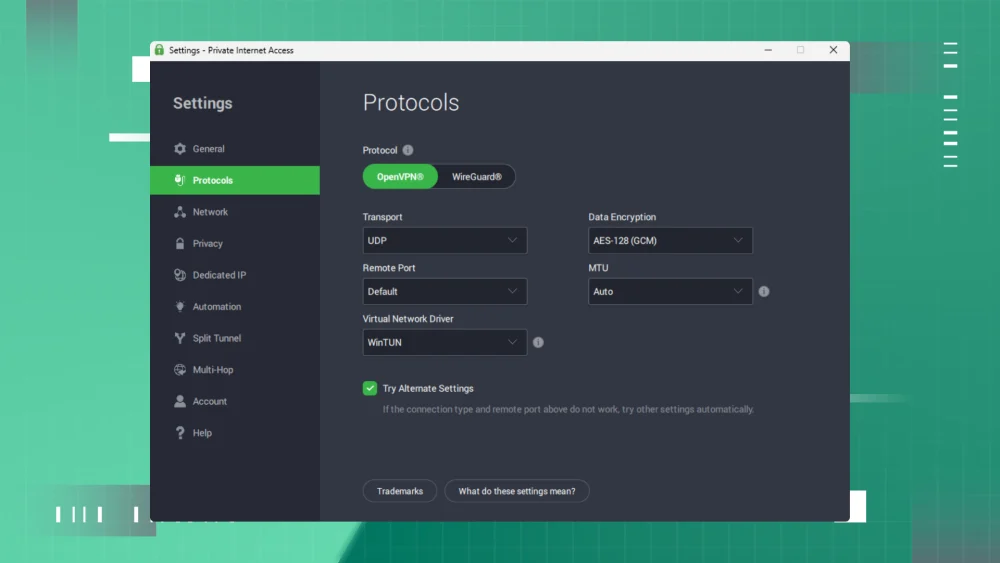
Most customers should use the recommended defaults. Manual changes make sense when the user understands the compatibility and security effects.
Are PIA apps open source?
Yes. PIA publishes the source code for its desktop and mobile applications. Researchers can inspect how the apps handle connections, encryption, permissions, and user settings.
The PIA open-source software page links to its public application repositories.
Open-source software does not guarantee flawless security. It improves transparency by allowing outside inspection, but its value depends on reviews, secure builds, maintenance, and timely updates.
Is PIA’s entire platform open source?
No. PIA publishes its customer application code, while WireGuard and OpenVPN also use open-source code. This does not mean every internal service, server setting, management system, or business process is public.
The distinction matters. Public app code lets researchers inspect the software installed on users’ devices, while audits provide evidence about server-side controls.
The public PIA repositories improve transparency without exposing every component of the company’s infrastructure.
PIA no-logs policy
Private Internet Access says it does not retain browsing history, DNS queries, original IP addresses, traffic destinations, bandwidth records, or connection timestamps associated with VPN use.
The company still processes limited information required to run subscriptions. This can include account details, payment records, and customer-support communications.
A no-logs policy does not mean the company collects no information. It means PIA says it does not store VPN activity that could reconstruct what a customer did while connected.
PIA completed its third Deloitte assessment
Deloitte Audit Romania has independently assessed PIA’s no-logs controls three times. The third review examined controls operating during 2025 and concluded in February 2026.
The third Deloitte assessment examined PIA’s VPN configuration, management systems, and token-based dedicated IP technology under ISAE 3000.
Deloitte reported that the tested controls matched PIA’s stated privacy commitments during the assessment period. An audit does not guarantee that a future breach, configuration error, or policy change cannot occur.
| Privacy evidence | What it provides |
|---|---|
| Deloitte assessments | Independent examination of no-logs controls |
| Transparency reports | Statistics about legal and government requests |
| Open-source apps | Public inspection of application code |
| RAM-only servers | Reduced persistent storage on VPN machines |
| Court cases | Historical examples in which PIA said it had no logs to provide |
| Bug bounty programme | A formal process for reporting vulnerabilities |
What the third audit means for users
The third review adds recent independent evidence that PIA configured its systems in line with its no-logs policy during the period Deloitte examined.
The PIA audit announcement says Deloitte reviewed its server configurations, management systems, and dedicated IP controls.
Customers should still reassess any VPN periodically. Ownership, software, privacy policies, infrastructure, and internal processes can change after an audit ends.
PIA privacy and US jurisdiction
Private Internet Access operates under US law. Authorities can serve valid legal demands on the company, and PIA must respond according to applicable law.
The practical question concerns the information PIA possesses. The company says its systems do not retain browsing or VPN connection activity that it could provide.
Users facing exceptional legal or political risks may still prefer another jurisdiction. Most customers should consider jurisdiction alongside technical architecture, audit results, ownership, and data-handling policies.
Who owns Private Internet Access?
Kape Technologies owns Private Internet Access. The same company also owns ExpressVPN, CyberGhost VPN, Intego, and other security and publishing businesses.
The Kape Technologies portfolio lists PIA as one of its major digital privacy brands.
Kape previously operated under the name Crossrider. Its earlier software distribution platform faced criticism because some outside developers used it to distribute unwanted advertising software.
Does PIA share servers with other Kape VPNs?
PIA says its VPN infrastructure remains separate from other Kape-owned services. Common ownership does not automatically mean PIA, ExpressVPN, and CyberGhost use the same apps, accounts, servers, or privacy policies.
Corporate ownership can still influence strategy, investment, leadership, and long-term product decisions. Customers should consider this relationship when evaluating the provider.
The Kape brand list confirms the ownership relationship but does not indicate that customers connect through one combined VPN network.
PIA kill switch
The standard kill switch blocks internet traffic when an active VPN connection drops unexpectedly. It reduces the chance of applications exposing the normal public IP address.
The advanced kill switch blocks all internet access unless the PIA app maintains a VPN connection. This stricter mode suits users who never want traffic to leave outside the encrypted tunnel.
| Kill-switch mode | Behaviour |
|---|---|
| Off | Internet traffic continues when the VPN disconnects |
| Standard | Blocks traffic after an unexpected VPN interruption |
| Advanced | Blocks internet access unless PIA remains connected |
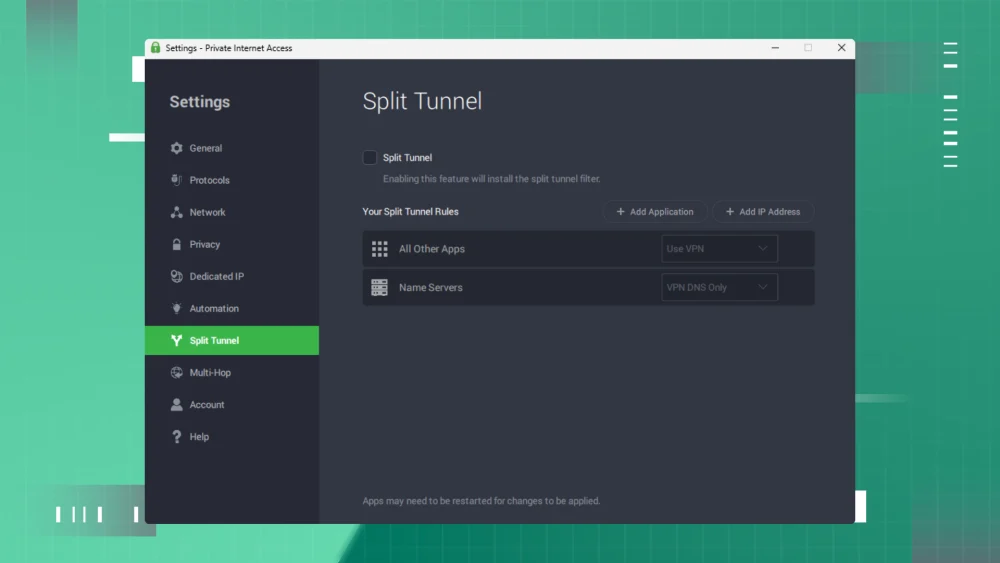
Advanced split tunneling
Split tunneling lets users decide which applications or destinations use PIA. Other traffic connects directly through the normal internet connection.
PIA supports application rules and, on compatible platforms, routing rules for specific IP addresses. This offers more control than a basic application exclusion list.
A user could route a browser and torrent client through PIA while allowing a printer tool, banking app, or local streaming service to connect directly.
When should you use split tunneling?
Split tunneling helps when an application blocks VPN addresses or needs direct access to devices on the local network.
It can also reduce VPN bandwidth use. However, excluded traffic loses the IP masking and encrypted VPN route provided by PIA.
- Exclude local printers and network storage.
- Use direct access for banking apps that reject VPN addresses.
- Keep sensitive browsers inside the VPN tunnel.
- Route torrent software through PIA.
- Review the rules after installing new applications.
- Avoid excluding sensitive traffic without a clear reason.
How PIA’s multi-hop feature works
PIA routes multi-hop connections through a Shadowsocks or SOCKS5 proxy before sending them to the VPN server.
This differs from a traditional double-VPN configuration that routes traffic through two complete VPN servers. The proxy adds obfuscation but does not create a second full layer of VPN encryption.
Multi-hop can make VPN use less obvious on restrictive networks. It also adds extra distance and processing, so users should expect lower speeds and higher latency.
PIA MACE ad and tracker blocker
MACE blocks connections to domains associated with advertising, tracking, and malicious activity. It works through DNS filtering rather than removing every visible element from a page.
The feature can stop many banners, trackers, and malicious domains. Blocking these connections may also reduce the amount of data a website loads.
MACE cannot block every advertisement. Ads delivered from the same domain as wanted content, including many video advertisements, may remain visible.
PIA port forwarding
PIA supports port forwarding on selected servers outside restricted regions. The feature opens an inbound port through the VPN connection.
It can improve connectivity for peer-to-peer software, self-hosted applications, and other tools that accept incoming connections.
Port forwarding can increase exposure when an application listening on the port contains a vulnerability. Users should enable it only when required.
Is PIA good for torrenting?
PIA supports peer-to-peer traffic and offers unlimited bandwidth, port forwarding, split tunneling, a kill switch, and an independently assessed no-logs policy.
These features make it a strong VPN for lawful torrenting. Users should enable the kill switch and confirm that the torrent client uses the VPN adapter.
A VPN does not make copyright infringement legal. Customers remain responsible for following local laws and respecting content ownership.
PIA on public Wi-Fi
PIA encrypts internet traffic between the device and its VPN server. This reduces exposure to other people on a shared hotel, airport, café, or train network.
The VPN cannot make an unsafe website trustworthy or stop every phishing, malware, or account-takeover attack.
Users should still install security updates, enable multifactor authentication, check website addresses, and avoid opening suspicious files.
PIA for online banking
A VPN can protect traffic from local network monitoring. Modern banking apps and websites already use HTTPS, while PIA adds encryption around the wider connection.
A distant VPN location can trigger a bank’s fraud controls. Banks may flag unfamiliar IP addresses, countries, devices, and login behaviour.
Use a nearby server and open the bank through its official app or saved address. A VPN cannot protect users who enter their details on a phishing website.
PIA for remote work
PIA can secure general internet traffic on shared networks, but it does not automatically provide access to an employer’s private systems.
A company may require a separate corporate VPN, zero-trust access client, or managed security tool. Employees should follow workplace policies rather than replace an approved service with a consumer VPN.
PIA can still protect personal browsing and general internet traffic when the employer permits its use.
Can PIA bypass censorship?
PIA can help users reach websites blocked by a local network or internet provider. Results depend on the country, protocol, and blocking method.
Restrictive networks can block known VPN addresses, protocols, websites, and application stores. PIA’s proxy-based multi-hop and configurable OpenVPN settings may help in some cases.
No provider can guarantee access in every country. Users should understand local laws before attempting to bypass government restrictions.
PIA streaming performance
PIA provides streaming-optimized locations for several countries and platforms. These locations aim to offer more reliable access than a random server.
Streaming companies regularly block VPN addresses. A server that works today may stop working after the platform updates its blocklist.
Users can try a streaming-labelled location, clear old cookies, or select another supported server when a platform rejects the first connection.
Supported PIA apps
Private Internet Access provides applications for major desktop, mobile, browser, television, and router platforms.
| Platform | Availability |
|---|---|
| Windows | Native open-source app |
| macOS | Native open-source app |
| Linux | Graphical desktop app |
| Android | Phone, tablet, and compatible television app |
| iPhone and iPad | Native iOS and iPadOS app |
| Browsers | Chrome, Firefox, and Opera extensions |
| Smart televisions | Apps for supported television platforms |
| Routers | Manual configuration on compatible firmware |
Is Private Internet Access easy to use?
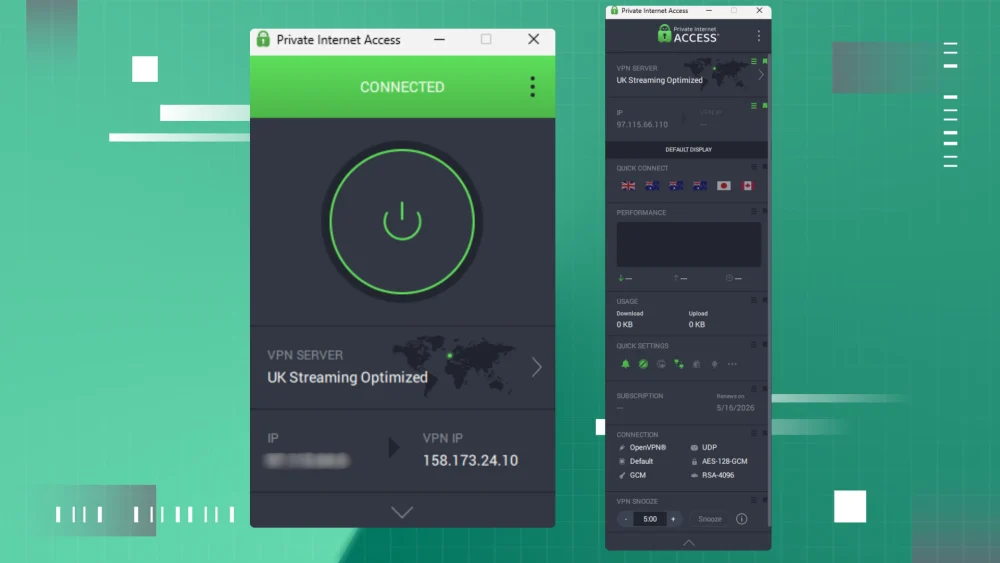
PIA’s main connection screen remains simple despite the number of settings. Users can select a location and press the power button without changing anything else.
Expandable panels display latency, protocol, performance, subscription status, quick settings, and connection information.
Advanced users can adjust encryption, DNS, automation, split tunneling, multi-hop, ports, and kill-switch behaviour through the settings menu.
Private Internet Access security
PIA combines modern protocols, strong encryption, private DNS, kill switches, RAM-only servers, and open-source apps.
Users should install updates promptly and avoid changing encryption or DNS settings without understanding the consequences.
The PIA privacy and security features protect against network monitoring, but they cannot replace antivirus software, safe browsing, strong passwords, and multifactor authentication.
Who should choose PIA?
PIA makes sense for users who want control over VPN encryption, protocols, DNS, applications, proxies, ports, and network routing.
It also suits large households because the subscription allows unlimited simultaneous connections. Torrent users may value its kill switch, split tunneling, and port-forwarding support.
People who prefer open-source apps and recent independent privacy assessments will also find more supporting evidence than many VPN providers offer.
Who should avoid PIA?
Users who refuse to use a VPN under US jurisdiction should consider another provider.
Anyone seeking a permanent free VPN will also need an alternative. PIA offers a 30-day refund period rather than an ongoing free plan.
Beginners who do not want encryption, protocol, DNS, port, and proxy controls may prefer a simpler VPN interface.
Private Internet Access verdict
Private Internet Access remains one of the most customizable consumer VPNs. It combines unlimited connections, open-source apps, RAM-only servers, split tunneling, port forwarding, multi-hop, and flexible kill-switch controls.
Its three Deloitte assessments provide recent evidence supporting the no-logs policy. Its long operating history and transparency efforts add further credibility.
US jurisdiction and Kape Technologies ownership deserve consideration, but PIA still earns a strong recommendation for customers who value advanced controls, privacy evidence, and competitive long-term pricing.
FAQ
Yes. Private Internet Access offers open-source apps, unlimited connections, RAM-only servers, advanced split tunneling, strong protocol controls, and a no-logs policy assessed three times by Deloitte.
Kape Technologies owns Private Internet Access. Kape also owns ExpressVPN, CyberGhost VPN, Intego, and other digital privacy and security brands.
PIA says it does not store browsing history, DNS queries, original IP addresses, traffic destinations, bandwidth records, or VPN connection timestamps. Deloitte has independently assessed its no-logs controls three times.
PIA publishes the source code for its customer VPN applications. Its WireGuard and OpenVPN protocols are also open source, but not every internal service or server configuration is publicly available.
Private Internet Access allows unlimited simultaneous personal device connections under one subscription.
PIA currently advertises VPN servers in 91 countries and more than 140 locations, including locations in all 50 US states.
Yes. PIA supports peer-to-peer traffic and provides unlimited bandwidth, a kill switch, split tunneling, port forwarding on supported servers, and an independently assessed no-logs policy.
No. PIA does not provide a permanent free plan. Eligible new subscriptions include a 30-day money-back guarantee.


Read our disclosure page to find out how can you help VPNCentral sustain the editorial team Read more


Improve this guide
User forum
0 messages