
Is Glacier Bancorp Stock Undervalued After Q2 Earnings?


 8 min. read
  Published on
Glacier Bancorp shares have fallen since the company reported its second-quarter 2026 results, leaving investors with a mixed valuation picture. The regional bank delivered strong earnings growth, a wider net interest margin, and continued loan expansion. However, its price-to-earnings ratio still sits above the level of many banking peers.
GBCI traded at around $49 on July 29, 2026, giving the company a market value of approximately $6.4 billion. At that price, the stock traded at roughly 23 times trailing earnings, which does not immediately suggest a conventional value opportunity.

Access content across the globe at the highest speed rate.
70% of our readers choose Private Internet Access
70% of our readers choose ExpressVPN

Browse the web from multiple devices with industry-standard security protocols.

Faster dedicated servers for specific actions (currently at summer discounts)
However, the latest results show that earnings are improving quickly. This means the trailing P/E ratio may overstate the stock’s valuation if Glacier Bancorp can maintain its current profitability, margin expansion, and loan growth.
Glacier Bancorp delivered strong Q2 earnings growth
Glacier Bancorp reported net income of $97.9 million for the second quarter of 2026. That represented a 19% increase from the previous quarter and an 85% increase from the same period in 2025, according to the company’s second-quarter earnings release.
Diluted earnings per share reached $0.75, compared with $0.63 in the first quarter and $0.45 one year earlier. Operating diluted earnings per share came in at $0.76, matching the consensus estimate cited before the report.
The company formally disclosed the results in a Form 8-K filed with the US Securities and Exchange Commission on July 23.
| Q2 2026 metric | Result | Change |
|---|---|---|
| Net income | $97.9 million | Up 85% year over year |
| Diluted EPS | $0.75 | Up 67% year over year |
| Operating diluted EPS | $0.76 | Up 33% year over year |
| Net interest income | $276 million | Up 33% year over year |
| Net interest margin | 3.90% | Up 69 basis points year over year |
| Loan portfolio | $21.36 billion | Up 15% year over year |
Improving margins support the valuation case
The strongest part of Glacier Bancorp’s report was its net interest margin. The tax-equivalent margin rose to 3.90%, up from 3.80% in the first quarter and 3.21% one year earlier.
This marked the company’s tenth consecutive quarter of net interest margin expansion. Glacier benefited from higher loan yields, lower deposit costs, and reduced reliance on expensive wholesale funding.
Total funding costs fell to 1.33%, compared with 1.40% in the previous quarter and 1.63% a year earlier. This helped net interest income rise to $276 million, based on figures in the official Q2 2026 results.
- Loan yields increased from the previous year.
- Core deposit costs fell to 1.18%.
- Higher-cost borrowings declined.
- Net interest income increased by $68.8 million year over year.
- The efficiency ratio improved to 56.65%.
GBCI still trades at a premium earnings multiple
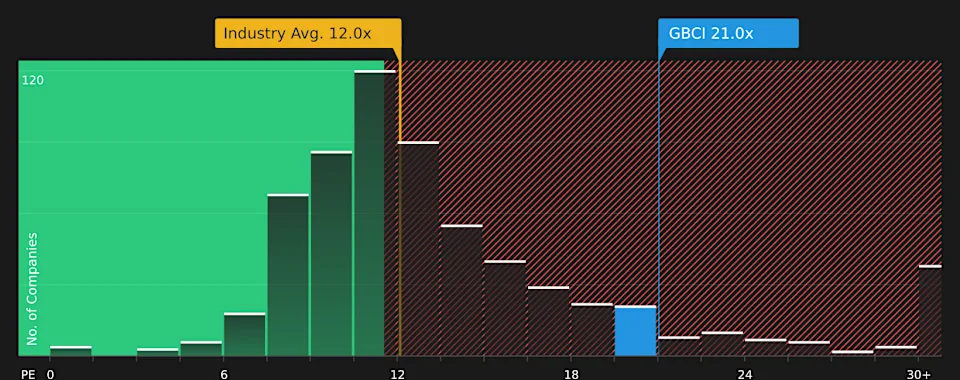
Despite the earnings improvement, Glacier Bancorp does not look inexpensive when measured only through its trailing P/E ratio. At around $49 per share, the stock traded at approximately 23 times trailing earnings on July 29.
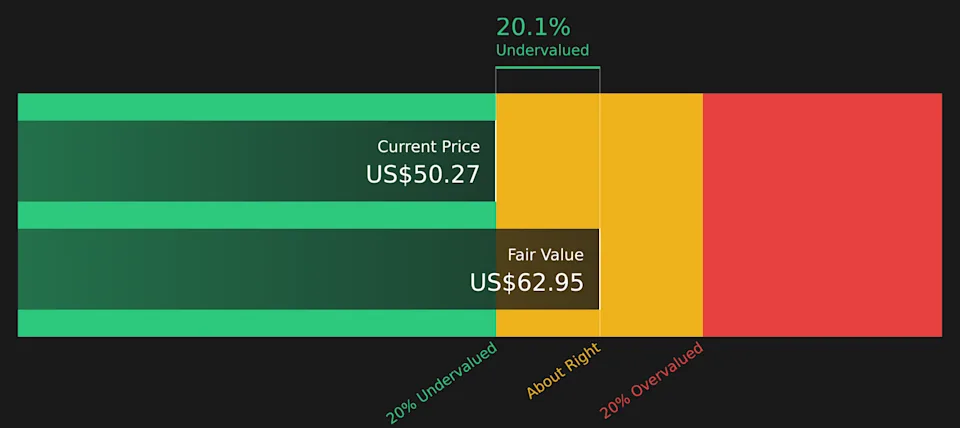
That valuation remains higher than the multiples commonly attached to many regional and community banks. Investors appear willing to pay a premium for Glacier’s earnings momentum, acquisition strategy, deposit franchise, and consistent dividend history.
The latest GBCI share price and valuation data therefore point to a stock that remains relatively expensive on past earnings, even after its post-results decline.
| Valuation signal | What it suggests |
|---|---|
| Trailing P/E near 23 | The stock trades at a premium to many banking peers |
| Rapid earnings growth | The premium could fall if profits continue rising |
| Price near $49 | Shares have pulled back from their July highs |
| $0.33 quarterly dividend | Provides an annualised dividend of $1.32 per share |
| Improving net interest margin | Supports stronger future earnings estimates |
Forward earnings may make the stock look cheaper
Trailing valuation measures use earnings generated during the previous 12 months. They do not fully reflect the recent jump in quarterly profitability.
Glacier Bancorp generated diluted EPS of $1.38 during the first half of 2026. If the bank maintained a similar earnings pace during the second half, full-year EPS could move closer to the high-$2 range, although investors should not assume that quarterly results will remain unchanged.
At annual earnings of $2.80 per share, for example, a $49 share price would represent a P/E ratio of about 17.5. At $3 per share, it would fall to approximately 16.3. These are illustrative calculations rather than company forecasts.
Credit quality creates a reason for caution
Glacier Bancorp’s earnings improved, but some credit measures moved in the wrong direction. Non-performing assets reached $91.8 million at the end of June, up 16% from the previous quarter and 89% from a year earlier.
Non-performing assets represented 0.29% of subsidiary assets, compared with 0.25% in the first quarter and 0.17% one year earlier. Net charge-offs also increased to $5.9 million from $3.1 million in the previous quarter.
The company’s SEC earnings filing confirms that the allowance for credit losses remained at 1.22% of total loans.
- Non-performing assets increased to $91.8 million.
- Net charge-offs rose to $5.9 million.
- The provision for credit losses increased during the quarter.
- Early-stage delinquencies improved from the previous quarter.
- The allowance for credit losses remained stable at 1.22% of loans.
Loan growth remains healthy
Glacier Bancorp ended the quarter with a loan portfolio of $21.36 billion. Loans increased by $330 million from the previous quarter, representing annualised growth of approximately 6%.
Total loans rose by $2.83 billion from the second quarter of 2025, although acquisitions contributed to part of that increase. Glacier completed its acquisition of Guaranty Bancshares in October 2025, expanding its presence into Texas.
The bank also reported total deposits of $24.65 billion. Deposits fell slightly from the previous quarter but remained 14% higher than a year earlier.
Glacier Bancorp continues to pay a steady dividend
Glacier Bancorp declared another quarterly dividend of $0.33 per share. This represents an annualised payment of $1.32 per share and a yield of about 2.7% at a $49 stock price.
The company has declared 165 consecutive quarterly dividends and has raised its payment 49 times. Its investor relations overview lists total assets of $31.6 billion, total deposits of $24.7 billion, and shareholder equity of $4.3 billion as of June 30.
The dividend adds to the total-return case, although income-focused investors may find higher yields elsewhere in the banking sector.
Is Glacier Bancorp stock trading at a discount?
Glacier Bancorp does not appear deeply undervalued on a traditional trailing P/E basis. Its multiple remains above many peer banks, and rising non-performing assets create a risk that investors should monitor.
However, the earnings-based valuation looks more reasonable when investors account for the company’s accelerating profits. Stronger margins, lower funding costs, continued loan growth, and acquisition benefits could reduce the forward earnings multiple significantly.
The GBCI market quote shows that shares have retreated from their recent highs. The decline gives new investors a better entry point, but it does not automatically make the stock a bargain.
What investors should watch next
Future performance will depend on whether Glacier can maintain its net interest margin while controlling credit losses and operating costs.
- Net interest margin trends
- Deposit growth and deposit pricing
- Non-performing assets and charge-offs
- Organic loan growth excluding acquisitions
- Integration costs from recent bank purchases
- Future dividend increases
Investors should also review how management balances growth with credit quality. A continued rise in problem loans could offset some of the benefit from higher margins.
Glacier Bancorp’s investor relations website provides earnings releases, SEC filings, presentations, and archived conference calls for investors following these developments.
The bottom line
Glacier Bancorp’s second-quarter results strengthened the argument that the company can grow into its valuation. Net income, earnings per share, net interest income, and margins all improved substantially.
Even so, GBCI still carries a premium trailing earnings multiple, while non-performing assets and charge-offs have increased. Those factors prevent the stock from looking like an obvious bargain.
At around $49, Glacier Bancorp appears more reasonably valued than it did before earnings, but the investment case depends on future profit growth. The stock may suit investors who expect continued margin expansion and stable credit quality, while strict value investors may prefer a lower multiple or a larger margin of safety.
This article provides general market information and does not constitute investment advice or a recommendation to buy or sell any security.
FAQ
Glacier Bancorp does not look deeply undervalued based on its trailing P/E ratio, which stood near 23 in late July 2026. However, its forward valuation could become more attractive if recent earnings growth continues.
Glacier Bancorp reported second-quarter net income of $97.9 million and diluted earnings of $0.75 per share. Operating diluted earnings reached $0.76 per share.
Earnings benefited from higher loan yields, lower funding costs, continued loan growth, a wider net interest margin, and lower acquisition-related expenses compared with the previous quarter.
The main risks include rising non-performing assets, higher charge-offs, weaker loan demand, deposit competition, falling interest margins, and difficulties integrating acquired banks.
Yes. Glacier Bancorp declared a quarterly dividend of $0.33 per share in the second quarter of 2026. This equals an annualised payment of $1.32 per share if the dividend remains unchanged.


Read our disclosure page to find out how can you help VPNCentral sustain the editorial team Read more


Improve this guide




User forum
0 messages