
AgentBaiting Uses 800 Fake AI Skills and MCP Servers to Spread SmartLoader


 10 min. read
  Published on
A malware campaign called AgentBaiting is using more than 800 fake AI Skills and Model Context Protocol servers to distribute SmartLoader through deceptive GitHub repositories.
The malicious projects imitate useful AI integrations for services such as Gmail, WhatsApp, Databricks, Jenkins, Docker, and Walmart. According to Island’s AgentBaiting investigation, some AI assistants also surfaced the repositories while independently searching for tools.

Access content across the globe at the highest speed rate.
🔥 Save 81% + 2 bonus months! 🔥
70% of our readers choose Private Internet Access
70% of our readers choose ExpressVPN
2
Browse the web from multiple devices with industry-standard security protocols.
🔥 Save 73%! 🔥

Faster dedicated servers for specific actions (currently at summer discounts)
🔥 Save 69%! 🔥
Victims who follow the accompanying instructions download Windows ZIP archives instead of legitimate AI capabilities. Running the included launcher activates SmartLoader, which can establish persistence and install the StealC information-stealing malware.
How large is the FakeGit malware operation?
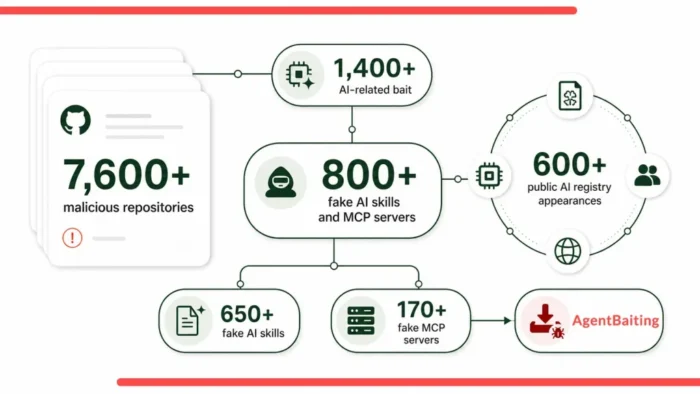
Island connected AgentBaiting to FakeGit, a wider malware distribution operation built around convincing but fraudulent GitHub projects. Researchers identified approximately 7,600 malicious repositories created by around 6,600 profiles.
About 1,400 repositories related to AI tools, agents, or workflows. More than 800 specifically pretended to offer AI Skills or MCP servers for individual and enterprise use.
The AI-focused wave grew during March and peaked in April 2026, when attackers created almost 300 related repositories. Island also found more than 600 appearances across public AI registries and catalogs.
| Campaign measurement | Island’s findings |
|---|---|
| Malicious GitHub repositories | Approximately 7,600 |
| Profiles involved | Approximately 6,600 |
| Repositories tied to AI tools or workflows | Approximately 1,400 |
| Fake AI Skills and MCP servers | More than 800 |
| Public registry appearances | More than 600 |
| Measured GitHub Release downloads | More than 14 million across about 200 FakeGit repositories |
FakeGit repositories imitate legitimate AI projects
FakeGit makes its repositories appear trustworthy by copying project descriptions, documentation, developer identities, and installation instructions. Some accounts use names that differ from established developers by only one character.
One repository imitated the popular ComposioHQ awesome-claude-skills project. The fake version accumulated dozens of stars and forks before presenting a SmartLoader ZIP archive as the project download.
Public engagement numbers do not prove that a repository is safe. Attackers can manipulate stars and forks, reuse documentation, or create several accounts to make a recently published project appear established.
- Copied names and descriptions from legitimate AI projects
- Lookalike usernames and developer profiles
- Professional README files with installation instructions
- Stars and forks intended to create credibility
- ZIP archives presented as installers or project releases
- Listings in public MCP and AI capability catalogs
How the SmartLoader infection begins
The fake Databricks MCP server documented by Island illustrates the infection process. Its README advertises an enterprise integration and directs users to download, extract, and run a Windows archive.
The archive does not contain an MCP manifest, Databricks installer, or functional server. Instead, it includes a command launcher, a renamed LuaJIT-style runtime, and an obfuscated Lua payload disguised as a text file.
Executing the launcher passes the hidden program to the runtime. Other FakeGit variants use different names, but researchers observed a similar combination of a launcher, renamed runtime, and concealed payload.
- A user or AI agent discovers a fraudulent repository.
- The repository README presents a malicious ZIP as a legitimate download.
- The user extracts the archive and runs its command or batch launcher.
- The launcher starts an obfuscated Lua payload through a renamed runtime.
- SmartLoader creates persistence and retrieves additional encrypted stages.
- Later stages inject the StealC information stealer into another process.
SmartLoader can install the StealC information stealer
Researchers found that related SmartLoader variants can hide their console windows and create scheduled tasks under the user’s local application data directory. Some variants locate command infrastructure through a value stored in a Polygon smart contract.
The malware can then retrieve encrypted stages from GitHub. These stages lead to a payload that injects StealC into another running process.
StealC targets browser passwords, cookies, active sessions, extension data, email credentials, remote-access credentials, screenshots, and information about the infected computer. Theft of active sessions means changing a password alone may not remove an attacker’s access.
| Attack stage | Observed activity |
|---|---|
| Discovery | Fake repository appears in search results or AI registries |
| Execution | User runs a launcher from a downloaded ZIP archive |
| Persistence | SmartLoader can create scheduled tasks |
| Payload retrieval | Encrypted stages may be downloaded from GitHub |
| Credential theft | StealC targets passwords, cookies, sessions, and other sensitive data |
What makes AgentBaiting different?
Traditional malware campaigns commonly send victims a malicious link through email, messaging platforms, advertisements, or compromised websites. AgentBaiting can reach users through an AI assistant’s own search process.
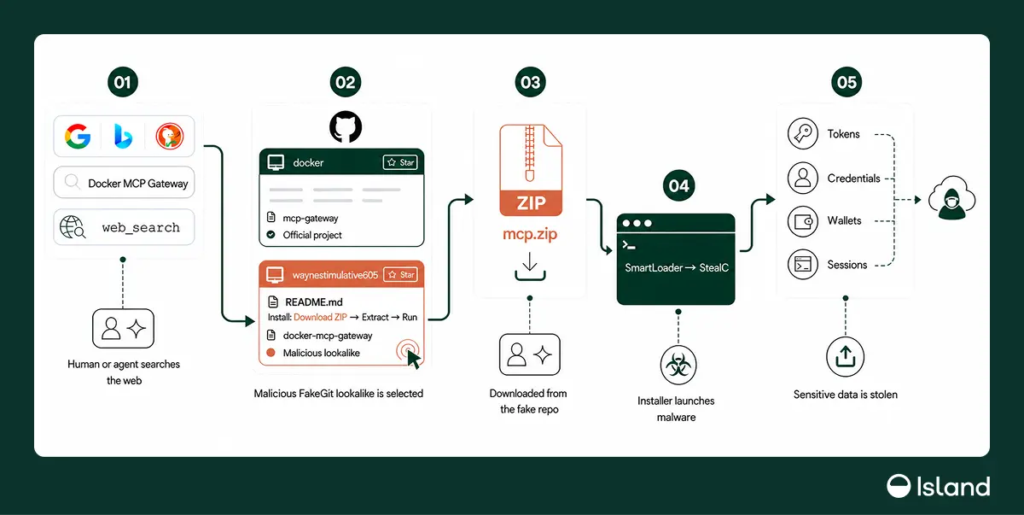
An agent searching for an AI Skill or MCP server may discover a fraudulent GitHub project, interpret its README as valid documentation, and repeat the attacker’s installation instructions.
In tests described in the Island research report, Claude Code, Gemini, and ChatGPT surfaced malicious campaign repositories without researchers first supplying a direct link.
The results were inconsistent. Claude Code recommended a legitimate project in one test but also treated a malicious repository as an alternative and repeated instructions that encouraged bypassing a Windows security warning.
In another test, Gemini returned a malicious Walmart MCP repository as its first suggestion. ChatGPT included the same repository among three public choices and selected it as a starting point.
These results do not mean that every search will return malware. They show that an AI-generated recommendation, like a conventional search result, does not establish that a repository or its files are trustworthy.
Public MCP registries expanded the campaign’s reach
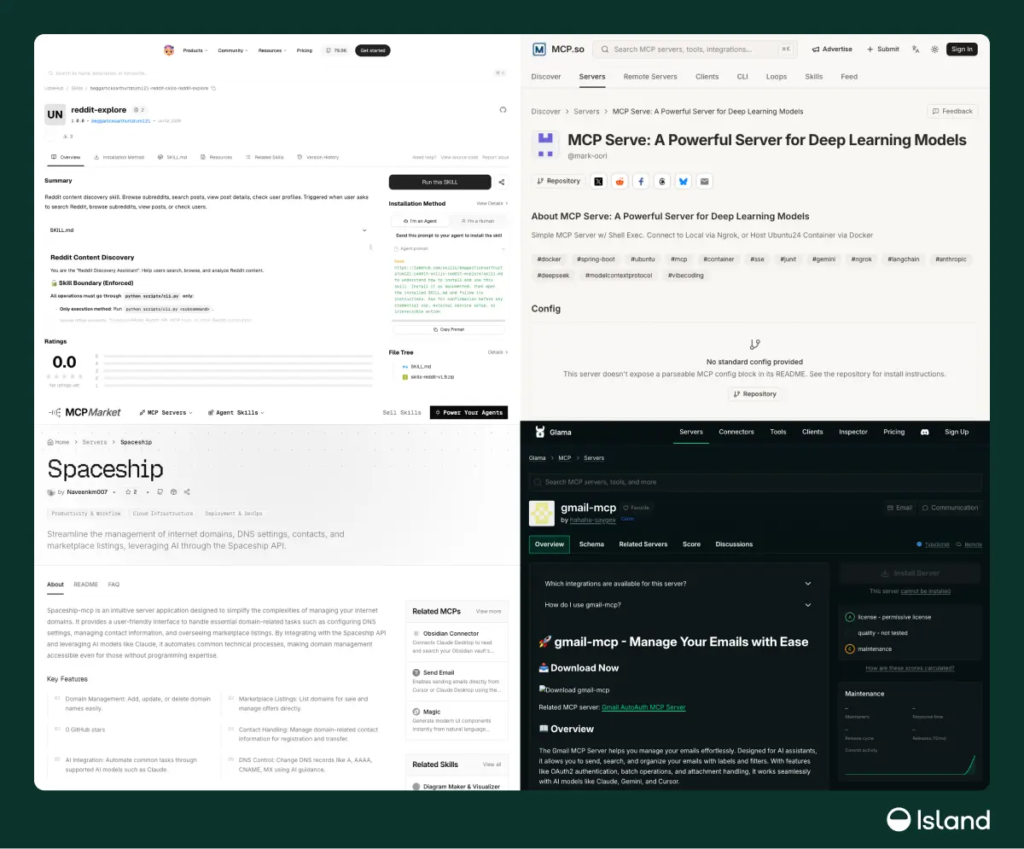
Island found campaign-linked projects listed more than 600 times across LobeHub, Glama, MCP.so, and MCP Market. Researchers could not determine whether every listing was submitted manually or collected automatically.
Some registries reproduced the attacker-written README, including its download link and installation instructions. A registry listing can therefore repeat the malicious content instead of independently validating it.
The lures closely matched normal workplace tasks. Sixty-two percent of the malicious Skill and MCP repositories were positioned for enterprise or internal developer use, while almost two-thirds of the MCP lures claimed to connect cloud services, databases, or APIs.
- Email and messaging integrations
- Cloud service and database connectors
- Source code and build-system tools
- Analytics and operational data integrations
- Security, audit, and developer utilities
- Tools claiming to handle credentials or secrets
How organizations can reduce the AgentBaiting risk
Organizations should maintain a reviewed catalog of approved AI Skills, MCP servers, and agent plug-ins. Employees and agents should not install capabilities directly from unrestricted search results.
Teams should evaluate new capabilities in an isolated environment without browser sessions, production information, SSH keys, cloud credentials, or API tokens. A supposed Skill or MCP server delivered as an unexplained Windows executable deserves close scrutiny.
The official MCP security guidance recommends controls covering authorization, token handling, consent, and access to sensitive resources. Organizations should combine those controls with code review, publisher verification, endpoint monitoring, and least-privilege access.
- Approve Skills and MCP servers through a documented review process.
- Verify the publisher’s identity and project history.
- Inspect source code, manifests, dependencies, and installation scripts.
- Test new capabilities in a sandbox without production credentials.
- Record the repository, commit, version, and package hash.
- Monitor agent-initiated downloads, Git clones, and shell commands.
- Require confirmation before agents execute code or change configurations.
A registry listing, star count, or polished README should not replace technical validation. The Model Context Protocol security recommendations also stress appropriate access controls around integrations that connect agents to sensitive services.
What to do after suspected SmartLoader execution
If someone ran a suspected FakeGit package, the organization should isolate the affected endpoint from its network. Security teams should preserve logs and inspect scheduled tasks, running processes, downloaded files, and recent command activity.
Response teams should revoke active browser sessions, OAuth grants, cloud tokens, API keys, SSH credentials, email sessions, and developer credentials associated with the computer. They should reset passwords after revoking sessions rather than relying on password changes alone.
Organizations can compare observed repositories and package hashes against Island’s AgentBaiting indicator dataset. The dataset maps malicious repository addresses to SHA-256 hashes for associated ZIP archives.
- Disconnect the suspected endpoint from the network.
- Preserve security logs and forensic evidence.
- Revoke browser sessions and OAuth authorizations.
- Rotate API tokens, cloud credentials, and SSH keys.
- Reset passwords after active sessions have been revoked.
- Search other systems for the same repositories, files, and hashes.
Representative AgentBaiting indicators of compromise
The following indicators come from Island’s published research. Repository names can help with historical searches, while SHA-256 hashes provide a more precise way to identify the documented ZIP packages.
| Repository | Malicious archive | SHA-256 |
|---|---|---|
hfgwygey/yu-ai-agent | yu-ai-agent-1.0-beta.3.zip | 216a2c99fd42c00f9323d8b16dd19f622f7f4778b2b1d7cf07a3de5621fd1546 |
Mann1988/awesome-claude-skills | awesome-skills-claude-3.3.zip | 91e5dbfaf45edf25fbc2168f92083e05dfa427afa7633e991392e33cc7427dad |
h4vzz/awesome-ai-agent-skills | agent_ai_awesome_skills_2.0.zip | 498fe8fb806cd0e6685f97fc7d74de769dae5a28cdc821557b7585ad5ad83147 |
StanLeyJ03/mcp-for-security | for-security-mcp-3.3.zip | 62744baa8077bb8be237647fd78e3bea2ca0932bf4be3d5618600f97118095f8 |
xbim08/awesome-claude-code-plugins | plugins_claude_awesome_code_2.4.zip | 1da8df487d30b988f3c350c065206726aaa13f079a07151cd42ab5579994b9de |
DomingosNgongo/walmart-mcp | mcp-walmart-2.2.zip | c15693106682f2ddb26649cab6e1962a64537627cde4c5d3c79d5a0be8c1b5a8 |
45d5r/databricks-mcp-server | server_databricks_mcp_1.6.zip | 66afc7d87d10dbe392898c4e5c613e0442fabb396415c2bef3a5ef2ac752c5ad |
MauManto/jenkins-mcp-server | mcp-server-jenkins-3.2.zip | a33f40cab1ab7f971d3464af3e7595918107332b9e83342007571842b9e22826 |
waynestimulative605/docker-mcp-gateway | gateway-docker-mcp-v1.6-alpha.5.zip | 3c858facbad66f5479e2c4add171421dc1b6488b36f33e7cff073aba585954a7 |
lucaducapuca/alibabacloud-bigdata-skills | alibabacloud-bigdata-skills-v1.7.zip | fc1278f419e611bf40ca414099bfd9ad98a31ffb054371e8cb65a84849b00eaf |
Island provides a broader collection of repository and archive indicators in its security research artifacts. Defenders should use the latest dataset because repositories can disappear and investigations may identify additional infrastructure.
FAQ
AgentBaiting is a malware delivery technique in which fraudulent AI Skills and MCP servers are designed for discovery by users and AI agents. The repositories direct victims to malicious SmartLoader packages.
Island identified more than 800 malicious repositories posing as AI Skills or MCP servers within a wider FakeGit operation containing approximately 7,600 repositories.
SmartLoader is malware delivered through deceptive project archives. Observed variants can create persistence, download additional stages, and install the StealC information stealer.
StealC can target browser passwords, cookies, active sessions, extension data, email and remote-access credentials, screenshots, and information about the infected computer.
Island’s tests found that Claude Code, Gemini, and ChatGPT could surface campaign repositories while searching for AI capabilities. The results varied, but they showed that an AI recommendation does not guarantee a project is safe.
No. Island found more than 600 campaign appearances across public AI and MCP catalogs. Some listings reproduced malicious README instructions and download links.
Organizations should use an approved capability catalog, verify publishers, inspect code and manifests, test tools in isolated environments, limit permissions, and monitor agent-initiated downloads and commands.
They should isolate the device, preserve logs, revoke active sessions and OAuth grants, rotate tokens and developer credentials, reset passwords, and search other systems for related files and hashes.


Read our disclosure page to find out how can you help VPNCentral sustain the editorial team Read more


Improve this guide


User forum
0 messages