
AWS Cost Explorer Bug Shows Trillion-Dollar Estimates, but Actual Charges Remain Unaffected


 7 min. read
  Published on
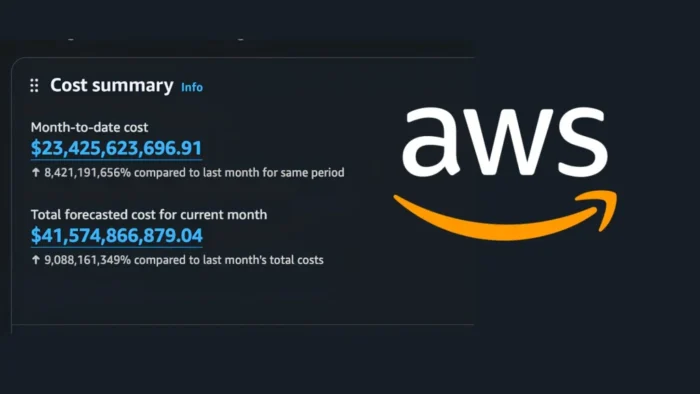
An Amazon Web Services billing error caused some customers to see cost estimates reaching billions or trillions of dollars. AWS says these figures were inaccurate and did not represent actual cloud usage or charges.
The global incident affected estimated data in the AWS Billing and Cost Management Console, Cost Explorer, and some Cost and Usage Reports. AWS traced the problem to incorrect unit pricing inside its estimated billing computation system.

Access content across the globe at the highest speed rate.
🔥 Save 81% + 2 bonus months! 🔥
70% of our readers choose Private Internet Access
70% of our readers choose ExpressVPN
2
Browse the web from multiple devices with industry-standard security protocols.
🔥 Save 73%! 🔥

Faster dedicated servers for specific actions (currently at summer discounts)
🔥 Save 69%! 🔥
AWS has mitigated the underlying issue and is recalculating data for affected accounts. According to the latest AWS billing incident update, the company expects all affected accounts to recover by July 19 at 12:00 AM PDT.
What Happened to AWS Billing Estimates?
The incident began at approximately 7:38 PM PDT on July 16, 2026. AWS later acknowledged that Cost Explorer was displaying inaccurate estimated billing information through an AWS Support notice.
Customers soon began sharing screenshots of unusually large charges and forecasts. Figures reported to WIRED ranged from several billion dollars to more than $7 trillion. One account that normally generated costs of about one cent per month reportedly showed more than $1.5 billion in usage fees.
The estimates triggered automated budget notifications at some organizations. This forced finance, engineering, security, and FinOps teams to investigate whether compromised accounts or runaway workloads had caused the apparent increases.
| Time | AWS incident development |
|---|---|
| July 16, 7:38 PM PDT | Inaccurate estimated billing data begins appearing |
| July 17, 1:33 AM PDT | AWS acknowledges the Cost Explorer problem |
| July 17, 3:03 AM PDT | AWS identifies a unit-pricing issue as the root cause |
| July 17, 4:59 PM PDT | AWS mitigates the underlying issue and starts rebuilding data |
| July 19, 12:00 AM PDT | Expected deadline for recovery across all affected accounts |
Why Did AWS Estimates Reach Trillions of Dollars?
AWS attributed the incident to unit pricing within its estimated billing computation subsystem. The company has not published a detailed technical explanation, but the available information indicates that incorrect pricing values were applied while estimated costs were being calculated.
AWS Cost Explorer combines usage and pricing data to help customers examine spending patterns and estimate future costs. The official Cost Explorer documentation explains that the service provides historical cost information and spending forecasts.
An incorrect unit-price value can produce an extreme result even when the underlying usage data remains valid. For example, multiplying normal resource consumption by a severely inflated price would create an impossible estimate without changing the number of compute hours, storage requests, or data transfers recorded by AWS.
Were Customers Actually Charged Trillions of Dollars?
No. AWS says the displayed estimates did not reflect customers’ actual usage or charges. The incident affected the systems responsible for calculating and presenting estimated billing information, not the validated metering and charging process.
The distinction matters because Cost Explorer forecasts are predictions rather than final invoices. As described in the AWS cost-management guide, Cost Explorer uses recorded spending and usage information to analyze costs and produce forecasts.
Customers should not make payments, delete resources, or shut down workloads solely because of the erroneous figures. However, an unexpected billing alert still deserves investigation until teams confirm that it matches the AWS incident.
| Billing component | Incident status |
|---|---|
| Estimated charges in the billing console | Displayed inaccurate values for some accounts |
| Cost Explorer data and forecasts | Affected while AWS recalculates estimates |
| Cost and Usage Reports | Some generated reports may contain inaccurate estimated data |
| Actual service usage | Not affected, according to AWS |
| Validated customer charges | Not affected, according to AWS |
AWS Is Rebuilding Affected Billing Data
AWS paused estimated billing computations while engineers worked on the problem. After mitigating the underlying pricing issue, the company began a backfill process to recreate accurate data across affected customer accounts.
The latest incident status says more accounts are showing correct information as the backfill progresses. Some customers may continue to see incorrect data until their accounts complete the recalculation process.
The scale of the reported figures led to widespread concern, but the amounts were clearly inconsistent with normal cloud spending. Screenshots and customer accounts collected by WIRED’s incident report illustrate how the error affected organizations and individual developers across different regions.
Cost and Usage Report Users May Need Extra Checks
The incident also affected some AWS Cost and Usage Reports, commonly called CUR files. These reports feed many internal FinOps dashboards, data warehouses, chargeback systems, and automated reporting pipelines.
Customers who configured AWS to overwrite existing reports do not need to replace files manually. AWS says the reports should update automatically as corrected data becomes available.
Customers who selected the option to create a new report version may receive corrected data under a new assembly ID. The AWS report versioning documentation explains how overwrite and separate-version configurations handle updated Cost and Usage Reports.
- Check whether the report uses overwrite mode or separate report versions.
- Confirm that analytics tools read the latest assembly ID after the backfill finishes.
- Review Amazon Athena, Amazon Redshift, Amazon QuickSight, and custom ETL integrations.
- Archive or remove stale report versions only after validating the corrected data.
- Recalculate internal forecasts, chargeback reports, and budget dashboards that consumed affected data.
What AWS Customers Should Do Now
AWS says customers do not need to take action to correct billing estimates. The company is rebuilding the affected records internally. Its initial Cost Explorer advisory also directed customers to the AWS Health Dashboard for updates.
Security teams should still verify that a cost spike belongs to this incident. Unauthorized access, exposed credentials, cryptomining, misconfigured autoscaling, and abandoned resources can also produce genuine increases in cloud spending.
Once AWS completes the backfill, customers should compare corrected Cost Explorer data with service-level usage and account activity. Any anomaly that remains after recovery may require a separate security or configuration investigation.
- Wait for AWS to complete the account-level billing recalculation.
- Check the AWS Health Dashboard for account-specific updates.
- Compare reported costs with service-level metrics and resource inventories.
- Review AWS CloudTrail for unexpected account activity or API calls.
- Rotate credentials if evidence suggests unauthorized access.
- Validate Cost and Usage Report pipelines against the newest report version.
Organizations using separate CUR versions should follow the AWS Cost and Usage Report guidance and ensure downstream systems process the corrected assembly ID. Otherwise, an internal dashboard could continue displaying stale trillion-dollar figures even after AWS repairs the source data.
FAQ
No. AWS says the extraordinary figures were inaccurate estimates and did not affect actual usage or validated customer charges.
AWS traced the incident to a unit-pricing problem within its estimated billing computation subsystem.
The incident affected estimated data in the Billing and Cost Management Console, Cost Explorer, and some Cost and Usage Reports.
AWS has mitigated the underlying issue and is rebuilding affected data. It expects all affected accounts to recover by July 19 at 12:00 AM PDT.
AWS says no action is required to correct the estimates. Customers should still review persistent anomalies and validate Cost and Usage Report integrations after recovery.
They should confirm that analytics and ETL systems use the corrected report under the latest assembly ID after AWS completes the backfill.


Read our disclosure page to find out how can you help VPNCentral sustain the editorial team Read more


Improve this guide




User forum
0 messages