
BugHunter Adds Free AI Provider Support for Bug Bounty Research


 6 min. read
  Published on
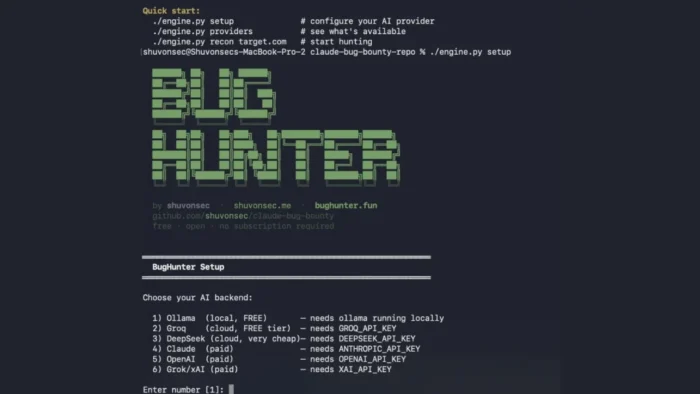
BugHunter is an open-source bug bounty toolkit that helps security researchers move from reconnaissance to vulnerability reports from the terminal. The BugHunter GitHub project says it can handle recon, testing, validation, and submission-ready reports for platforms such as HackerOne, Bugcrowd, Intigriti, and Immunefi.
The tool was originally tied closely to Claude Code, Anthropic’s terminal-based coding agent. It now also works as a standalone CLI through the bughunter command, which lowers the barrier for researchers who do not have a Claude Code or Claude Pro subscription.

Access content across the globe at the highest speed rate.
70% of our readers choose Private Internet Access
70% of our readers choose ExpressVPN

Browse the web from multiple devices with industry-standard security protocols.

Faster dedicated servers for specific actions (currently at summer discounts)
Developer Shuvon Md Shariar Shanaz said in a public announcement that the project was renamed because it is no longer limited to Claude Code. The new direction focuses on broader AI provider support and easier access for bug bounty hunters.
BugHunter now works without a paid Claude setup
The biggest change is standalone mode. Researchers can install the project once and run commands such as bughunter recon, bughunter hunt, bughunter validate, and bughunter report from a normal terminal.
BugHunter auto-detects AI providers in a free-first order. The README lists Ollama, Groq, DeepSeek, Claude API, and OpenAI as supported options, with Ollama placed first for local use.
The project also supports Groq, which markets its platform around fast and low-cost inference and offers a free API key option. That gives researchers another cloud-based choice when they do not want to run a local model.
| Mode | How it works | Main benefit |
| Standalone CLI | Runs through the bughunter command | No Claude Code subscription required |
| Claude Code plugin | Adds slash commands inside Claude Code | Fits researchers already using Anthropic’s coding agent |
| Local AI provider | Uses Ollama on the researcher’s machine | Can keep prompts and target notes local |
| Cloud AI provider | Uses services such as Groq, DeepSeek, Claude API, or OpenAI | Can be faster or easier to start on some systems |
The toolkit follows a full bug bounty workflow
BugHunter’s workflow mirrors the way many researchers already work. It starts with attack surface mapping, moves into vulnerability testing, checks whether a finding is strong enough to report, and then creates a platform-specific submission.
The project README describes support for subdomain enumeration, live host probing, URL crawling, nuclei sweeps, IDOR checks, authentication bypass checks, SSRF, XSS, SQL injection, logic flaws, and other common web bug classes.
It also includes Web3-focused testing. The smart contract mode covers 10 vulnerability classes, and the token scanner looks for issues such as mint authority, liquidity pool lock status, honeypot behavior, and bonding curve risks.
False positive reduction is now a focus
The latest v5.0.0 release focuses heavily on reducing false positives. That matters because weak findings can waste time for researchers and platform triage teams.
The update adds scanner confidence states, stricter validation checks, rejection reason codes, and regression tests. Findings can be marked as confirmed, possible, or informational before they move through the rest of the pipeline.
The release also hardens validation for issues such as IDOR, authentication bypass, account takeover, and privilege escalation. The validation flow now asks for stronger proof, including cross-account checks and reproducibility from a clean session.
- Recon maps subdomains, live hosts, URLs, and initial findings.
- Hunt mode checks common Web2 and Web3 vulnerability classes.
- Validation filters weak, duplicate, or unproven findings.
- Report mode creates submissions for major bug bounty platforms.
- Memory features preserve patterns across sessions.
AI providers give researchers more flexibility
Local AI support is a key part of the update. Ollama says it can run open models locally and even offline for mission-critical work, which is useful for researchers who do not want to send prompts or target notes to a cloud model.
Cloud providers still have a role. Groq positions its service around fast inference, while paid Claude and OpenAI options remain available for users who prefer those ecosystems.
The result is a more flexible toolchain. A beginner can start with a free provider, while an experienced hunter can choose a faster or more capable model depending on the target, budget, and privacy needs.
Claude Code support remains available
BugHunter has not dropped Claude Code support. The project still works as a plugin for Anthropic’s Claude Code, which describes itself as an agentic coding tool that lives in the terminal and understands a user’s codebase.
For researchers already using Claude Code, BugHunter adds specialized commands and agents around bug bounty workflows. For everyone else, the standalone CLI offers the same broad direction without requiring the Claude Code environment.
The developer’s rebrand announcement frames the change as an accessibility move for the wider bug bounty community.
Researchers still need to stay inside scope
BugHunter is a dual-use security tool, so authorization matters. The project states that it is for authorized security testing only and that users should test only within an approved bug bounty program scope.
This point should not be treated as a footnote. Automated recon, scanning, and AI-assisted testing can create legal and operational problems when used against targets without permission.
The latest release notes also show a clear attempt to reduce low-quality reports by forcing stronger proof before a finding becomes a report. That is important for platforms that already deal with large volumes of duplicate, theoretical, or non-actionable submissions.
| Feature | Why it matters |
| 7-Question Gate | Helps reject weak findings before submission. |
| Cross-session memory | Lets patterns found on one target inform future testing. |
| Standalone CLI | Allows researchers to use the toolkit without a paid Claude setup. |
| Web3 audit mode | Adds coverage for smart contract and token-related issues. |
| Report generation | Turns validated findings into platform-specific reports. |
BugHunter shows where AI-assisted security tools are going
BugHunter’s shift from a Claude Code plugin to a standalone multi-provider CLI reflects a wider trend in security tooling. Researchers want AI assistance, but they also want control over cost, privacy, provider choice, and workflow.
The tool does not remove the need for skill or judgment. Bug bounty programs still reward clear impact, reproducible proof, clean reporting, and strict scope control.
What BugHunter changes is the amount of manual work around recon, triage, validation, and report drafting. Used responsibly, it can help researchers move faster while keeping the final decision in human hands.
FAQ
BugHunter is an open-source bug bounty toolkit that helps researchers run reconnaissance, test for vulnerabilities, validate findings, and generate submission-ready reports from the terminal.
No. BugHunter still supports Claude Code, but it now also works as a standalone CLI through the bughunter command, so users do not need a Claude Code or Claude Pro subscription.
BugHunter supports Ollama, Groq, DeepSeek, Claude API, and OpenAI, with a free-first provider order that starts with Ollama for local use.
The 7-Question Gate checks whether a finding has real impact, is reproducible, stays in scope, and has enough proof before a researcher spends time writing a report.
No. BugHunter should only be used for authorized testing within an approved bug bounty program scope or on systems the researcher owns or has permission to test.


Read our disclosure page to find out how can you help VPNCentral sustain the editorial team Read more


Improve this guide

User forum
0 messages