
F5 BIG-IP compromise let attackers pivot from Linux to Confluence and Active Directory


 6 min. read
  Published on
Microsoft says a threat actor used a compromised F5 BIG-IP edge appliance as the starting point for a multi-stage intrusion that reached Linux systems, an internal Atlassian Confluence server, and Active Directory. The incident shows how one exposed appliance can give attackers a trusted path into systems that are not directly open to the internet.
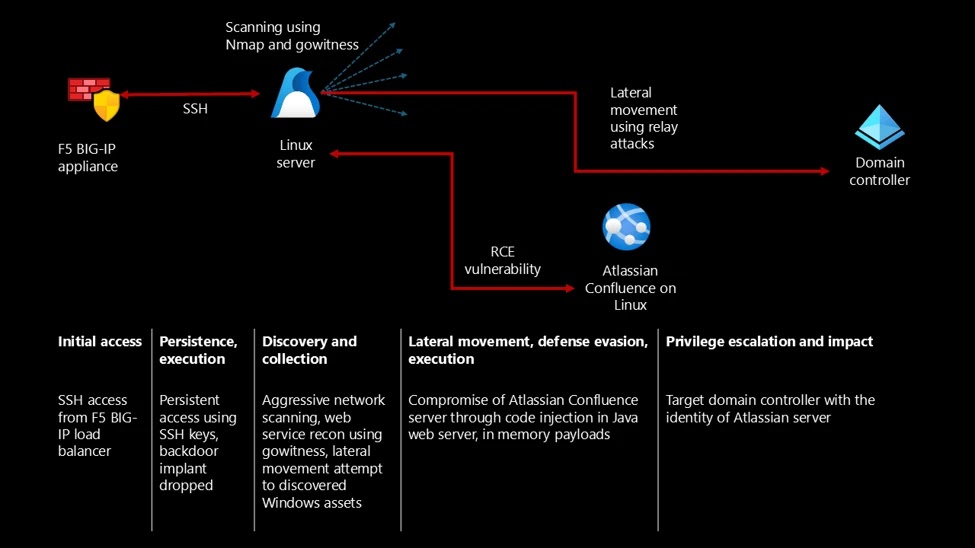
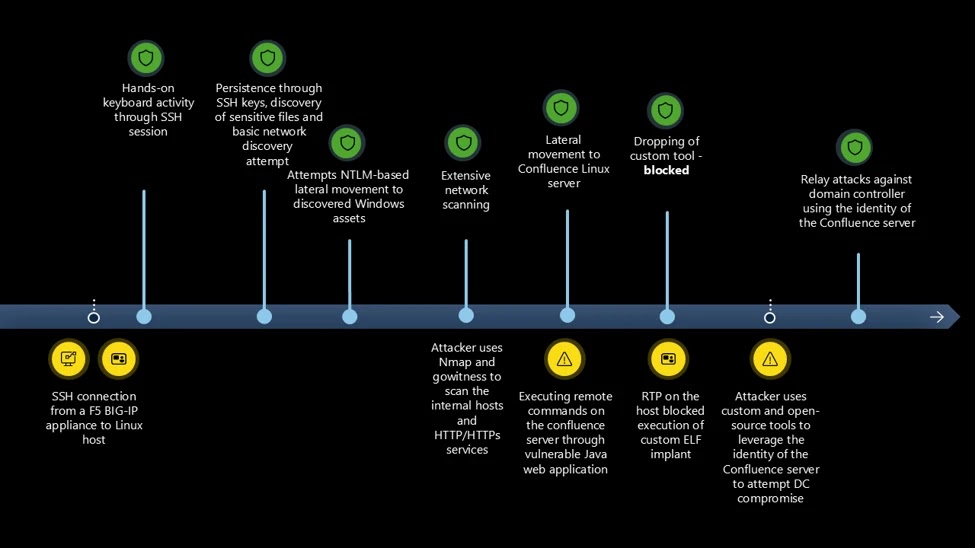
The attack began after the actor established SSH access to a Linux host from a network device identified as an F5 BIG-IP load balancer, according to Microsoft Defender Security Research. Microsoft traced the source to an Azure-hosted BIG-IP Virtual Edition appliance running version 15.1.201000.

Access content across the globe at the highest speed rate.
70% of our readers choose Private Internet Access
70% of our readers choose ExpressVPN

Browse the web from multiple devices with industry-standard security protocols.

Faster dedicated servers for specific actions (currently at summer discounts)
That detail matters because BIG-IP 15.1.x reached end of life on December 31, 2024, according to an F5 support notice. Unsupported edge devices receive no normal security maintenance, which makes them dangerous assets when they sit between the public internet and internal services.
How the attack moved through the network
After gaining SSH access to the Linux host, the attacker used a privileged account and kept hands-on keyboard access during the operation. Microsoft said the actor did not need obvious persistence because the account already provided broad access.
The attacker then scanned internal subnets with Nmap, looked for open services, and used gowitness to capture screenshots of HTTP and HTTPS services through a SOCKS5 proxy. The activity helped the actor map systems that normal perimeter controls would not expose to the public internet.
Where Windows servers appeared, the actor tried common NTLM-based lateral movement tools, including netexec, smbclient, rpcclient, ldapsearch, Kerbrute, and Responder. Microsoft said those first attempts failed, but the attack continued.
| Stage | What happened | Why it matters |
|---|---|---|
| Initial access | SSH access came from an F5 BIG-IP load balancer | A trusted edge device acted as the bridge into the network |
| Reconnaissance | The actor scanned Linux and Windows systems | Internal assets became visible after the first foothold |
| Confluence compromise | An internal Confluence server with unpatched flaws was exploited | Internal-only applications still created serious risk |
| Identity attack | Stolen credentials supported Kerberos relay activity | The intrusion crossed into Active Directory abuse |
Confluence became the next target
The attacker later downloaded a custom scanning tool from the command-and-control address 206.189.27[.]39. Microsoft detected the tool as HackTool:Linux/MalPack.B, and said it probed the organization’s web applications and mobile services to understand access controls.
That reconnaissance exposed an internal Atlassian Confluence server with unpatched vulnerabilities. Atlassian maintains a public list of Atlassian security advisories, including Confluence security fixes, but Microsoft’s incident report did not name the exact Confluence CVE used in this case.
Once inside Confluence, the actor pulled credentials from configuration files, including server.xml and confluence.cfg.xml. Those credentials then gave the attacker a path toward Windows infrastructure, showing how an internal collaboration system can become a bridge into identity systems.
Active Directory abuse raised the impact
The stolen credentials helped the actor attempt relay-style authentication attacks against the Windows environment. Microsoft said the activity included Kerberos relay attacks and exploitation of CVE-2025-33073, a Windows SMB Client improper access control vulnerability.
The campaign shows why patching only internet-facing apps does not solve the whole problem. The Confluence server was not public, but it became reachable after the attacker used the edge appliance and Linux host as stepping stones.
Microsoft Defender for Endpoint blocked repeated payload drops on the Confluence host where real-time protection was enabled. On other Linux systems, limited protection gave the attacker more room to run scripts, scanners, and public offensive tools.
Why edge appliances need Tier-0 treatment
Firewalls, VPN gateways, and load balancers often hold certificates, session data, routing visibility, authentication tokens, and directory integrations. That makes them more than network equipment. They can become identity assets when attackers compromise them.
In this incident, Microsoft’s report frames the BIG-IP device as a trusted entry point rather than a standalone server compromise. The lesson for defenders is clear: internet-facing appliances need strict lifecycle management, centralized logging, and fast patch governance.
Organizations still running F5 BIG-IP 15.1.x should prioritize replacement or upgrade planning because that branch is no longer supported. Teams should also restrict appliance management access to known administrative networks and monitor for SSH logons that originate from network infrastructure.
- Inventory every internet-facing firewall, VPN gateway, load balancer, and reverse proxy.
- Track end-of-life dates for appliance software, not only operating systems.
- Restrict management interfaces by IP range and administrative role.
- Enable detailed logging for SSH, management-plane access, and appliance-originated connections.
- Patch internal apps with the same urgency as public-facing systems.
What admins should do now
Security teams should treat the incident as an attack-chain problem, not a single-product issue. The path touched edge infrastructure, Linux, internal web apps, Windows authentication, and Active Directory.
Microsoft recommends reducing NTLM use where possible, enforcing SMB signing, enabling LDAP signing and channel binding, and using Extended Protection for Authentication on relevant services. The CVE-2025-33073 record also points admins toward vendor guidance for the Windows SMB issue.
Atlassian customers should review Confluence security updates and make sure internal servers do not lag behind because they lack internet exposure. Attackers only need one internal foothold to reach them.
| Priority | Action | Goal |
|---|---|---|
| High | Upgrade or retire unsupported BIG-IP versions | Remove exposed security debt |
| High | Patch Confluence and other internal web apps | Block lateral RCE paths |
| High | Enforce SMB and LDAP signing | Reduce relay attack success |
| Medium | Limit SSH trust and privileged sudo access | Reduce blast radius after appliance compromise |
| Medium | Hunt for suspicious appliance-originated SSH activity | Find hidden entry points faster |
The incident also gives defenders useful detection clues. Microsoft published indicators including the command-and-control address 206.189.27[.]39 and hashes tied to the custom scanner, network scanning script, Kerbrute, gowitness, and an NTLM relay script.
The bigger warning is broader than F5 or Confluence. Attackers increasingly look for weak links between trusted systems. Once they cross that line, internal tools, cached credentials, and old authentication settings can turn one appliance compromise into an enterprise identity incident.
FAQ
Microsoft said a threat actor used a compromised F5 BIG-IP edge appliance to access a Linux host over SSH, then moved through internal systems, targeted Confluence, stole credentials, and attempted identity-based attacks against Active Directory.
No. Microsoft identified an Azure-hosted BIG-IP Virtual Edition appliance running version 15.1.201000, which belonged to the end-of-life BIG-IP 15.1.x branch. The report did not name a new F5 zero-day for the initial access step.
The Confluence server became reachable after the attacker gained an internal foothold. This shows why internal web applications still need fast patching, monitoring, and credential protection.
CVE-2025-33073 is a Windows SMB Client improper access control vulnerability. Microsoft said the attacker used it during relay-style authentication activity after stealing credentials from Confluence configuration files.
Admins should upgrade or retire unsupported F5 BIG-IP versions, patch internal Confluence servers, restrict appliance management access, enforce SMB and LDAP signing, reduce NTLM use, and hunt for SSH activity that originates from edge infrastructure.


Read our disclosure page to find out how can you help VPNCentral sustain the editorial team Read more


Improve this guide



User forum
0 messages