
Hackers Abuse 20+ Brazilian Government Websites to Spread PhantomEnigma Malware


 12 min. read
  Published on
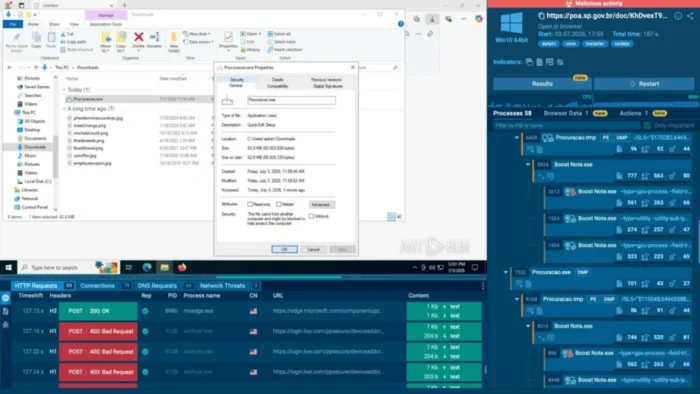
Hackers are using more than 20 compromised Brazilian government websites to distribute malware through links that appear trustworthy. The active campaign, tracked as PhantomEnigma, primarily targets banking and public-sector organizations in Brazil.
The attackers combine legitimate .gov.br infrastructure, compromised government email accounts, police-themed phishing messages, and frequently changing command-and-control servers. This approach makes malicious emails and downloads harder to distinguish from genuine government communications.

Access content across the globe at the highest speed rate.
🔥 Save 81% + 2 bonus months! 🔥
70% of our readers choose Private Internet Access
70% of our readers choose ExpressVPN
2
Browse the web from multiple devices with industry-standard security protocols.
🔥 Save 73%! 🔥

Faster dedicated servers for specific actions (currently at summer discounts)
🔥 Save 69%! 🔥
According to the ANY.RUN PhantomEnigma investigation, researchers connected 231 sandbox analyses through a recurring Delphi, Inno Setup, Node.js, and Electron build chain. Approximately 108 to 125 analyses contained stronger indicators directly associated with the campaign.
Government Websites Became Malware Delivery Channels
The attackers compromised legitimate municipal, police, public-security, and fire-department websites across Brazil. They then used those systems to host malicious files or redirect visitors toward attacker-controlled infrastructure.
These government organizations were not necessarily the campaign’s intended victims. Their systems became trusted delivery points that helped attackers reach banking, government, and other Brazilian organizations.
A recipient may trust a download link ending in .gov.br more readily than an unfamiliar domain. Reputation-based security systems can also apply less scrutiny to websites with an established history of legitimate government activity.
| Campaign characteristic | ANY.RUN finding |
|---|---|
| Compromised government hosts | At least 20 Brazilian government websites |
| Broader build-chain cluster | 231 sandbox analyses |
| Stronger PhantomEnigma indicators | Approximately 108 to 125 analyses |
| Ofício-PC activity | 99 sandbox analyses |
| Primary geographic focus | Brazil |
| Observed activity | January through July 2026 |
| Peak months | March and May 2026 |
| Attribution confidence | High for the campaign, medium-high for the specific Inno and Node.js arm |
Compromised Mailboxes Help Phishing Pass Authentication
Researchers recovered an email sent from a Brazilian police department that passed SPF, DKIM, and DMARC authentication. This indicates that attackers likely used a genuinely compromised mailbox or authorized mail system.
SPF, DKIM, and DMARC help receiving services determine whether a message came through infrastructure authorized by the sender’s domain. They primarily defend against forged sender information and do not prove that the person controlling an authenticated account is trustworthy.
Microsoft’s guidance on anti-phishing protection notes that impersonation can pass SPF, DKIM, and DMARC when attackers control an authenticated source or properly configured lookalike domain. Additional behavioral and impersonation checks remain necessary.
Phishing Emails Impersonate Brazilian Police
The malicious messages use themes such as “Polícia Civil,” “Ofício Polícia Civil,” and “Procuração Digital.” Some direct recipients to compromised government hosts, while others use police-themed lookalike domains controlled by the attackers.
The wording creates urgency around official notices, legal documents, investigations, or digital authorizations. A victim who follows the link receives a Windows installer presented as a legitimate document or government application.
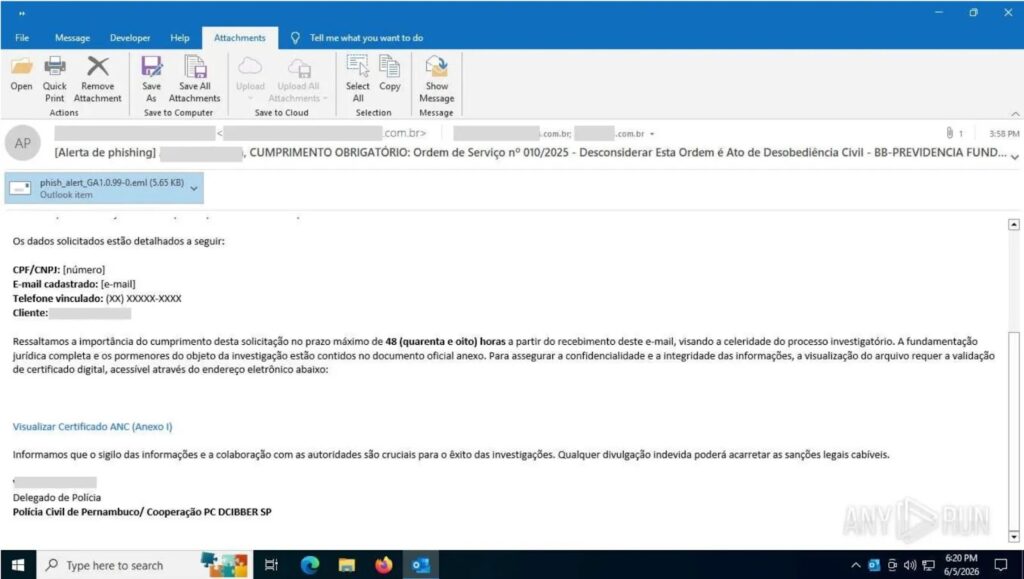
Security teams should avoid describing every message as spoofed. Some campaign emails use impersonation or lookalike domains, but evidence shows that at least one message likely came through a compromised official mailbox.
How the PhantomEnigma Infection Chain Works
The download commonly arrives as an executable built with Inno Setup and compiled using Delphi. One observed file used the name Procuracao_Digital.exe to support the official-document lure.
When launched, the installer silently extracts a modified Electron application. Researchers identified a patched version of Boostnote, a legitimate note-taking application, containing a malicious index.js file.
Electron applications use JavaScript and Node.js components. The attackers abuse that trusted application structure to load their backdoor while making the installed package appear more ordinary.
| Attack stage | Observed behavior |
|---|---|
| Phishing delivery | The victim receives a police or digital-authorization email. |
| Trusted link | The message links to a compromised government host or police-themed lookalike domain. |
| Installer download | The host provides a Delphi-compiled Inno Setup executable. |
| Electron deployment | The installer extracts a patched Boostnote or another JavaScript-based application. |
| Backdoor execution | Electron loads an obfuscated malicious index.js file. |
| System discovery | The backdoor collects system and user information and performs reconnaissance. |
| Persistence | The malware configures a Windows Run key and application login settings. |
| Command execution | The server can return JavaScript or send another executable payload. |
The JavaScript Backdoor Collects System Information
After Electron loads index.js, the script deobfuscates itself and gathers information about the infected system. Collected data can include the computer name, username, domain details, and a campaign-specific identifier.
The backdoor can launch child processes to perform additional reconnaissance. It then sends the collected information to an attacker-controlled command-and-control server.
Persistence allows the malware to run again after the user signs in. Researchers observed both a Windows Run registry entry and Electron’s setLoginItemSettings functionality in related samples.
Attackers Can Send JavaScript or Executable Payloads
PhantomEnigma uses a modular command structure. The command-and-control server can return JavaScript for execution inside the running Electron process.
The backdoor processes this code through eval(), which allows the server to change its instructions without requiring the attackers to replace the initial installer.
The server can also send a complete executable file. The backdoor writes the second-stage payload to the computer and launches it as a child process.
- Information stealers
- Malware loaders
- Remote access tools
- Banking credential theft components
- Additional reconnaissance utilities
Researchers Found a New Backdoor Generation
ANY.RUN analysts detonated a sample again on July 12, 2026, and observed a previously undocumented communication pattern in a live environment.
An earlier backdoor generation sent a GET request to a /laravel.php endpoint. The newly observed version sent victim information through a POST request to an /nbw/ path.
The new beacon communicated with zsxocjarsate[.]com, confirming that the domain was receiving system information during the live test. The finding indicates that at least two backdoor generations operated during the campaign.
| Backdoor generation | Request method | Observed path |
|---|---|---|
| Earlier generation | GET | /laravel.php |
| Newly documented generation | POST | /nbw/ |
Two PhantomEnigma Attack Arms Operated Together
The activity initially appeared to involve separate attack waves. One used fake Ofício Polícia Civil PDF documents and QR codes, while another distributed the Inno Setup and Node.js backdoor.
Researchers later found that the two operations overlapped. At least four compromised government hosts delivered both Ofício-PC content and PhantomEnigma installers.
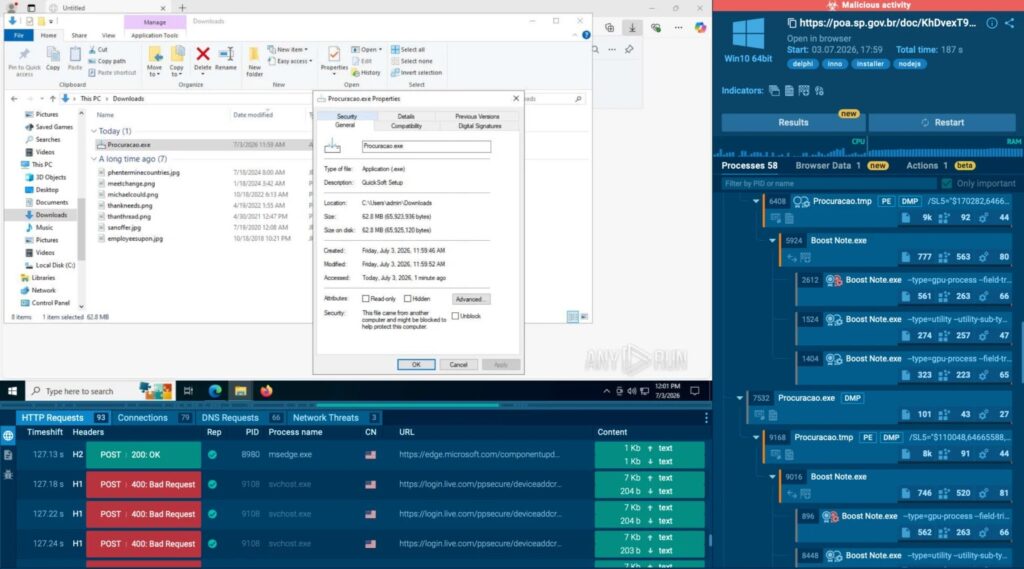
The shared infrastructure, police-themed lures, delivery evidence, and timing support the assessment that the QR-code campaign represents another arm of the same operation. ANY.RUN assigns medium-high confidence to this connection.
QR Codes Direct Victims Toward Malicious Content
The Ofício-PC campaign uses fake police documents containing QR codes. Scanning the code directs victims toward a malicious website or another stage of the infection chain.
QR-code phishing, also called quishing, can hide the final destination from email scanners that inspect conventional text links. It may also move the victim from a managed computer to a less-protected mobile device.
The Ofício-PC cluster produced 99 sandbox analyses. Researchers kept other adjacent ClickFix and StealC activity separate because available evidence did not support a confident operator-level connection.
PhantomEnigma Evolved From an Earlier Banking Campaign
Positive Technologies documented an earlier Phantom Enigma operation in 2025. That version used malicious browser extensions to target Brazilian banking information, particularly data associated with Banco do Brasil.
The original Phantom Enigma research described phishing emails, PowerShell, browser shortcut modification, remote administration tools, and extensions installed in Chromium-based browsers.
The 2026 activity adds a modular Electron and Node.js backdoor while retaining a strong focus on Brazil. Compromised government infrastructure represents a change in delivery rather than proof that the campaign selected government organizations as a new victim category.
Researchers Used the Build Chain as a Fingerprint
Domains, IP addresses, and compromised hosts changed frequently, but the underlying malware construction remained more consistent. Analysts repeatedly found the combination of Delphi, Inno Setup, Node.js, Electron, and an obfuscated index.js backdoor.
That build chain identified 231 related sandbox analyses. However, the broader technical match does not establish the same attribution confidence for every sample.
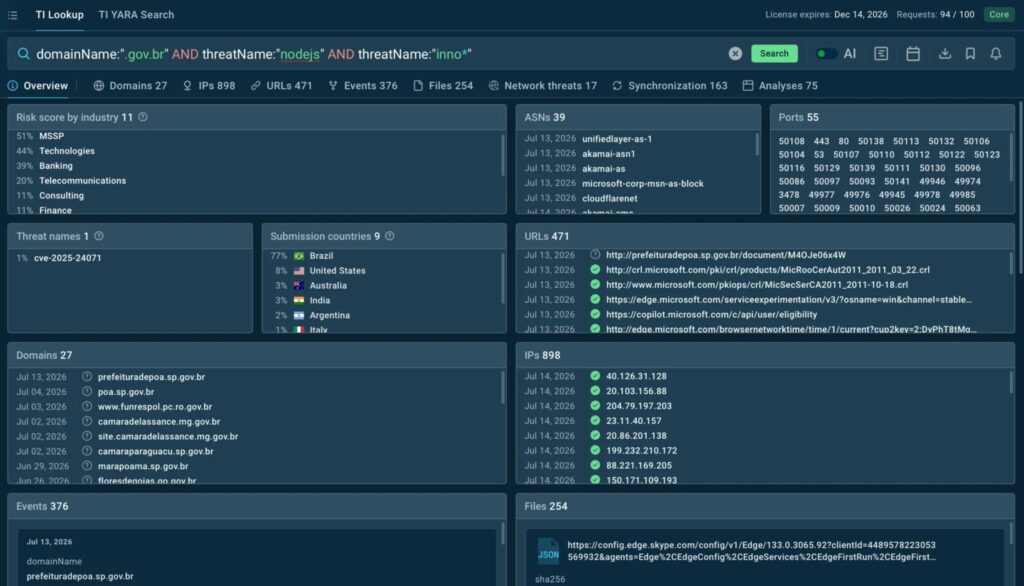
Approximately 108 to 125 analyses also included stronger PhantomEnigma indicators. These included known command-and-control infrastructure, government delivery hosts, beacon IP addresses, and the /laravel.php or /nbw/ communication patterns.
| Detection level | Evidence | Recommended use |
|---|---|---|
| Broad build-chain match | Delphi, Inno Setup, Node.js, and Electron characteristics | Threat hunting and investigation |
| Higher-confidence campaign match | Build chain plus known C2, beacon paths, IP addresses, or compromised government hosts | Prioritized incident response |
| Behavioral confirmation | System collection, persistence, beacon traffic, or second-stage execution | Containment and forensic investigation |
One Seed Domain Appeared in Only 15% of Analyses
The policiacivilmg[.]com domain became a widely referenced indicator for the campaign. However, it appeared in only about 15% of the analyzed sessions.
A detection rule based only on that domain would therefore miss approximately 85% of the wider dataset. This demonstrates the limited lifespan of static indicators in campaigns with frequently changing infrastructure.
Security teams should combine domains with installer characteristics, JavaScript patterns, process behavior, persistence, and network paths. This provides better coverage when attackers replace individual servers.
Command-and-Control Infrastructure Changes Frequently
PhantomEnigma separates delivery websites, beacon servers, origin systems, and exfiltration infrastructure. Cloudflare also concealed some origin systems behind proxy services.
Researchers observed government delivery hosts and associated C2 domains changing together over several weeks. The operator appears capable of moving to new infrastructure without redesigning the malware.
ANY.RUN expects this rotation to continue. Future versions may rely more heavily on encrypted HTTPS traffic, which would reduce the usefulness of plaintext network signatures.
Nearly One-Third Initially Received Clean Verdicts
Almost one-third of the activity reviewed by ANY.RUN initially received a clean automated verdict. Some samples revealed malicious behavior only after deeper sandbox inspection and correlation with related activity.
In one correlation test, researchers combined the recurring build chain with network indicators. This identified 59 analyses, including nine that had initially received clean verdicts.
A clean result should not end an investigation when a suspicious government-themed installer creates persistence, launches child processes, or contacts unfamiliar infrastructure.
SPF, DKIM, and DMARC Are Not Content Safety Checks
Email authentication can confirm that a message traveled through a domain’s authorized infrastructure. It does not examine whether the sender’s account was compromised or whether a link leads to malware.
Lookalike domains can also configure valid SPF, DKIM, and DMARC records. A message can therefore pass authentication while still impersonating a police department, government organization, or trusted company.
Organizations should combine email authentication with the impersonation controls described in Microsoft’s anti-phishing policy documentation, along with URL analysis, attachment inspection, account monitoring, and behavioral detection.
How Organizations Can Detect PhantomEnigma
Defenders should focus on the malware’s recurring behavior rather than treating every .gov.br link as safe or malicious. Broadly blocking Brazilian government domains could interfere with legitimate public services.
- Inspect unexpected government emails even when authentication checks pass.
- Verify police, legal, tax, and digital-authorization notices through a separate channel.
- Analyze QR codes and shortened links before allowing users to open them.
- Sandbox unfamiliar Inno Setup installers from government-themed messages.
- Monitor Electron applications that load unexpected or obfuscated index.js files.
- Detect Node.js child processes performing system reconnaissance.
- Alert on unusual Windows Run-key changes after installer execution.
- Monitor traffic to /laravel.php and /nbw/ paths.
- Correlate Delphi, Inno Setup, Node.js, and Electron detections.
- Review clean verdicts when suspicious process or network behavior remains.
The complete ANY.RUN investigation recommends initially deploying behavioral and network rules in monitoring mode. Security teams can then check for false positives before enabling automated blocking.
The earlier Positive Technologies analysis also provides detection context for PhantomEnigma’s browser-extension, PowerShell, and banking-focused activity.
Selected Compromised Government Hosts
The following legitimate Brazilian government domains appeared in the delivery infrastructure. They have been defanged to prevent accidental access. Their presence does not mean that every page or service on each domain remains malicious.
| Compromised government host | Role |
|---|---|
| areal[.]rj[.]gov[.]br | Malicious delivery or redirection |
| camaradelassance[.]mg[.]gov[.]br | Malicious delivery or redirection |
| camaraparaguacu[.]sp[.]gov[.]br | Malicious document and installer hosting |
| circ[.]rs[.]gov[.]br | Malicious delivery infrastructure |
| condemat[.]sp[.]gov[.]br | Malicious delivery infrastructure |
| ferrazdevasconcelos[.]sp[.]gov[.]br | Malicious delivery infrastructure |
| floresdegoias[.]go[.]gov[.]br | Malicious delivery infrastructure |
| funrespol[.]pc[.]ro[.]gov[.]br | Police-related government delivery host |
| lontra[.]mg[.]gov[.]br | Malicious delivery infrastructure |
| marapoama[.]sp[.]gov[.]br | Malicious delivery infrastructure |
| pinhalgrande[.]rs[.]gov[.]br | Malicious delivery infrastructure |
| poa[.]sp[.]gov[.]br | Malicious download delivery |
| protocolo[.]sorocaba[.]sp[.]gov[.]br | Shared across related delivery activity |
| seplag[.]mt[.]gov[.]br | Malicious delivery infrastructure |
| policiacivil[.]pe[.]gov[.]br | Police-related government delivery host |
Selected Attacker-Controlled Indicators
Security teams should handle attacker-owned infrastructure differently from compromised government systems. The following indicators can support threat hunting, but attackers may replace them quickly.
| Type | Indicator | Description |
|---|---|---|
| Domain | policiacivilmg[.]com | Police-themed seed and delivery domain |
| Domain | pccvill[.]com | Police-themed lookalike domain |
| Domain | zsxocjarsate[.]com | Live C2 observed with the /nbw/ POST beacon |
| Network path | /laravel.php?api=api&hash= | Earlier beacon generation |
| Network path | /nbw/ | Newly documented POST beacon generation |
| JavaScript behavior | String.fromCharCode decoding with system-information collection | Recurring index.js backdoor characteristic |
| Persistence | HKCU\Software\Microsoft\Windows\CurrentVersion\Run | Observed Windows logon persistence |
Because infrastructure rotates quickly, organizations should not rely on these indicators alone. Build-chain analysis, endpoint telemetry, sandbox behavior, YARA rules, and current threat intelligence provide more durable detection.
FAQ
PhantomEnigma is a Brazil-focused malware campaign associated with banking credential theft and modular backdoors. Its operators use phishing, compromised government infrastructure, malicious installers, and frequently changing command-and-control servers.
ANY.RUN identified at least 20 legitimate Brazilian government websites used to host malicious files or redirect victims. These systems were delivery infrastructure and not necessarily the campaign’s intended targets.
Not necessarily. The number 231 refers to sandbox analyses sharing a broader technical build chain. Approximately 108 to 125 contained stronger indicators associated with PhantomEnigma.
Evidence indicates that at least one message likely came through a genuinely compromised government mailbox. Email authentication verifies the sending infrastructure, but it does not prove that an authenticated account remains under its legitimate owner’s control.
A phishing link leads to a compromised government host or lookalike domain that delivers an Inno Setup installer. The installer deploys a patched Electron application containing a malicious JavaScript backdoor.
Defenders should correlate government-themed phishing, Delphi and Inno Setup installers, Electron applications, obfuscated index.js files, Run-key persistence, system reconnaissance, and traffic using the /laravel.php or /nbw/ paths.


Read our disclosure page to find out how can you help VPNCentral sustain the editorial team Read more


Improve this guide


User forum
0 messages