
HSBC India tells customers to enter internet banking passwords in uppercase from April 6


 5 min. read
  Published on
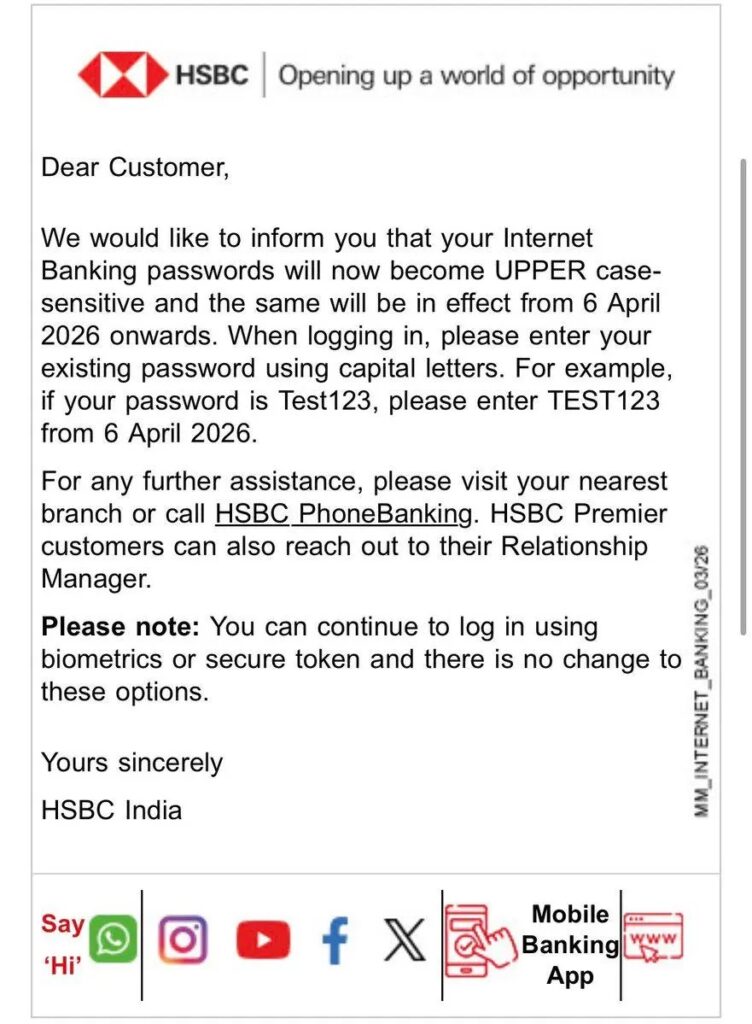
HSBC India has told customers that, from April 6, 2026, they must enter their existing internet banking passwords in uppercase letters when they sign in. That instruction has drawn attention because HSBC India’s own online banking FAQ still says internet banking passwords are not case-sensitive.
The policy change matters because it appears to alter how existing passwords are processed without forcing a full password reset first. If a customer previously used a password such as “Test123,” the reported instruction says they should now type “TEST123” instead. The wording that circulated publicly matches screenshots of a branded customer email, but HSBC’s public FAQ has not yet been updated to reflect the same change.

Access content across the globe at the highest speed rate.
70% of our readers choose Private Internet Access
70% of our readers choose ExpressVPN

Browse the web from multiple devices with industry-standard security protocols.

Faster dedicated servers for specific actions (currently at summer discounts)
At the same time, this does not automatically prove HSBC stored passwords in plaintext. A legacy login system could have normalized passwords to uppercase before hashing or verification, which would still be a weak design choice, but it would not be the same as storing readable passwords. What is clear is that uppercase-only entry reduces effective password complexity for users who relied on mixed case.
Why the change is raising questions
The biggest issue is the contradiction between the reported customer message and HSBC India’s live help documentation. On its FAQ page, HSBC India says, “Your password is not case sensitive.” If customers now need to type all letters in uppercase, then the bank’s public guidance and its customer messaging point in different directions.
That mismatch creates both security and usability risk. Customers may try to log in the old way, fail, and then assume there is a broader outage or account issue. In banking, even a small login-policy change can cause lockouts, more support calls, and confusion around phishing, especially when the bank also warns users not to trust unusual credential prompts.
The security criticism also has a technical basis. When a system stops distinguishing between uppercase and lowercase letters, the number of possible password combinations falls. That does not make every account easy to crack overnight, but it does make mixed-case passwords less strong than they were before.
What HSBC says publicly today
HSBC India’s public materials still describe its online banking password as an “8-30 character alphanumeric Password” for online banking access. The bank also tells users to choose a unique password and says no staff member will ever ask for it. Those statements remain standard and sensible, but they do not explain the uppercase-only instruction now circulating among customers.
HSBC India also continues to push stronger login layers around its app. Its Digital Secure Key documentation says customers can generate one-time security codes through the HSBC India mobile app, and the online banking section describes that feature as a replacement for the physical security device. That means the password change sits inside a broader authentication flow rather than acting as the bank’s only line of defense.
Still, the central question remains unanswered in public: why change the expected input to uppercase for existing passwords instead of requiring users to create a new one under updated rules. Until HSBC India publishes a technical explanation or updates its help pages, customers and security teams will keep asking whether this came from a legacy design decision, a backend migration, or a login-normalization issue that should have been retired years ago.
What this likely means in practice
| Issue | What it suggests |
|---|---|
| Public FAQ says passwords are not case-sensitive | Existing documentation has not caught up, or the bank changed behavior without updating help pages |
| Customers reportedly told to type old passwords in uppercase | The backend may normalize case during verification |
| No public reset-first instruction | HSBC may be preserving compatibility with existing credentials |
| Mixed-case value reduced | Password strength drops if case no longer matters |
What customers should do now
- Check for a fresh message from HSBC India inside official channels before following any unusual login instruction.
- Log in only through HSBC India’s official website or mobile app.
- If access fails after April 6, use the bank’s official recovery or support flow rather than trying repeated guesses.
- Consider resetting the internet banking password once logged in, especially if it was reused elsewhere.
- Keep Digital Secure Key or other bank-supported second-factor protections active.
Security impact at a glance
| Area | Likely impact |
|---|---|
| User confusion | High |
| Support burden | High |
| Mixed-case password strength | Lower than before |
| Proof of plaintext storage | Not established by public evidence alone |
| Need for official clarification | High |
FAQ
Yes. HSBC India’s online banking FAQ currently says, “Your password is not case sensitive.”
No. Public evidence does not prove that. It could point to a weaker legacy design where the system normalized case before verification, which still raises concerns, but that is not the same as confirmed plaintext storage.
Because changing effective password behavior without a reset can reduce password strength, confuse customers, and suggest outdated authentication logic. Those concerns grow when the bank’s own public FAQ still describes passwords differently.
Customers should use only official HSBC India channels, avoid email links if unsure, keep second-factor protections enabled, and reset passwords through official recovery paths if they have concerns or login trouble.


Read our disclosure page to find out how can you help VPNCentral sustain the editorial team Read more


Improve this guide


User forum
0 messages