
Lucid Stealer Targets Browsers, Crypto Wallets, Discord Tokens, and Adds Hidden Remote Access


 9 min. read
  Published on

A newly analyzed Windows malware called Lucid Stealer can steal browser data, cryptocurrency wallet information, Discord tokens, Roblox sessions, and other sensitive data while also giving attackers hidden remote access to infected systems.
Security researchers at Foresiet said Lucid Stealer is not just a basic credential thief. Their Lucid Stealer malware analysis found a commercial malware-as-a-service operation promoted through Telegram-linked channels and backed by a web panel, license keys, and customer support.

Access content across the globe at the highest speed rate.
🔥 Save 81% + 2 bonus months! 🔥
70% of our readers choose Private Internet Access
70% of our readers choose ExpressVPN
2
Browse the web from multiple devices with industry-standard security protocols.
🔥 Save 73%! 🔥

Faster dedicated servers for specific actions (currently at summer discounts)
🔥 Save 69%! 🔥
The analyzed sample targets 18 browsers, 21 cryptocurrency clipper formats, seven desktop wallets, seven wallet browser extensions, and four Discord client variants. It also includes keylogging, screenshots, file management, remote shell access, DDoS support, and HVNC-style hidden desktop control.
Lucid Stealer is packaged inside a legitimate Node.js runtime
The malware arrives as a password-protected ZIP archive. Inside it sits a large Windows x64 executable that looks like a Node.js application but carries a malicious embedded payload.
This packaging matters because Node.js can create single executable applications that bundle JavaScript code into a standalone binary. The official Node.js documentation says this feature lets developers distribute a Node.js application to systems that do not already have Node.js installed.
Lucid Stealer abuses that same general idea as a concealment layer. Foresiet said the inner executable is roughly 100 MB and contains an embedded NODE_SEA_BLOB JavaScript loader of about 8.5 MB, which stages helper components and decrypts the second-stage stealer and remote access payload.
| Feature | Observed Lucid Stealer behavior | Risk to victims |
|---|---|---|
| Browser theft | Targets saved credentials, cookies, autofill data, and browser history. | Attackers can hijack accounts and reuse stolen sessions. |
| Crypto theft | Targets wallet files, wallet extensions, and clipboard wallet addresses. | Funds can be stolen or redirected during transactions. |
| Discord theft | Steals Discord tokens and injects code into Discord clients. | Attackers can take over accounts or spread follow-on attacks. |
| Hidden remote access | Includes HVNC, remote shell, screenshots, keylogging, and file management. | Operators can control the machine without obvious visual signs. |
| Persistence | Creates a WindowsUpdate autorun entry under HKCU Run. | The malware can start again after reboot. |
The stealer goes after browser credentials and session data
Lucid Stealer uses a bundled SQLite helper to query copied browser databases. That allows it to collect stored logins, cookies, autofill records, and browser history from many Chromium-based and other supported browsers.
This behavior matches a well-known attacker technique. MITRE ATT&CK explains that attackers can acquire credentials from web browsers by reading browser-specific files, including database files that store saved usernames and passwords.
Browser cookies and tokens create a major risk because they can let attackers access accounts without immediately needing the victim’s password again. For businesses, that means a single infected workstation can expose email, cloud storage, collaboration tools, developer accounts, and financial platforms.
Discord, Roblox, and crypto users face extra risk
The malware includes dedicated logic for Discord theft and injection. It can steal tokens from Discord clients and modify client files so stolen data continues to flow back to the attacker.
Lucid Stealer also targets Roblox session data and cryptocurrency assets. Its clipper module monitors clipboard activity and can replace copied wallet addresses with attacker-controlled addresses, although Foresiet said the clipper was present but disabled in the recovered build.
The wallet targeting covers both desktop wallets and browser extensions. That combination makes the malware dangerous for users who manage crypto assets from the same Windows profile they use for browsing, gaming, messaging, and payments.
- Targets include 18 browsers and four Discord client variants.
- The analyzed build includes 21 cryptocurrency clipper formats.
- Seven desktop wallets and seven wallet extensions appear in the configured target list.
- Browser cookies, saved passwords, Discord sessions, Roblox sessions, and wallet material should be treated as exposed after infection.
Hidden remote access makes infections full compromise events
Lucid Stealer’s remote access module makes it more serious than many commodity stealers. The sample includes HVNC-style hidden desktop control, which can let an operator interact with a separate desktop session without displaying a normal window to the victim.
The malware also supports keylogging and screen capture. MITRE ATT&CK describes input capture as a technique where attackers collect user input, including keystrokes, to obtain credentials or other sensitive information.
Combined with a remote shell and file manager, these functions can give attackers broad control after the first run. They can steal files, watch activity, capture credentials as they are typed, issue commands, and potentially stage additional payloads.
| Capability | What it enables | Defender priority |
|---|---|---|
| HVNC | Hidden desktop control without a visible user window. | Watch for unusual native modules and remote-control behavior. |
| Keylogger | Captures typed passwords, messages, and sensitive entries. | Force password resets after containment. |
| File manager | Allows browsing, upload, download, and deletion of files. | Review data access and outbound transfers. |
| Remote shell | Lets operators run commands on the victim machine. | Hunt for child processes and unusual command execution. |
| Screenshots | Captures visible activity and sensitive windows. | Assume exposed content may include personal and business data. |
The infection chain creates several useful detection points
The infection begins with a password-protected archive and moves through several layers. The Node.js wrapper extracts and runs the embedded loader, writes helper files, creates persistence, attempts elevation, decrypts the main JavaScript payload, and connects to command-and-control infrastructure.
The same Node.js single executable application model can serve legitimate software, so defenders should not block Node.js binaries blindly. Instead, they should focus on suspicious staging patterns, unexpected .node modules, persistence entries, and network behavior tied to unknown executables in user-writable locations.
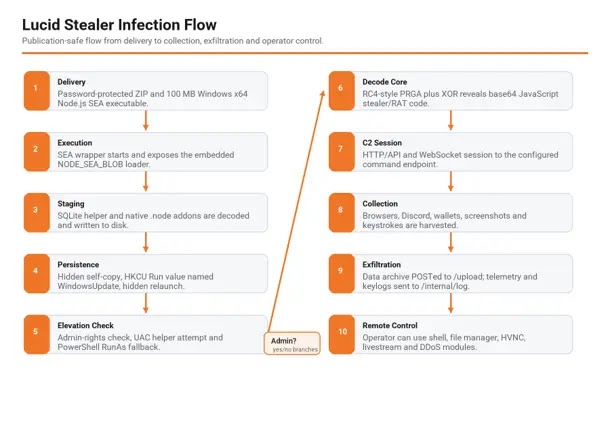
Foresiet said the operators briefly closed the project in May 2026, then returned with claims of a rebuilt site and a possible future shift from Node.js to Java for better evasion and performance. That means hash-only detection will likely age quickly.
- Look for self-copies named %TEMP%\winupd_<random>.exe.
- Monitor %TEMP%\_sq3e_<pid>.exe for a dropped SQLite helper.
- Review %LOCALAPPDATA%\Common\<id>\*.node for unexpected native addons.
- Alert on HKCU\Software\Microsoft\Windows\CurrentVersion\Run\WindowsUpdate pointing to a suspicious loader copy.
- Watch for %TEMP%\Data_<hwid>.zip as a staged exfiltration archive.
- Investigate repeated traffic to /upload, /internal/log, /dc-injector, and /ws endpoints.
Indicators linked to the analyzed Lucid Stealer build
The indicators below come from the analyzed build and related infrastructure context. Security teams should use them as hunting leads together with endpoint behavior, not as the only basis for response.
| Type | Indicator | Description |
|---|---|---|
| SHA-256 | a380e66f381c9f88f4f221906f12b73e1f43517c8e5f6affcaca71fad3340d5f | Outer WinZip-AES password-protected ZIP archive |
| SHA-256 | 101351cff5f971cd39bd6280be02a5e0e8f08d9874cae78b971e3a421a7050f6 | Inner Windows x64 Node.js SEA executable |
| SHA-256 | 8422c48d6301426a39bf9b3d7f11bdbee7708e8a4e58171f38a5b5e51a8a53b8 | Embedded NODE_SEA_BLOB JavaScript loader |
| SHA-256 | cad3f0dde70a5d37c996abee75f39aff8e7603862f071a8c85cb48ee5482750f | Decrypted JavaScript stealer and RAT core |
| IP address | 45[.]138[.]16[.]107:3001 | Hard-coded command-and-control endpoint in the sample |
| IP address | 85[.]239[.]155[.]68 | Resolving infrastructure for lucidstealer[.]one during analysis |
| Domain | lucidstealer[.]one | User-supplied panel domain |
| Domain | iloveyoulucid[.]space | User-supplied panel domain observed in infrastructure context |
| URI | /upload | Stolen-data archive upload endpoint |
| URI | /internal/log | Metadata and keylog telemetry endpoint |
| URI | /dc-injector | Discord injection payload retrieval endpoint |
| URI | /ws | WebSocket C2 communication path |
| Registry key | HKCU\Software\Microsoft\Windows\CurrentVersion\Run\WindowsUpdate | Autorun persistence value pointing to the loader copy |
Defenders should treat Lucid Stealer infections as full compromises
Organizations should respond to Lucid Stealer as a full endpoint and identity compromise. Removing the file is not enough because the malware can steal cookies, tokens, passwords, wallet keys, screenshots, typed data, and files before security teams detect it.
After containment, security teams should isolate the host, collect forensic data, revoke sessions, reset passwords, rotate exposed keys, reissue affected tokens, review cloud account activity, and check for unauthorized Discord, Roblox, crypto, email, and business app access.
Teams should also map detections to browser credential theft and input capture behaviors. The MITRE browser credential technique and MITRE input capture technique provide useful references for building stronger monitoring around the actions Lucid Stealer performs.
- Block known C2 infrastructure at the network edge and DNS layer.
- Monitor for unexpected Node.js executables in temporary or user profile paths.
- Alert on unknown .node modules written under %LOCALAPPDATA%\Common.
- Inspect Discord client modifications and token theft behavior.
- Rotate browser sessions and invalidate cookies after infection.
- Reset passwords from a clean device, not from the infected machine.
- Move crypto funds to new wallets if any wallet material was stored on the host.
The Foresiet analysis shows how commodity stealers continue to evolve into hybrid theft and remote-access platforms. For users and businesses, the main lesson is clear: once this malware runs, every browser session, wallet, token, and account used on that Windows profile should be treated as exposed.
FAQ
Lucid Stealer is a Windows information stealer and remote-access trojan promoted as a commercial malware-as-a-service product. It targets browser data, crypto wallets, Discord tokens, Roblox sessions, files, screenshots, and typed input.
Lucid Stealer combines credential theft with hidden remote access. It can steal passwords, cookies, tokens, wallet data, and files while also giving attackers remote shell, file manager, screenshot, keylogging, and HVNC-style hidden desktop control.
The analyzed build targets 18 browsers, 21 cryptocurrency clipper formats, seven desktop wallets, seven wallet browser extensions, four Discord client variants, Roblox session data, browser cookies, saved credentials, autofill data, and browser history.
Lucid Stealer is packaged inside a legitimate Node.js Single Executable Application wrapper. It also stages helper files, creates registry persistence, uses native .node modules, and runs a decrypted JavaScript payload after several setup steps.
Users should disconnect the infected device, run incident response from a clean system, reset passwords, revoke browser sessions, rotate exposed tokens, review cloud and financial account activity, and move crypto funds to new wallets if wallet data was stored on the machine.


Read our disclosure page to find out how can you help VPNCentral sustain the editorial team Read more


Improve this guide


User forum
0 messages