
Malicious NuGet Package Used One Extra “t” to Manipulate Betting Results


 8 min. read
  Published on
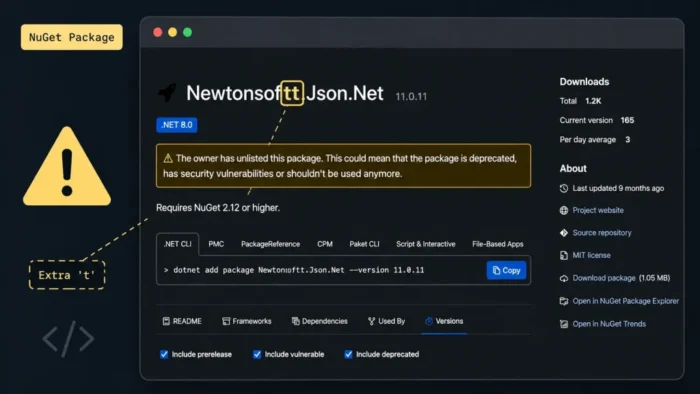
A malicious NuGet package named Newtonsoftt.Json.Net impersonated the popular Newtonsoft.Json library while hiding code designed to manipulate results in Digitain’s FG-Crash betting-game backend.
The counterfeit package added one extra “t” to the Newtonsoft name and included a misleading .Net suffix. According to JFrog Security Research, the package functioned as a normal JSON library for most developers but activated targeted fraud code when it detected Digitain’s game backend.

Access content across the globe at the highest speed rate.
🔥 Save 81% + 2 bonus months! 🔥
70% of our readers choose Private Internet Access
70% of our readers choose ExpressVPN
2
Browse the web from multiple devices with industry-standard security protocols.
🔥 Save 73%! 🔥

Faster dedicated servers for specific actions (currently at summer discounts)
🔥 Save 69%! 🔥
The threat actor published seven malicious versions between August 13 and October 10, 2025. NuGet later removed the package from search results, and its gallery listing now states that the package violated its terms and can no longer support installation or restoration.
Typosquatting Made the Package Look Legitimate
Typosquatting relies on package names that closely resemble trusted dependencies. A developer searching quickly or typing the name manually could mistake Newtonsoftt.Json.Net for the genuine Newtonsoft.Json package.
The attacker also copied metadata from the legitimate project. The package claimed James Newton-King as its author, linked to the official Json.NET website, used the Json.NET title, referenced the MIT licence, and followed a believable 11.0.x version pattern.
The real Newtonsoft.Json package uses the shorter name without the extra “t” or .Net suffix. Its current stable release is version 13.0.4, while NuGet reserves its package prefix to help users identify the authentic library.
| Detail | Malicious package | Official package |
|---|---|---|
| Package name | Newtonsoftt.Json.Net | Newtonsoft.Json |
| Notable difference | Extra “t” and added .Net suffix | Original name |
| Observed versions | 11.0.4 to 11.0.11, with gaps | Current stable version 13.0.4 |
| Purpose | Targeted betting-result manipulation | Legitimate JSON serialization |
| Current NuGet status | Deleted and unavailable for restore | Available with a reserved prefix |
Why Applications Continued Working Normally
The package contained a trojanized fork of Newtonsoft.Json 13.0.3. It preserved the genuine library’s normal serialization features, so applications could build successfully and pass routine tests after developers installed it.
Inside its lib/net8.0 directory, the package included three assemblies. NuGet automatically references assemblies in this directory, allowing the malicious payload to load without requiring developers to call it directly.
- Newtonsoft.Json.net.dll, a trojanized fork containing the activation trigger
- Newtonsoft.Values.Net.dll, the malicious game-rigging payload
- 0Harmony.dll, the legitimate HarmonyLib runtime-patching library
HarmonyLib itself did not contain malicious code. The attacker used its runtime-patching features to modify a game function after the host application loaded the package.
A Modified JSON Setting Triggered the Payload
The malicious code connected itself to the JsonConvert.DefaultSettings property setter. Applications commonly use this property during startup to define global JSON serialization settings.
When an application assigned DefaultSettings, the trojan replaced the selected contract resolver with its own resolver. It then scheduled the runtime patch through a timer rather than activating it immediately.
This delay reduced the chance that developers would notice suspicious behavior during application startup or initial testing. Some versions waited ten minutes, while earlier variants could wait until approximately 3 p.m. on the following day and add a random delay.
The Trojan Targeted Digitain’s FG-Crash Backend
The payload searched for a specific class and method in Digitain’s betting software:
| Target class | Digitain.FG.SharedCrash.GameLogic.SharedCrashRules |
|---|---|
| Target method | GenerateGameResult |
| Target product | Digitain or BetOnGames FG-Crash |
| Modification tool | HarmonyLib |
| Harmony identifier | com.example.harmony |
FG-Crash belongs to a category of crash-style betting games in which a multiplier increases until the round ends. Players must cash out before the multiplier stops to collect winnings.
By altering GenerateGameResult, the payload could change the crash multiplier returned by the game backend. The attacker could schedule selected outcomes and gain advance knowledge of manipulated rounds.
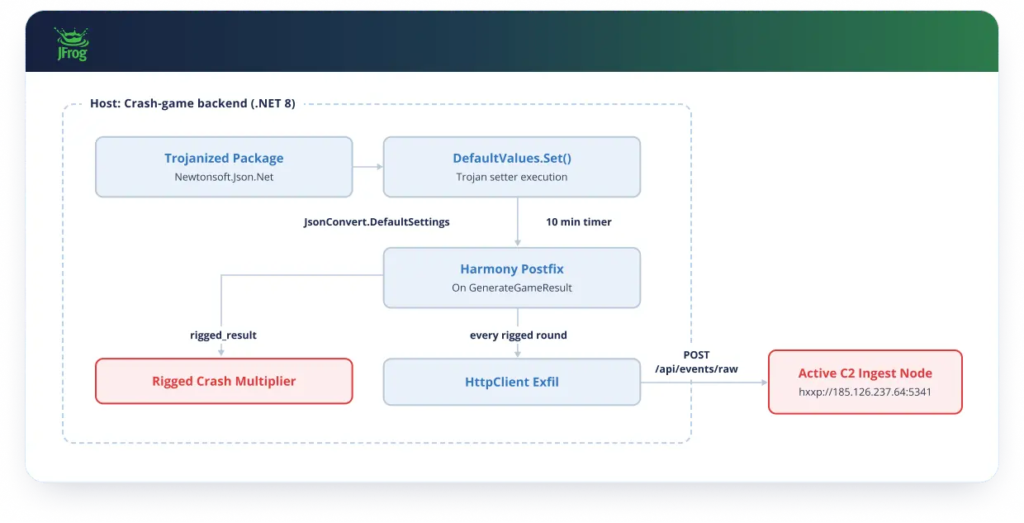
The malicious package metadata also exposed an internal Digitain Team Foundation Server repository connected to BetOnGames and FG-Crash. Every published version included this information, suggesting that the package creator had access to internal project details or source code.
Seven Versions Developed Across Three Generations
JFrog divided the seven package versions into three malware generations. The attacker changed the obfuscation, result-manipulation method, and data-exfiltration process over time.
| Version | Generation | Obfuscation | Upload date |
|---|---|---|---|
| 11.0.4 | Generation 2 | Heavy ConfuserEx | August 13, 2025 |
| 11.0.5 | Generation 2 | Heavy ConfuserEx | August 16, 2025 |
| 11.0.7 | Generation 1 | Dotfuscator | August 16, 2025 |
| 11.0.8 | Generation 1 | Dotfuscator | August 16, 2025 |
| 11.0.9 | Generation 2 | Heavy ConfuserEx | August 16, 2025 |
| 11.0.10 | Generation 3 | Light ConfuserEx | October 6, 2025 |
| 11.0.11 | Generation 3 | None | October 10, 2025 |
Generation 1 acted like a local proof of concept. It patched the target method and printed manipulated values to the console but did not send results to an external server.
Generation 2 introduced data exfiltration and used reflection, encrypted constants, and heavy ConfuserEx obfuscation to hide its network activity. Generation 3 simplified the manipulation method and stabilized the exfiltration process.
Version 11.0.11 contained no code obfuscation. This exposed the command-and-control address, API key, request structure, and target method, helping researchers reconstruct the complete operation.
Latest Version Disguised Exfiltration as Logging Traffic
Version 11.0.11 sent manipulated game results to an attacker-controlled server. It formatted the requests to resemble events sent to Seq, a structured logging platform commonly used with .NET applications.
The malware used the /api/events/raw path, a JSON event structure, and an X-Seq-ApiKey header. This design could make malicious outbound traffic resemble ordinary application telemetry.
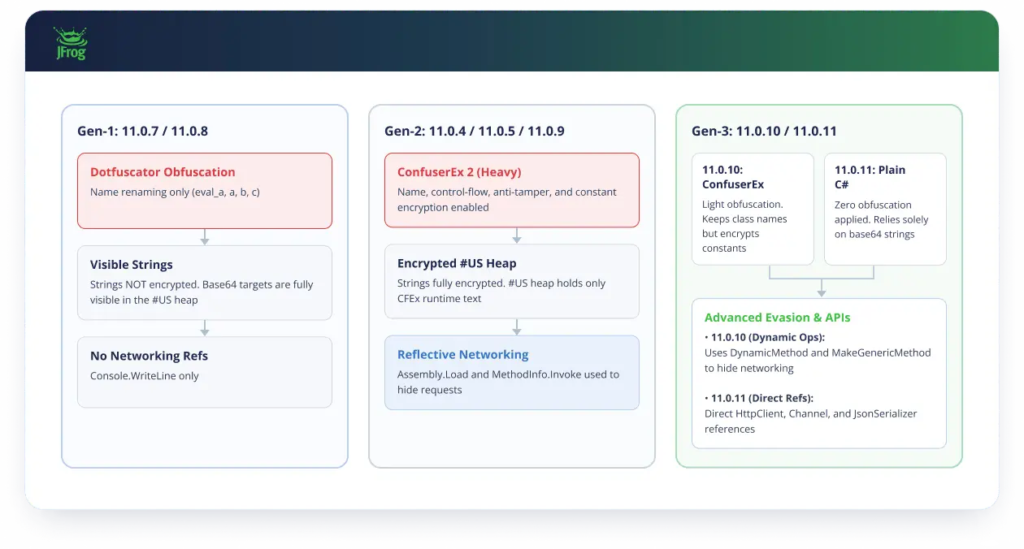
The attacker could use the transmitted data to learn manipulated round results in advance, confirm that the payload remained active, and maintain an external record of the fraud.
| Indicator type | Indicator |
|---|---|
| JFrog detection | XRAY-1019668 |
| Malicious package | Newtonsoftt.Json.Net |
| Command-and-control host | 185.126.237[.]64:5341 |
| Request path | /api/events/raw |
| HTTP header | X-Seq-ApiKey: theperfectheist2025 |
| Payload assembly | Newtonsoft.Values.Net.dll |
| Trojanized assembly | Newtonsoft.Json.net.dll |
| Runtime-patching assembly | 0Harmony.dll |
Other Developers May Not Have Seen Malicious Activity
The payload required two specific conditions. The application had to assign JsonConvert.DefaultSettings, and the host needed to expose Digitain’s FG-Crash GenerateGameResult method.
Applications without that method could continue using the counterfeit package as a functional JSON library. Developers might see no errors, suspicious output, credential theft, or obvious system changes.
JFrog found no credential-stealing, lateral-movement, or traditional host-persistence features. The package focused on compromising the integrity of one betting-game backend rather than infecting large numbers of unrelated systems.
Digitain Says It Resolved the Issue
JFrog informed Digitain about the package on July 7, 2026. Digitain responded on July 9 and said it already knew about the issue and had resolved it.
Neither JFrog nor Digitain disclosed whether the malicious package ever ran on production systems. As a result, researchers cannot confirm whether attackers successfully manipulated live betting rounds or caused financial losses.
The official NuGet package page now says NuGet deleted the content because it violated the platform’s terms. Developers can no longer install or restore the package directly from the public gallery, but cached copies and internal mirrors may remain available inside organizations.
How Developers Should Remove the Malicious Package
Teams should search source repositories, project files, dependency manifests, lock files, build records, artifact repositories, and internal package mirrors for Newtonsoftt.Json.Net and its seven known versions.
- Remove every Newtonsoftt.Json.Net dependency reference.
- Replace it with the official Newtonsoft.Json 13.0.4 release or another approved version.
- Delete newtonsoftt.json.net from global NuGet caches.
- Remove cached packages from internal feeds and artifact repositories.
- Perform a clean package restore, rebuild, and deployment.
- Block outbound connections to 185.126.237[.]64 on port 5341.
- Search historical network logs for connections to the listed host and port.
- Review build logs to identify when teams introduced or restored the dependency.
- Check deployed systems for the malicious DLLs and known SHA-256 hashes.
Developers should also use packages.lock.json or central package management to pin approved dependency versions. Private package feeds can apply allowlists and block packages whose names closely resemble trusted dependencies.
Organizations should verify package identity through the exact package name, reserved-prefix status, owner information, download history, source repository, and digital signature. A functioning dependency does not prove that the package came from the expected publisher.
The full JFrog investigation includes the SHA-256 hashes for every observed payload version. Security teams can use those hashes alongside the package name, network address, header value, and targeted method during incident-response searches.
FAQ
Newtonsoftt.Json.Net was a malicious NuGet package that impersonated the legitimate Newtonsoft.Json library. It contained targeted code designed to manipulate results in Digitain’s FG-Crash betting backend.
JFrog identified versions 11.0.4, 11.0.5, 11.0.7, 11.0.8, 11.0.9, 11.0.10, and 11.0.11 as malicious.
No. NuGet deleted the package and now blocks installation and restoration. However, organizations may still hold copies in local caches, build artifacts, or internal package mirrors.
The package could load in any application that referenced it, but its game-rigging code required Digitain’s specific FG-Crash backend method. Other applications could appear to operate normally.
Developers should remove the counterfeit package and use the official Newtonsoft.Json package from its verified NuGet listing. Version 13.0.4 is the latest stable release.


Read our disclosure page to find out how can you help VPNCentral sustain the editorial team Read more


Improve this guide


User forum
0 messages