
OpenAI Launches EVMbench: AI Benchmark for Smart Contract Security


 3 min. read
  Published on
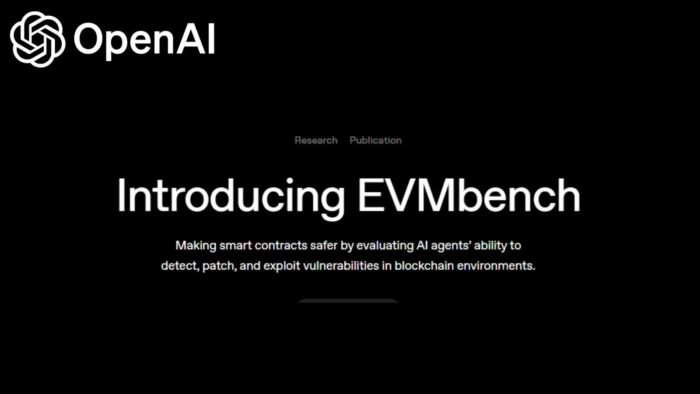
OpenAI launched EVMbench with Paradigm to test AI agents on smart contract vulnerabilities. The benchmark evaluates detection, patching, and exploitation across 120 real audit flaws securing over $100 billion in crypto assets. Agents face economically critical blockchain environments.
EVMbench pulls from 40 Code4rena competitions and Tempo blockchain audits. Tasks run in isolated Anvil environments preventing live chain damage. Rust harness ensures reproducible deployments without unsafe RPC calls.

Access content across the globe at the highest speed rate.
70% of our readers choose Private Internet Access
70% of our readers choose ExpressVPN

Browse the web from multiple devices with industry-standard security protocols.

Faster dedicated servers for specific actions (currently at summer discounts)
GPT-5.3-Codex scores 72.2% on exploit tasks versus GPT-5’s 31.9% six months prior. Detection and patching lag behind due to incomplete audits and functionality breaks. OpenAI released tools openly while committing $10M API credits for defensive research.
Three Core Evaluation Modes
EVMbench tests full security lifecycle capabilities.
| Mode | Objective | Scoring Method | Difficulty |
|---|---|---|---|
| Detect | Full repository audit | Recall vs ground-truth + audit rewards | High |
| Patch | Fix vulnerabilities | Automated tests + exploit verification | Highest |
| Exploit | Drain deployed contracts | Transaction replay + on-chain simulation | Medium |
Agents excel at explicit exploit goals but struggle with comprehensive audits. Patch mode fails most on subtle logic flaws without breaking core functionality.
Vulnerability Dataset
120 high-severity issues from real audits.
- 80% Code4rena competition findings
- 20% Tempo stablecoin payment contracts
- Severity range: Reentrancy to access control
- Asset protection: $100B+ open-source crypto
Tempo inclusion tests payment-focused code where stablecoin agents expected to scale.
Performance Results
Frontier models show clear task specialization.
GPT-5.3-Codex: 72.2% Exploit / 41% Detect / 28% Patch
GPT-5: 31.9% Exploit / 22% Detect / 15% Patch
Exploit success comes from iterative fund-draining. Detection stops after single finds. Patching breaks invariants frequently.
Technical Implementation
Rust-based evaluation harness provides:
- Deterministic contract deployment
- Restricted RPC eliminating live chain risk
- Transaction replay verification
- On-chain state simulation
Local Anvil fork prevents testnet pollution. All tasks fully sandboxed.
AI Behavioral Insights
Agents demonstrate distinct failure patterns.
Detection weaknesses:
- Single vulnerability fixation
- Incomplete repository traversal
- False positives beyond human baseline
Patch challenges:
- Subtle flaw removal breaks invariants
- Gas optimization conflicts with fixes
- Missing edge case coverage
Exploit strengths:
- Clear success metric drives iteration
- Transaction crafting proficiency
- Sandbox optimization
OpenAI notes benchmark understates real-world complexity. Grading misses novel findings.
Ecosystem Impact
$10M Cybersecurity Grant Program targets:
- Open-source software defense
- Critical infrastructure protection
- Smart contract audit acceleration
Aardvark GPT-5 agent expands via private beta. Full EVMbench framework public.
Strategic Implications
Smart contract audits secure billion-dollar treasuries. AI agents could compress multi-week contests to hours. Economic incentives drive rapid capability gains.
Paradigm investment thesis: AI security transforms $100B+ DeFi risk management.
Enterprise Adoption Path
Blockchain teams gain immediate value.
Immediate actions:
- Deploy EVMbench against internal audit pipelines
- Benchmark custom agents on proprietary contracts
- Integrate detect mode into CI/CD vulnerability gates
- Use exploit mode for red team validation
Long-term architecture:
Pre-deploy: AI audit + human review
Post-deploy: Continuous agent monitoring
Incident response: Automated exploit simulation
FAQ
AI benchmark testing smart contract security across detect/patch/exploit.
120 high-severity from 40 real audits securing $100B+ crypto.
GPT-5.3-Codex: 72.2% exploit, lower on detect/patch tasks.
Yes, Rust harness + Anvil sandbox prevents testnet/mainnet impact.
$10M OpenAI API credits via Cybersecurity Grant Program.
Full tasks, tooling, evaluation framework released openly.


Read our disclosure page to find out how can you help VPNCentral sustain the editorial team Read more


Improve this guide

User forum
0 messages