
OWASP Smart Contract Top 10 2026: Critical Web3 Vulnerabilities Ranked


 3 min. read
  Published on

OWASP released the Smart Contract Top 10 for 2026, ranking the most dangerous smart contract flaws based on 2025 incidents. This awareness document guides Web3 developers, auditors, and teams building DeFi protocols. It projects highest-impact risks from real breach data.
Attackers now chain vulnerabilities instead of single bugs. Flash loans amplify logic flaws. Oracle manipulation drains liquidity pools. Over $2.2 billion lost shows urgency. The list evolved from 2025 rankings with new threats emerging.

Access content across the globe at the highest speed rate.
70% of our readers choose Private Internet Access
70% of our readers choose ExpressVPN

Browse the web from multiple devices with industry-standard security protocols.

Faster dedicated servers for specific actions (currently at summer discounts)
SC01 Access Control tops the chart. Unauthorized roles call privileged functions. Full protocol takeovers result. SC02 Business Logic moved to second place. Design flaws break lending or governance rules despite clean code.
SC03 Price Oracle Manipulation ranks third. Weak feeds let attackers borrow under-collateralized assets. SC04 Flash Loan Attacks exploit small bugs with massive uncollateralized loans in one transaction. Single tx drains become routine.
SC05 Input Validation gaps corrupt state. SC06 Unchecked External Calls enable reentrancy. Arithmetic precision issues (SC07) and classic reentrancy (SC08) persist. Integer math failures (SC09) wrap values breaking invariants.
SC10 Proxy & Upgradeability enters as new entry. Weak governance lets attackers seize upgrade control or reinitialize contracts maliciously.
Top 10 Rankings Table
| Rank | Vulnerability | Impact Example |
|---|---|---|
| SC01 | Access Control | Unauthorized admin calls drain funds |
| SC02 | Business Logic | Governance vote manipulation |
| SC03 | Price Oracle | Under-collateralized borrowing |
| SC04 | Flash Loans | Single-tx liquidity drains |
| SC05 | Input Validation | Malicious parameters corrupt state |
| SC06 | External Calls | Reentrancy withdrawals |
| SC07 | Arithmetic Errors | Rounding siphons fees |
| SC08 | Reentrancy | Multiple withdrawals pre-update |
| SC09 | Integer Overflow | Wrapped values break pools |
| SC10 | Proxy/Upgrade | Attacker controls new logic |
Business Logic jumped from lower rank as DeFi exploits evolve. Proxy flaws emerged from recent governance hacks. Insecure Randomness and DoS dropped off reflecting matured defenses.
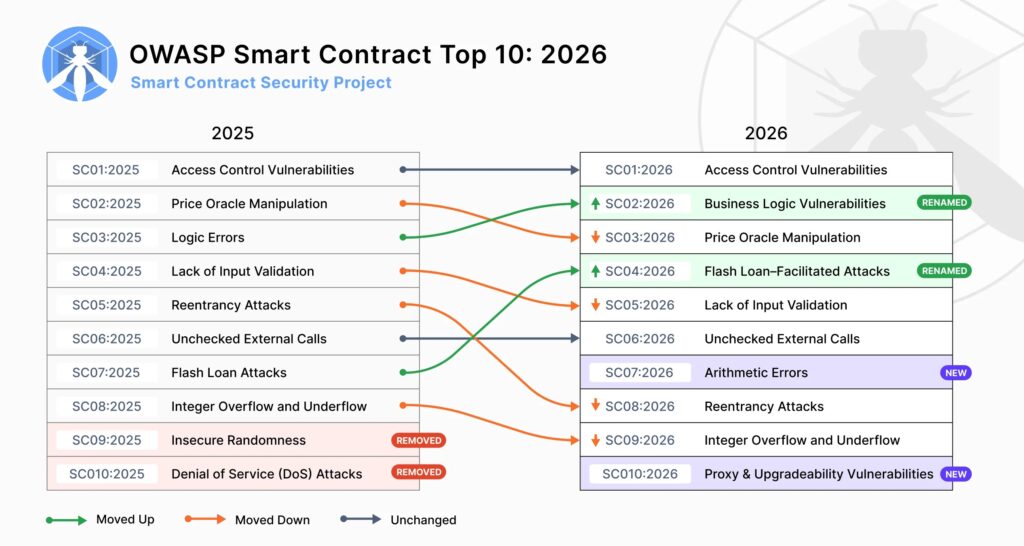
Key Changes from 2025
Business logic flaws now recognized as costliest after code bugs. Protocol design breaks economic invariants attackers exploit ruthlessly.
Upgrade patterns failed spectacularly in 2025. Weak timelocks and multisig let malicious upgrades steal billions. New SC10 addresses this gap directly.
Attackers favor flash loan combos now. Small oracle skew plus logic flaw equals catastrophe. Auditors must test chained scenarios.
Complementary Resources
OWASP SCS checklist prevents Top 10 issues during development. SC Weakness Enumeration details CWEs mapped to blockchain. Top 15 Web3 Attack Vectors covers frontend risks.
DeFi teams report $2.2B+ losses demand structured audits. OWASP framework standardizes testing across chains. Compliance reduces insurance costs significantly.
Smart contract security matured but threats accelerated. Flash loans weaponize every flaw type. Developers need vulnerability chaining in test suites.
FAQ
Business Logic to #2. New Proxy/Upgradeability #10. DoS and randomness dropped.
Amplify tiny flaws into billion-dollar drains in single transactions.
Over $2.2 billion documented. Governance flaws caused largest incidents.
SCS Checklist, SCWE mappings, Web3 Attack Vectors. Links above.


Read our disclosure page to find out how can you help VPNCentral sustain the editorial team Read more


Improve this guide


User forum
0 messages