
Private Internet Access VPN Review: Affordable, Private, and Highly Customizable


 18 min. read
  Published on
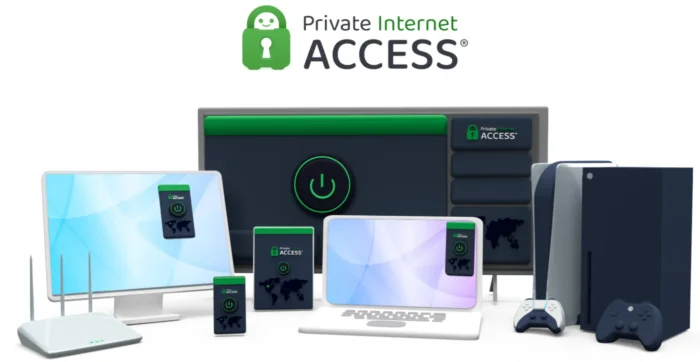
Private Internet Access is an affordable and highly customizable VPN with unlimited device connections, open-source apps, RAM-only servers, and a no-logs policy independently assessed three times by Deloitte.
PIA provides strong privacy tools and more technical controls than most consumer VPNs. Its apps support split tunneling, two kill-switch modes, automation rules, port forwarding, encrypted DNS, proxy-based multi-hop, and adjustable OpenVPN settings.

Access content across the globe at the highest speed rate.
🔥 Save 81% + 2 bonus months! 🔥
70% of our readers choose Private Internet Access
70% of our readers choose ExpressVPN
2
Browse the web from multiple devices with industry-standard security protocols.
🔥 Save 73%! 🔥

Faster dedicated servers for specific actions (currently at summer discounts)
🔥 Save 69%! 🔥
It does not lead the market in every area. Recent testing found average speeds, inconsistent streaming access, weak protection against newly discovered phishing sites, and slower customer-support responses. Even so, PIA remains a strong choice for privacy-focused users, torrenting, large households, and people who want granular control over their VPN connection.
Private Internet Access review summary
Private Internet Access, usually shortened to PIA, launched in 2010 and has become one of the longest-running consumer VPN services. Kape Technologies now owns the company.
PIA supports Windows, macOS, Linux, Android, iPhone, iPad, browser extensions, compatible smart televisions, and routers. One subscription allows unlimited simultaneous connections.
The Private Internet Access feature list confirms that every standard subscription includes the main VPN tools. PIA does not reserve essential privacy features for a more expensive premium tier.
| Category | Private Internet Access details |
|---|---|
| Best for | Advanced users, torrenting, large households, and customizable privacy |
| Device limit | Unlimited simultaneous connections |
| Server coverage | 91 countries and more than 140 locations |
| US coverage | Locations in all 50 states |
| Protocols | WireGuard and OpenVPN, with IKEv2 on iOS |
| Infrastructure | RAM-only VPN servers |
| Applications | Open-source customer apps |
| Jurisdiction | United States |
| Parent company | Kape Technologies |
| Refund period | 30 days for eligible new subscriptions |
PIA’s biggest strengths
Customization remains PIA’s main advantage. Users can modify how the VPN handles protocols, ports, DNS requests, packet sizes, encryption, applications, websites, and local networks.
The apps can look simple or detailed. Beginners can select a location and press the connection button, while experienced users can expand the interface to view performance data and technical connection details.
Unlimited connections also improve its value. One account can cover a household’s computers, phones, tablets, televisions, and other supported devices without forcing users to disconnect older devices.
- Unlimited simultaneous connections
- Open-source desktop and mobile apps
- Three independent Deloitte assessments
- RAM-only server infrastructure
- Advanced split tunneling
- Standard and advanced kill switches
- Port forwarding on supported locations
- WireGuard and configurable OpenVPN connections
- Automation rules for different networks
- Cryptocurrency and gift-card payment options
PIA’s main weaknesses
PIA operates under US jurisdiction. The United States belongs to the Five Eyes intelligence-sharing group and can issue legally binding requests to companies operating within the country.
The company says its no-logs architecture prevents it from providing browsing or VPN connection records. Its audits and transparency reports support that claim, but some users may still prefer a VPN based outside the United States.
PIA also lacks some newer cybersecurity and identity-protection tools found in competing VPN packages. Its applications remain capable, but recent product development has focused more on refining existing features than introducing major new ones.
- No permanent free subscription
- US legal jurisdiction
- Average rather than class-leading speeds
- Inconsistent streaming performance
- Weak blocking of newly created phishing URLs
- Slower support responses during testing
- Advanced settings may overwhelm beginners
- Dedicated IP and antivirus cost extra
How much does Private Internet Access cost?
PIA sells monthly, annual, and multi-year subscriptions. Every term includes the same main VPN features, unlimited connections, and access to the complete network.
The monthly plan starts at $11.95. Longer subscriptions reduce the effective monthly price, although they require a larger payment upfront and provide less flexibility.
PIA clearly displays the subscription length and renewal conditions during checkout. Prices and promotional extras can change, so customers should confirm the total payment before completing an order.
| Subscription | Typical advertised price | Billing structure |
|---|---|---|
| One month | $11.95 per month | Billed monthly |
| One year | About $3.33 per month | Billed as one annual payment |
| Long-term plan | Promotional pricing varies | Billed upfront for the full term |
PIA provides a 30-day money-back guarantee for eligible new subscriptions. Purchases through Apple or Google may follow the app store’s separate cancellation and refund rules.
Optional dedicated IP and antivirus
The standard subscription includes the complete VPN service, but PIA sells a dedicated IP address and antivirus protection as optional additions.
A dedicated IP gives one customer the same VPN address each time they connect. It can reduce CAPTCHAs and blocked logins, but it provides less crowd-based anonymity than an address shared by many users.
PIA uses a token-based system designed to separate a dedicated address from the customer’s main account. The company says this structure prevents staff from directly linking the assigned address to an individual subscriber.
Server network and locations
Private Internet Access reports coverage in 91 countries and more than 140 locations. Its network includes servers representing all 50 US states, which provides particularly extensive coverage across the United States.
The company does not publish a dependable total number of servers. This does not necessarily indicate a small network because providers count physical machines, virtual servers, and IP addresses differently.
PIA identifies virtual locations as geolocated servers. These connections provide an IP address associated with one country while the physical hardware operates elsewhere.
| Network feature | Details |
|---|---|
| Country coverage | 91 countries |
| Location coverage | More than 140 locations |
| US network | Locations in all 50 states |
| Server storage | RAM-only infrastructure |
| Virtual locations | Clearly marked as geolocated servers |
| Network capacity | 10 Gbps connections across supported infrastructure |
Why PIA uses virtual server locations
Virtual locations allow PIA to offer IP addresses in countries where installing physical hardware would create operational, legal, or security problems.
They can also improve coverage in regions where suitable data centres remain limited. However, the physical route may be longer than the country displayed in the app suggests.
Users who care about the server’s physical location should check PIA’s geolocation labels before connecting. A nearby-looking virtual location may operate from another country.
PIA speed test results
PIA delivered usable but unexceptional performance in TechRadar’s latest testing. The tests used a 10 Gbps connection and measured WireGuard and OpenVPN speeds through a nearby European server.
WireGuard reached 419 Mbps, down from more than 600 Mbps in the previous testing round. OpenVPN reached 129 Mbps, falling from an earlier result of 244 Mbps.
These speeds remain sufficient for 4K streaming, browsing, video calls, torrenting, and most online games. However, several leading VPNs now deliver much faster benchmark results.
| Protocol | Latest measured speed | Previous measured speed |
|---|---|---|
| WireGuard | 419 Mbps | More than 600 Mbps |
| OpenVPN | 129 Mbps | 244 Mbps |
What the speed results mean in practice
A 419 Mbps WireGuard connection provides much more bandwidth than most households need for ordinary VPN use. One 4K stream usually requires only a fraction of that capacity.
OpenVPN’s 129 Mbps result also supports high-resolution streaming and large downloads. Users with gigabit connections will notice a larger speed reduction than those with slower home broadband.
Server distance, congestion, device hardware, local Wi-Fi, protocol settings, and internet routing can all affect performance. A nearby WireGuard location will usually provide the best starting point.
Is PIA good for gaming?
PIA can hide a player’s public IP address and reduce exposure to attacks aimed directly at the home connection. Its network also provides many regional options, particularly in the United States.
A VPN normally increases latency because it sends traffic through an extra server. It may improve ping only when the VPN route avoids a poor path used by the internet provider.
- Select the nearest available server.
- Use WireGuard for lower protocol overhead.
- Avoid multi-hop connections while gaming.
- Close downloads and background updates.
- Compare latency with and without the VPN.
- Follow the game publisher’s regional rules.
WireGuard and OpenVPN support
PIA supports WireGuard and OpenVPN across its main applications. The iOS app also provides IKEv2.
WireGuard offers faster connection establishment, efficient cryptography, and a relatively small codebase. It provides the best default choice for browsing, streaming, gaming, and downloads.
OpenVPN offers more configuration options. PIA lets users select UDP or TCP, adjust encryption, choose ports, and modify other connection settings.
| Protocol | Main advantage | Recommended use |
|---|---|---|
| WireGuard | Efficient performance | Browsing, streaming, gaming, and downloads |
| OpenVPN UDP | Balance of security and speed | General privacy and unstable networks |
| OpenVPN TCP | Reliable delivery | Networks that disrupt other VPN traffic |
| IKEv2 | Fast reconnection | Supported iPhone and iPad connections |
Adjustable OpenVPN encryption
Advanced users can choose between supported AES-128 and AES-256 configurations when using OpenVPN.
AES-128 requires slightly less processing and remains secure for normal VPN use. AES-256 provides a wider security margin but may use more processing power on older devices.
Most customers should keep PIA’s default settings. Incorrect changes can reduce performance, break the connection, or weaken other security settings.
PIA apps are open source
PIA publishes the source code for its customer applications. Researchers and developers can inspect how the apps manage connections, encryption, settings, and permissions.
The PIA open-source VPN page provides access to the public repositories for its supported apps.
Open-source software does not guarantee perfect security. It makes independent inspection possible, but users still depend on secure development, build processes, maintenance, and timely updates.
Is PIA’s entire infrastructure open source?
No. PIA publishes its customer application code, while WireGuard and OpenVPN also use open-source code. The company does not publish every internal service, server configuration, administrative system, or business process.
This distinction corrects claims that every part of PIA operates as open-source software. Customers can inspect the apps installed on their devices, while audits provide evidence about selected server-side controls.
The public PIA repositories improve transparency without exposing the complete production environment.
PIA no-logs policy
Private Internet Access says it does not store browsing history, DNS requests, original IP addresses, connection timestamps, bandwidth activity, or traffic destinations associated with VPN use.
The company still processes limited information required to manage subscriptions and customer support. This can include account credentials, payment records, and communications with support staff.
A no-logs policy does not mean a provider processes no personal information. It means the VPN says it does not retain activity data that could reconstruct a customer’s browsing or connection history.
Three independent Deloitte assessments
Deloitte Audit Romania has independently assessed PIA’s no-logs controls three times. The latest examination reviewed configurations, management systems, and dedicated IP technology used during 2025.
The third Deloitte assessment concluded in February 2026 and used the ISAE 3000 assurance standard.
The review found that the tested controls aligned with PIA’s no-logs commitments during the assessment period. It does not guarantee that the company can never suffer a breach, error, or future policy change.
| Privacy evidence | What it provides |
|---|---|
| Deloitte assessments | Independent examination of selected no-logs controls |
| Transparency reports | Figures covering legal and government requests |
| Open-source apps | Public inspection of application code |
| RAM-only servers | Reduced persistent storage on VPN machines |
| Court cases | Historical examples where PIA said it had no activity logs |
| Bug bounty program | A process for reporting security flaws |
PIA transparency reports
PIA publishes quarterly reports covering subpoenas, warrants, foreign requests, and other legal notices received by its legal department.
Its Q1 2026 transparency report covers requests received between January 1 and March 31, 2026.
PIA reported receiving 19 domestic and international requests during the quarter. It said none resulted in the production of VPN activity logs.
Why transparency reports matter
A transparency report shows how often authorities request information and how the company responds. It does not independently prove every part of a no-logs policy.
PIA combines these reports with technical controls, outside assessments, and public app code. Together, these measures provide more evidence than an unsupported privacy promise.
The latest PIA report continues the company’s practice of publishing legal-request figures every quarter.
Private Internet Access ownership
Kape Technologies owns Private Internet Access. Kape also owns ExpressVPN, CyberGhost VPN, Intego, and Webselenese.
The Kape Technologies portfolio lists PIA among its major consumer privacy and security brands.
Kape previously operated under the name Crossrider. Its former software distribution business attracted criticism because third-party developers used the platform to distribute unwanted advertising software.
Does PIA share infrastructure with other Kape VPNs?
PIA says its VPN infrastructure remains separate from other Kape-owned services. Shared ownership does not automatically mean PIA, ExpressVPN, and CyberGhost use the same apps, servers, accounts, or privacy policies.
Common ownership can still influence leadership, investment, product strategy, and corporate governance. Customers should include this relationship in their wider assessment of the service.
The Kape brand list confirms the ownership structure but does not describe a single combined VPN network.
PIA’s standard and advanced kill switches
The standard kill switch blocks internet traffic if an active PIA connection fails unexpectedly. This reduces the chance that apps expose the normal public IP address.
The advanced kill switch takes a stricter approach. It blocks all internet access unless PIA remains connected.
This mode suits users who never want traffic to leave outside the VPN. It can also make troubleshooting more difficult when the VPN app closes or cannot connect.
| Kill-switch mode | Behaviour |
|---|---|
| Off | Internet traffic continues after the VPN disconnects |
| Standard | Blocks traffic after an unexpected VPN interruption |
| Advanced | Blocks internet access unless PIA remains connected |
Advanced split tunneling
Split tunneling lets users choose which applications or destinations use the VPN. Other traffic connects through the normal internet connection.
PIA supports rules for applications, IP addresses, DNS requests, and virtual machines on compatible operating systems.
A user could route a browser and torrent client through PIA while allowing a printer utility, banking app, or local streaming service to connect directly.
- Route sensitive browsers through PIA.
- Keep torrent software inside the VPN tunnel.
- Exclude local printers and network storage.
- Allow selected banking apps to connect directly.
- Force DNS requests through PIA’s encrypted servers.
- Review exclusions after installing new software.
Automation rules
PIA can automatically connect or disconnect when a device joins specific networks. Users can apply different rules to secure Wi-Fi, public hotspots, and wired connections.
For example, the VPN can remain disconnected on a trusted home network and activate automatically when the device joins public Wi-Fi.
Automation reduces the risk that users forget to enable protection in an airport, café, hotel, or other shared location.
How PIA multi-hop works
PIA’s multi-hop feature uses a Shadowsocks or SOCKS5 proxy alongside the VPN connection. It does not route traffic through two complete VPN servers.
The proxy can obscure the VPN connection and make traffic resemble ordinary encrypted web activity. This may help on networks that block standard VPN protocols.
Multi-hop only works with supported OpenVPN configurations. Switching to WireGuard can disable the feature, so users should check the connection status after changing protocols.
PIA MACE ad and tracker blocking
MACE blocks connections to domains associated with advertising, tracking, and malicious activity. It uses DNS-based filtering rather than analysing every visible item on a webpage.
The feature can block many common advertising and tracking domains. However, it cannot remove every advertisement, particularly video ads delivered from the same domain as wanted content.
TechRadar tested MACE against 100 recently identified phishing URLs from OpenPhish. It blocked only two, suggesting that it relies heavily on known-domain lists and may miss new threats.
Do not use MACE as your only phishing protection
MACE can provide a useful extra layer, but it should not replace browser protections, endpoint security, safe browsing, or phishing-resistant multifactor authentication.
New phishing sites can appear faster than a domain blocklist can classify them. A page may also imitate a legitimate login screen without delivering malware.
- Check the complete website address before signing in.
- Use bookmarks for banking and sensitive accounts.
- Enable passkeys or security keys where available.
- Keep browser phishing protection enabled.
- Avoid opening unexpected login links.
- Report suspected phishing sites promptly.
Port forwarding and torrenting
PIA supports port forwarding on selected servers. The feature opens an inbound port through the VPN and can improve peer-to-peer connectivity.
Port forwarding represents one of PIA’s strongest advantages for torrent users because many competing VPN providers have removed it.
Opening a port can increase exposure when an application contains a vulnerability. Users should enable it only for software they understand and trust.
Is PIA good for torrenting?
PIA supports peer-to-peer traffic and provides unlimited bandwidth, port forwarding, split tunneling, a kill switch, and independently reviewed no-logs controls.
These features make it a strong option for lawful torrenting. Its speeds do not lead the market, but they remain sufficient for large downloads.
Users should bind the torrent client to the PIA network adapter where supported and enable the kill switch before starting a transfer.
PIA streaming performance
PIA’s recent streaming performance produced mixed results. It successfully accessed all Netflix regions included in TechRadar’s testing.
However, it failed to access most tested YouTube and Prime Video regions. Disney+ also failed during testing from Canada.
Streaming services regularly identify and block VPN addresses, so results can change quickly. A server that works today may stop after a platform updates its detection systems.
| Streaming service | Latest reported result |
|---|---|
| Netflix | All tested regions worked |
| YouTube | Only the UK region worked |
| Prime Video | The UK and Australia worked |
| Disney+ | Failed in the Canadian test |
PIA applications and interface
PIA provides apps for Windows, macOS, Linux, Android, iOS, and several television and browser platforms.
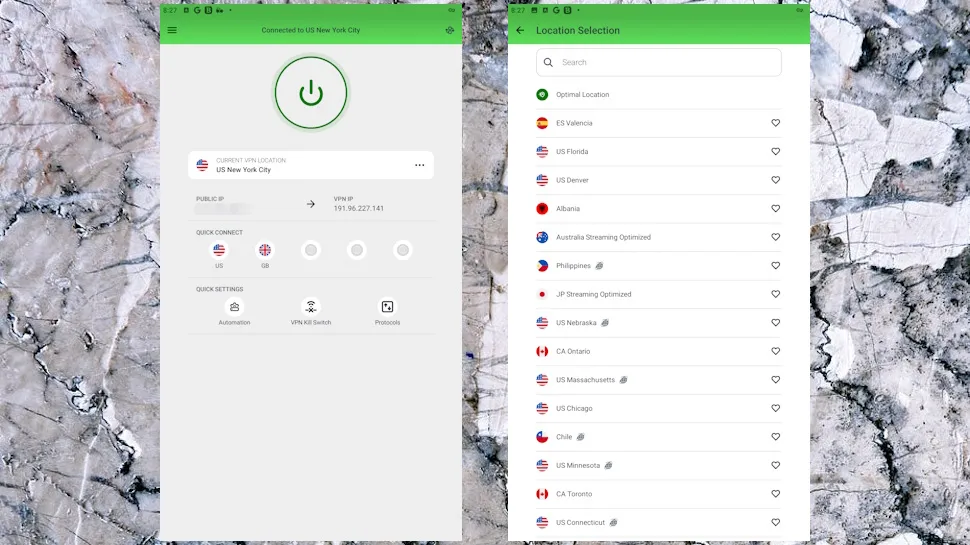
The compact interface shows a connection button, selected location, normal IP address, and VPN IP address. Users can expand it to display performance graphs, protocol details, quick controls, and session statistics.
The apps also include favourite locations, recent connections, and a snooze timer that temporarily pauses the VPN before reconnecting automatically.
Improved Android application
PIA recently redesigned its Android app to align it more closely with the desktop and iOS versions.
The updated app adds a modern interface, dark mode, advanced automation, expanded DNS controls, and more multi-hop configuration options.
The changes improve feature consistency between platforms, although exact controls still vary according to operating-system restrictions.
Is PIA easy to use?
PIA works well for beginners when they keep the compact interface and default settings. Connecting requires selecting a location and pressing one large button.
Tooltips explain many advanced controls, reducing the risk that users change an unfamiliar option without understanding it.
Power users can open the detailed view and configure the service extensively. This flexibility remains a strength, but the number of settings can still feel overwhelming.
Customer support
PIA provides 24-hour live chat, email support, a knowledge base, and a community forum.
TechRadar found that live-chat and email responses could be slow. It also encountered a broken support link and an additional email-verification step before submitting a ticket.
The knowledge base covers common installation and connection problems, but some articles need updated screenshots and more current platform details.
User reviews and reputation
PIA maintains strong ratings across several major review and app platforms. The supplied review reported a Trustpilot score of about 4.3 out of 5.
Its Google Play rating stood near 4.5, while the Apple App Store rating reached approximately 4.7. Its Chrome extension received a lower rating of about 3.2.
App-store and review-site scores can change frequently. Users should read recent reviews rather than relying only on the overall average.
Who should choose Private Internet Access?
PIA suits people who want detailed control over VPN protocols, encryption, DNS, proxies, ports, applications, and connection automation.
It also works well for large households because one subscription covers unlimited devices. Torrent users may value its port forwarding, split tunneling, and kill-switch controls.
Users who prefer open-source apps, recent privacy assessments, and quarterly transparency reports will find more supporting evidence than many VPNs provide.
Who should avoid Private Internet Access?
Users who reject VPN providers under US jurisdiction should consider another service.
Frequent streamers may also prefer a VPN with more consistent access to Prime Video, Disney+, YouTube, and regional platforms.
People seeking the fastest benchmark results, a permanent free plan, or an extensive bundle of identity-protection tools may find better alternatives.
Private Internet Access verdict
Private Internet Access remains a strong privacy-focused VPN with unlimited connections, open-source apps, RAM-only servers, extensive customization, and independently reviewed no-logs controls.
Its latest speed and streaming results prevent it from leading the overall VPN market. Weak phishing-domain blocking and inconsistent support also leave room for improvement.
PIA still earns a recommendation for power users, torrenting, large households, and customers who value transparency and control. Its affordable long-term pricing makes those strengths easier to justify.
FAQ
Yes. PIA offers unlimited connections, open-source apps, RAM-only servers, advanced split tunneling, port forwarding, and a no-logs policy assessed three times by Deloitte. Its speeds and streaming performance do not lead the market.
Kape Technologies owns Private Internet Access. Kape also owns ExpressVPN, CyberGhost VPN, Intego, and Webselenese.
PIA says it does not retain browsing history, DNS requests, original IP addresses, connection timestamps, bandwidth activity, or traffic destinations. Deloitte has assessed its no-logs controls three times.
PIA publishes the source code for its customer applications. WireGuard and OpenVPN are also open source, but PIA does not publish every server configuration or internal management system.
TechRadar recorded 419 Mbps with WireGuard and 129 Mbps with OpenVPN in its latest tests. Those speeds support streaming, gaming, and large downloads but trail the fastest VPN services.
PIA accessed all Netflix regions included in TechRadar’s latest tests. Its results were less consistent with YouTube, Prime Video, and Disney+.
Yes. PIA supports peer-to-peer traffic and provides unlimited bandwidth, port forwarding on supported servers, split tunneling, a kill switch, and independently assessed no-logs controls.
Private Internet Access allows unlimited simultaneous personal device connections under one subscription.


Read our disclosure page to find out how can you help VPNCentral sustain the editorial team Read more


Improve this guide

User forum
0 messages