
Trump Administration AI Standards Chief Chris Fall Resigns After Three Months


 10 min. read
  Published on
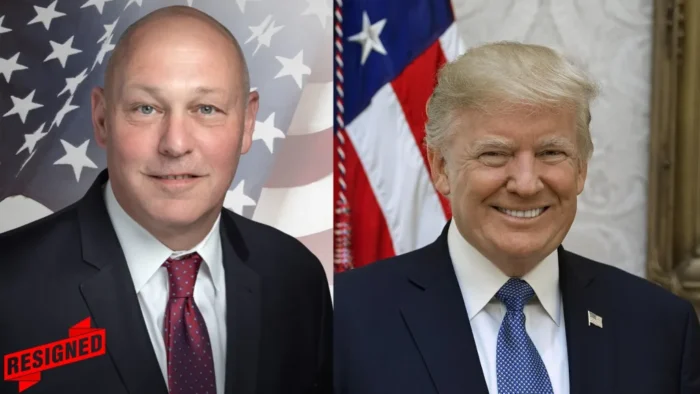
Chris Fall has resigned as director of the US Center for AI Standards and Innovation, leaving the federal AI testing organization after approximately three months in charge.
The Commerce Department confirmed his departure but did not provide a reason. NIST Director Arvind Raman will oversee the center and serve as its acting director while the department searches for a permanent replacement.

Access content across the globe at the highest speed rate.
🔥 Save 81% + 2 bonus months! 🔥
70% of our readers choose Private Internet Access
70% of our readers choose ExpressVPN
2
Browse the web from multiple devices with industry-standard security protocols.
🔥 Save 73%! 🔥

Faster dedicated servers for specific actions (currently at summer discounts)
🔥 Save 69%! 🔥
The Axios report that first disclosed Fall’s resignation said the Commerce Department expects to announce a new director in the coming weeks.
What Happened to Chris Fall?
Fall joined the Center for AI Standards and Innovation, commonly called CAISI, in April 2026. His short tenure included agreements with major AI developers and work involving national security evaluations of frontier models.
Neither the Commerce Department nor the White House explained why Fall resigned. Attempts by reporters to reach Fall for comment did not produce an immediate public response.
Reuters confirmed the leadership change and reported that Raman would take over temporarily. Raman became the 18th director of the National Institute of Standards and Technology in June 2026.
| Confirmed detail | Information |
|---|---|
| Departing official | Chris Fall |
| Former position | Director of the Center for AI Standards and Innovation |
| Appointment | April 2026 |
| Resignation confirmed | July 20, 2026 |
| Reason for departure | Not publicly disclosed |
| Acting director | Arvind Raman |
| Permanent replacement | Expected to be announced in the coming weeks |
Who Is Arvind Raman?
Raman serves as Under Secretary of Commerce for Standards and Technology and director of NIST. He previously worked at Purdue University, where he served as executive associate dean and dean of engineering.
As acting CAISI director, Raman will oversee the center while continuing to lead NIST. The arrangement places both responsibilities under one official until Commerce appoints a permanent CAISI chief.
The Commerce Department said Raman will also lead the search for Fall’s replacement. Officials reportedly want a candidate with substantial AI knowledge and technical expertise.
What Does CAISI Do?
CAISI operates within NIST, an agency of the US Department of Commerce. The Trump administration reorganized the former US AI Safety Institute under the new name in 2025.
The center serves as a government contact for AI developers, researchers, evaluators, and other federal agencies. It focuses on technical standards, security testing, commercial AI systems, and national security risks.
The official CAISI mission statement says the organization facilitates testing and collaborative research related to the security and potential of commercial AI systems.
| CAISI responsibility | Purpose |
|---|---|
| AI testing | Evaluate advanced AI systems and their capabilities. |
| Security research | Assess risks involving cybersecurity, biosecurity, and chemical weapons. |
| Standards development | Work with NIST and industry on voluntary AI standards and guidelines. |
| Developer agreements | Establish voluntary arrangements with AI companies and evaluators. |
| Foreign model assessment | Examine adversary AI systems, backdoors, and malicious behavior. |
| Federal coordination | Develop evaluation methods with defense, security, energy, and intelligence agencies. |
| International standards | Represent US interests in global AI standards discussions. |
CAISI Tests Advanced Commercial AI Models
The center works with developers including OpenAI, Anthropic, Google DeepMind, Microsoft, and xAI. Its scientists and engineers test AI capabilities and identify security weaknesses before or around deployment.
CAISI’s work includes assessing whether advanced systems could assist with cybersecurity attacks, chemical or biological threats, or efforts to compromise AI training data.
The center also evaluates foreign AI systems for covert behavior, security vulnerabilities, and national security concerns. Recent assessments have included models developed by Chinese AI companies.
Fall Signed Frontier AI Testing Agreements
During Fall’s tenure, CAISI announced voluntary agreements concerning national security testing of frontier AI systems. Fall described the agreements as part of the government’s effort to understand advanced model capabilities.
The arrangements allow AI companies and federal researchers to cooperate under confidentiality and security requirements. This can give government evaluators controlled access to models that have not received broad public distribution.
The NIST center also develops voluntary technical standards rather than acting as a conventional licensing regulator for AI companies.
Why the Leadership Change Matters
Fall’s resignation comes while federal agencies are designing new processes for evaluating AI systems with advanced cybersecurity capabilities. These models may find vulnerabilities, develop exploit code, automate reconnaissance, or strengthen defensive security work.
A permanent director would help establish priorities, coordinate work across agencies, and manage relationships with developers. An acting director can maintain operations, but prolonged interim leadership may complicate long-term planning.
The reported departure therefore affects more than one personnel position. CAISI sits at the intersection of AI development, technical standards, commercial testing, and national security policy.
Trump’s June AI Order Created a Voluntary Framework
President Donald Trump signed Executive Order 14409 on June 2, 2026. The order directs agencies to develop a classified benchmarking process for assessing advanced cyber capabilities in AI models.
The process will help officials determine when a model meets the definition of a “covered frontier model.” That designation applies within the executive order and does not create a general licensing system.
The AI innovation and security executive order gives designated federal agencies 60 days to create the benchmarking process and voluntary framework.
| Executive order provision | Requirement |
|---|---|
| Classified benchmark | Assess advanced cybersecurity capabilities in AI models. |
| Covered frontier model threshold | Determine when a model reaches capabilities covered by the order. |
| Developer participation | Voluntary rather than mandatory. |
| Government model access | Up to 30 days before release to other trusted partners. |
| Framework deadline | Within 60 days of the June 2 order. |
| Mandatory licensing | Explicitly not authorized. |
| Government preclearance | Explicitly not authorized. |
The Order Does Not Require Pre-Release Approval
Developers may ask the government to determine whether an unreleased system qualifies as a covered frontier model. They may then provide controlled access under confidentiality, cybersecurity, intellectual-property, and insider-risk protections.
The framework can give the government up to 30 days of access before a developer releases the model to other trusted partners. The order does not state that every AI model must undergo this process.
The executive order explicitly says it does not authorize mandatory government licensing, preclearance, or permitting for developing or releasing AI models.
Gold Eagle Coordinates Vulnerability Research
The same executive order called for an AI cybersecurity clearinghouse that would coordinate software vulnerability scanning, validation, remediation, and patch distribution.
The White House later announced the initiative under the name Gold Eagle. It brings government agencies, AI companies, open-source software partners, and critical infrastructure organizations into a coordinated vulnerability process.
The White House Gold Eagle announcement named the Treasury Department, Department of Homeland Security, CISA, and Department of War among the government participants.
How Gold Eagle Is Expected to Work
Gold Eagle aims to prevent several organizations from independently scanning the same software without coordination. It can help participants prioritize serious findings and direct them toward the affected maintainers.
The clearinghouse also coordinates validation and patching. This becomes important when AI systems identify vulnerabilities faster than software vendors can investigate and correct them.
- Receive vulnerability findings from participating organizations
- Coordinate scanning to reduce duplicated research
- Validate whether reported vulnerabilities are genuine
- Prioritize findings according to severity and potential impact
- Coordinate remediation with software vendors and maintainers
- Support patch development and distribution
- Protect critical infrastructure from rapidly discovered vulnerabilities
CAISI did not appear in the public list of agencies participating in Gold Eagle. However, that omission does not establish that CAISI has no supporting or future role in AI model testing connected with the initiative.
The Gold Eagle release concentrates on operational vulnerability coordination. CAISI’s published mandate focuses more directly on model evaluation, standards, and national security assessment.
David Sacks Moved to a Different Advisory Role
Fall’s departure follows another change in the administration’s AI leadership. David Sacks ended his role as the White House special adviser for AI and cryptocurrency in March 2026.
Sacks left after reaching the 130-day working limit that applies to special government employees. He did not leave the administration’s technology-policy structure completely.
A Reuters report on Sacks’ transition said he moved to co-chair the President’s Council of Advisors on Science and Technology, where he can continue making technology-policy recommendations.
| Official | Previous role | Current status |
|---|---|---|
| Chris Fall | CAISI director | Resigned, reason not disclosed |
| Arvind Raman | NIST director | Also serving as acting CAISI director |
| David Sacks | Special adviser for AI and cryptocurrency | PCAST co-chair |
Sacks’ move differs from Fall’s departure because Sacks continues to advise on AI and other technology issues through PCAST. The White House has not publicly announced a direct replacement carrying the same special-adviser title.
The leadership transition nevertheless changed how AI policy advice flows through the administration.
What CAISI Leadership Means for Cybersecurity
Advanced AI models can support vulnerability discovery, code auditing, malware analysis, incident response, and patch development. The same capabilities can create risks when used for unauthorized access or exploit generation.
CAISI helps the government measure these capabilities before relying on broad assumptions about a model’s safety or danger. Standardized testing can also make comparisons between models more meaningful.
- Automated software vulnerability discovery
- Exploit development and validation
- Large-scale phishing and impersonation
- Malicious code generation
- Cybersecurity reconnaissance
- Chemical and biological risk research
- Backdoors or covert behavior in foreign models
- Attacks against AI training data and infrastructure
The center must balance national security, voluntary industry cooperation, international competition, and the administration’s preference against burdensome regulation.
The Commerce Department’s choice of a permanent director may therefore shape how aggressively CAISI tests models, how it works with private developers, and how it contributes to government cybersecurity initiatives.
What Happens Next?
Raman will oversee CAISI while Commerce searches for a permanent director. The department expects to announce the replacement within weeks, although it has not published a precise date.
CAISI’s existing evaluations, developer agreements, research, and standards work can continue under acting leadership. The larger question concerns which priorities the next permanent director will emphasize.
Axios reported that Commerce Secretary Howard Lutnick wants a replacement with deep AI knowledge and expertise. That appointment will arrive as agencies implement the June executive order and expand Gold Eagle’s vulnerability-coordination work.
FAQ
The Commerce Department confirmed Chris Fall’s resignation but did not publicly disclose a reason. Fall and the White House had not provided a separate public explanation when the departure was reported.
NIST Director Arvind Raman is serving as acting director of the Center for AI Standards and Innovation while the Commerce Department searches for a permanent replacement.
CAISI tests advanced AI systems, develops evaluation methods and voluntary standards, works with commercial developers, and examines risks involving cybersecurity, biosecurity, chemical weapons, and foreign AI systems.
No. The order creates a voluntary framework and explicitly states that it does not authorize mandatory licensing, preclearance, or permitting for AI model development or release.
Gold Eagle is a US government and industry clearinghouse for coordinating AI-assisted vulnerability scanning, validating findings, prioritizing remediation, and helping distribute software patches.
No. Sacks ended his special government employee role as the White House AI and crypto adviser, but he continues advising on technology policy as a co-chair of PCAST.


Read our disclosure page to find out how can you help VPNCentral sustain the editorial team Read more


Improve this guide



User forum
0 messages