
How to cut MTTR by improving threat visibility in your SOC


 6 min. read
  Published on
If you want to cut MTTR in a SOC, start with better threat visibility. Faster response usually does not begin with a new dashboard. It begins with cleaner logs, stronger telemetry, richer alert context, and workflows that help analysts act without stopping to hunt for missing details. NIST says incident response depends on rapidly detecting incidents, minimizing loss, and restoring services efficiently. CISA also says event logging improves network visibility and resilience.
That matters because time still drives breach impact. IBM says the global mean time to identify and contain a breach dropped to 241 days in its 2025 report, the lowest in nine years, and it links that improvement to faster containment and greater use of AI-powered defenses. IBM also says organizations that used AI heavily in security saved an average of $1.9 million.

Access content across the globe at the highest speed rate.
70% of our readers choose Private Internet Access
70% of our readers choose ExpressVPN

Browse the web from multiple devices with industry-standard security protocols.

Faster dedicated servers for specific actions (currently at summer discounts)
So the question is not whether MTTR matters. It does. The real question is why response still drags inside many SOCs. In most cases, the answer is weak visibility at the point of triage. Analysts waste time switching tools, checking stale indicators, re-enriching the same alert, or trying to understand attacker behavior from thin evidence. CISA’s 2025 SIEM and SOAR guidance says these platforms improve visibility into network activity and help teams identify and respond more quickly.
Threat visibility also needs depth, not just volume. More logs alone do not fix MTTR. CISA’s event logging guidance says logging supports continued operations and improves resilience by enabling network visibility. MITRE describes ATT&CK as a knowledge base of adversary tactics and techniques based on real-world observations, which is exactly why behavioral context helps analysts decide what matters first.
What usually slows MTTR inside a SOC
| Visibility problem | How it slows response | What fixes it |
|---|---|---|
| Missing or inconsistent logs | Analysts cannot confirm scope quickly | Centralized logging and better source coverage |
| Too many low-quality alerts | Triage queues grow and real incidents wait | Higher-fidelity detections and better enrichment |
| No behavioral context | Teams see an IOC but not the attack story | Sandbox context, ATT&CK mapping, linked artifacts |
| Tool sprawl | Analysts keep pivoting between consoles | SIEM and SOAR integration plus API-based enrichment |
| Slow investigation handoffs | Tier 1 teams escalate too early | Better context at first touch so analysts can decide faster |
The fastest SOCs reduce MTTR by improving the first ten minutes of an investigation. If an analyst can tell whether an IP, domain, URL, hash, or process belongs to an active threat without leaving the main workflow, response gets shorter almost immediately. That is why good visibility programs focus on three things first: log quality, context quality, and workflow speed. NIST’s log management guidance says effective logging and analysis help organizations identify and investigate cybersecurity incidents.
What better visibility looks like in practice
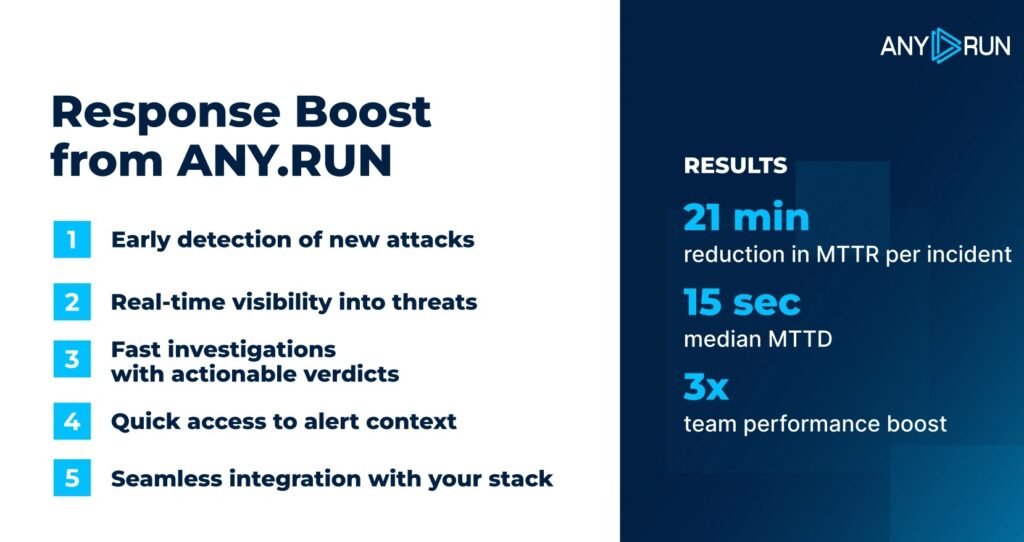
A strong visibility stack usually gives the analyst five things on first view:
- the alert itself
- the affected user, host, or asset
- related network or endpoint activity
- threat context tied to known behavior
- a clear next action for containment or escalation
When those pieces show up together, MTTR drops because the analyst spends less time collecting context and more time making decisions. IBM says AI-powered security tools can reduce alert volume, spot security gaps, detect breaches earlier, and enable faster, more precise responses.
Where threat intelligence feeds help
Threat intelligence feeds help when they improve the quality of decisions, not when they simply add more data. The useful feeds are the ones that give security teams fresh indicators, confidence in those indicators, and enough context to decide whether an alert deserves immediate action. That includes behavioral clues, malware family links, ATT&CK mapping, and integration into the tools the SOC already uses.
That is where products like ANY.RUN’s Threat Intelligence Feeds fit into the picture. On its official site, ANY.RUN says its feeds deliver fresh malicious IPs, domains, and URLs enriched with sandbox analysis, and that the data comes from malware and phishing investigations. The company also says the service supports STIX/TAXII plus API and SDK-based integration, which matters because SOC teams usually need feeds inside existing SIEM, SOAR, and TIP workflows rather than in a separate portal.
ANY.RUN also says its feeds are sourced from a community of more than 600,000 analysts and 15,000 organizations, and that 99% of the IOCs added to the feeds are unique and high confidence after validation. Those are vendor claims, but they are directly relevant to the visibility question because freshness and confidence are what keep triage queues from filling with noise.
Verified ANY.RUN details that matter for MTTR
| Verified claim from official ANY.RUN sources | Why it matters to a SOC |
|---|---|
| Threat Intelligence Feeds provide malicious IPs, domains, and URLs enriched with sandbox analyses | Analysts get context with the indicator, not just a match |
| STIX/TAXII, API, and SDK are supported | Easier ingestion into existing tools and automations |
| Indicators are linked to sandbox sessions and ATT&CK TTPs | Faster understanding of attacker behavior and better containment choices |
| ANY.RUN lists integrations or connectors for OpenCTI, QRadar SOAR, Palo Alto Cortex XSOAR, and custom API/SDK routes | Cuts manual pivoting between consoles |
| ANY.RUN says TI Feeds are meant to speed triage and response | Directly aligned with MTTR reduction goals |
Still, no feed fixes a weak SOC by itself. If logging is poor, roles are unclear, or playbooks are broken, response times stay high. CISA’s guidance on SIEM, SOAR, and event logging makes the same point in a broader way: visibility improves when the organization collects the right logs, centralizes them, and uses automation to speed investigation and response.
The practical path to lower MTTR
If you want to reduce MTTR without overcomplicating your SOC, focus on this order:
- centralize the logs that matter most
- enrich alerts before the analyst opens them
- map activity to behavior, not just static indicators
- automate the first containment or validation step
- measure response by incident type, not one blended average
That approach works because it improves the decision point, not just the data pile. Better threat visibility gives analysts a shorter path from alert to action. And that is what MTTR really measures.
FAQ
MTTR usually means mean time to respond, or the average time it takes a team to contain and remediate an incident after detection. Some organizations define it differently, so the metric only helps when the definition stays consistent. NIST and IBM both tie rapid detection and containment to better security outcomes.
Because analysts cannot respond quickly to what they cannot see clearly. CISA says event logging improves network visibility, and visibility is what lets teams detect, investigate, and contain threats sooner.
They can, if they improve alert quality and add context at triage time. Feeds help most when they are fresh, high confidence, behavior-linked, and integrated into the SOC’s main workflow.
No. Better logging, stronger SIEM coverage, better SOAR playbooks, ATT&CK-based investigation, and cleaner detections all help. ANY.RUN is one vendor example because its official material explicitly connects TI Feeds with faster triage and response.


Read our disclosure page to find out how can you help VPNCentral sustain the editorial team Read more


Improve this guide




User forum
0 messages