
Hackers Abuse Residential Proxy Networks to Hide Malicious Traffic


 10 min. read
  Published on

Hackers are abusing residential proxy networks to make malicious activity look like normal traffic from home internet users. A new Infoblox research report found that more than 65% of Infoblox Threat Defense Cloud customers queried domains used to access or orchestrate residential proxy networks in 2026.
Residential proxies route traffic through real consumer devices, including phones, routers, media boxes, IoT devices, and apps with embedded proxy software. To a website or security system, the traffic appears to come from a normal household connection rather than a suspicious datacenter server.

Access content across the globe at the highest speed rate.
70% of our readers choose Private Internet Access
70% of our readers choose ExpressVPN

Browse the web from multiple devices with industry-standard security protocols.

Faster dedicated servers for specific actions (currently at summer discounts)
That disguise helps attackers bypass IP reputation checks, fraud controls, geolocation filters, and some account protection systems. Security teams now face a harder problem: malicious activity may arrive from legitimate internet service provider addresses that do not look suspicious at first glance.
What Residential Proxies Do
A residential proxy uses a real consumer IP address as an exit point for another person’s traffic. Some users knowingly join these networks to earn money or rewards by sharing unused bandwidth. Others may get enrolled through apps, browser extensions, free VPNs, streaming software, or low-cost devices without understanding the risks.
This differs from a commercial VPN or Tor connection. Those tools often reveal that the user is masking the connection. A residential proxy can make the destination believe it is dealing with an ordinary home user.
Attackers use that trust gap for credential stuffing, account takeover, ad fraud, scraping, reconnaissance, phishing infrastructure testing, and access attempts against cloud or enterprise services.
| Tool | How it appears to a website | Main risk |
|---|---|---|
| Commercial VPN | Traffic usually comes from known VPN or datacenter ranges | Easier to classify and restrict |
| Tor | Traffic comes from known exit nodes | Often blocked or challenged |
| Residential proxy | Traffic comes from a real home or mobile IP address | Harder to separate from legitimate users |
Infoblox Found Residential Proxy Traffic Across Industries
Infoblox said residential proxy-related DNS queries grew from nearly 400 billion per month in January 2025 to more than 500 billion per month by April 2026. That represented about 25% growth over the period.
The company also found residential proxy activity across every vertical it examined. At least 40% of customers in each industry had queried residential proxy indicators, while more than 90% of pharmaceutical and food and beverage customers had such activity.
The second Infoblox customer network data reference also showed more than 60% of government and banking customers querying residential proxy indicators. That finding raises concern because those sectors tend to have strict security and compliance requirements.
| Infoblox finding | Reported detail |
|---|---|
| Customer exposure | More than 65% of Threat Defense Cloud customers queried residential proxy domains in 2026 |
| Monthly DNS volume | Nearly 400 billion queries in January 2025 to over 500 billion in April 2026 |
| Industry spread | At least 40% of customers in every examined vertical showed proxy-related traffic |
| High-exposure sectors | Pharmaceutical, food and beverage, government, banking, electronics, industrial, and healthcare |
| IPIDEA anomaly | Customer networks querying ipinfo[.]ipidea[.]io jumped 265% in one day |
Google Says IPIDEA Was Used by Hundreds of Threat Groups
Residential proxy abuse became more visible after Google took action against IPIDEA, one of the world’s largest residential proxy networks. The Google Threat Intelligence Group said it observed more than 550 tracked threat groups using IPIDEA exit nodes during a single seven-day period in January 2026.
Google said the activity involved groups from China, North Korea, Iran, and Russia. The observed use cases included access to victim SaaS environments, on-premises infrastructure, and password spray attacks.
The disruption did not remove the broader problem. Infoblox said it saw no reduction in residential proxy use after action against IPIDEA, and it observed unusual traffic shifts around the time of the takedown.
- Residential proxy traffic can make attacks look like ordinary consumer activity.
- Threat groups can rotate across many home IP addresses.
- Victims may blame the household or company IP address used as the exit node.
- Legal, reputational, and investigation costs can fall on the network owner.
- Traditional datacenter IP blocklists do not solve the problem.
How Consumer Devices Become Proxy Exit Nodes
Many residential proxy networks depend on software running on consumer devices. That software may come through opt-in bandwidth sharing apps, but it can also appear in bundled SDKs, free streaming apps, browser extensions, unofficial app stores, or questionable Android TV devices.
Google said IPIDEA-related operators used software development kits that could be embedded into Android, Windows, iOS, and WebOS applications. Once installed, those applications could enroll devices into a proxy pool.
This creates a serious consent problem. A user may think they installed a free app or bought a cheap streaming box, while the device also routes third-party traffic that the owner never approved or reviewed.
| Enrollment path | Why it matters |
|---|---|
| Free VPNs | Some services monetize user bandwidth by turning users into proxy peers |
| Streaming apps | Unofficial apps can bundle proxy SDKs or connect to proxy infrastructure |
| Browser extensions | Extensions may quietly route traffic or enroll users in peer networks |
| IoT and media boxes | Always-on devices can provide long-term residential IP access |
| Bundled SDKs | Developers can monetize installations by embedding proxy code |
Android TV Boxes Show the Home Network Risk
Residential proxy abuse is not limited to enterprise networks. A KrebsOnSecurity report warned that some Android TV streaming boxes routed household network traffic through proxy services and showed other intrusive network behavior.
Infoblox also cited Grass, a residential proxy service that says it turns unused internet bandwidth into rewards and pays users with the $GRASS token. Grass was reportedly seen on Superbox Android TV devices, although Grass’s founder told KrebsOnSecurity he had no connection with Superbox.
The second KrebsOnSecurity analysis reference said the situation illustrates how a device sold for entertainment can expose a home IP address to traffic linked to fraud, account takeover attempts, and scraping.
Synthient Says Proxy Abuse Targets High-Value Services
Separate research from Synthient, published in collaboration with Infoblox, found that residential proxy traffic often targets financial institutions, advertising networks, e-commerce platforms, streaming services, and major consumer websites.
Synthient said it observed about 9.2 million unique domains and subdomains targeted by residential proxies in May. The company also said a large share of traffic in one observed botnet went to video streaming and media targets, with likely mixes of scraping, credential stuffing, and botting.
That makes residential proxies useful for attackers and fraud operators. They can test stolen credentials, create fake engagement, scrape high-demand platforms, and hide reconnaissance behind IP addresses that look like real users.
- Credential stuffing against consumer and business accounts
- Account takeover attempts against streaming, retail, and email services
- Ad fraud that mimics real user traffic
- Web scraping against sites that block datacenter traffic
- Reconnaissance against exposed enterprise systems
- Proxy-based access to internal or poorly protected network devices
Why Detection Is So Difficult
Security tools often trust residential IP addresses more than hosting provider ranges. That creates an opening for attackers because the exit node belongs to a real ISP customer, not an obvious criminal server.
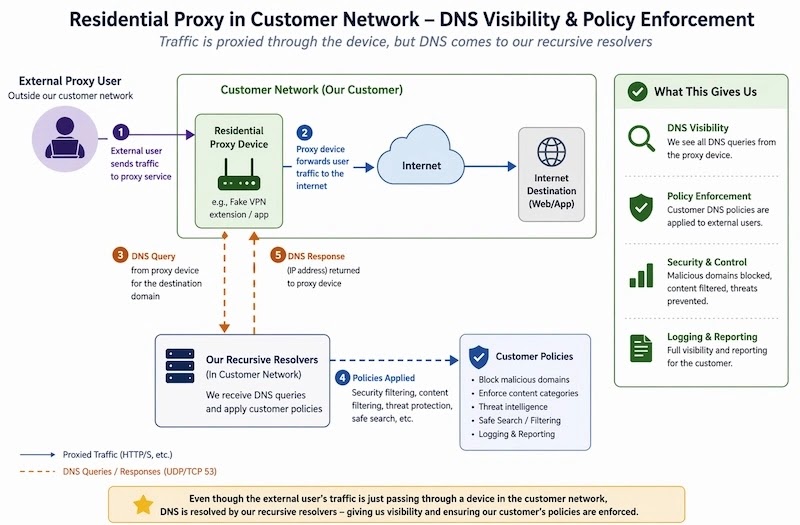
Residential proxy providers and resellers can also share traffic sources. Google noted that overlaps between residential proxy network exit nodes make attribution and quantification difficult. In practice, one device may support traffic from multiple services or buyers.
Content filtering also becomes uneven. If proxy users route traffic through a company IP address, the destination may see the company as the source. At the same time, the company’s own DNS and web security policies may generate alerts for traffic the local user did not intentionally start.
| Detection challenge | Defensive implication |
|---|---|
| Traffic comes from real ISP ranges | IP reputation alone can miss malicious activity |
| Devices may enroll silently | Asset inventory and app review matter |
| Proxy providers use many domains | DNS visibility becomes important |
| Exit nodes overlap across services | Attribution can be uncertain |
| Traffic can trigger alerts in unrelated networks | Security teams need clear investigation playbooks |
How Organizations Should Respond
Organizations should start with DNS visibility. Residential proxy platforms often need domains for orchestration, bootstrap activity, status checks, and traffic routing. Blocking or alerting on known proxy orchestration domains can stop unwanted participation early.
Security teams should review DNS query logs, installed software, browser extensions, mobile apps, and connected IoT devices. They should also check whether corporate IP addresses appear in residential proxy tracking data.
The second Synthient report reference recommends moving beyond traditional IP risk data and using layered detection, including behavioral analytics and real-time proxy intelligence.
- Use Protective DNS to block known residential proxy orchestration domains.
- Review DNS logs for proxy service domains and lookalike domains.
- Audit browser extensions, free VPNs, streaming apps, and productivity tools.
- Inspect Android TV boxes, routers, media devices, and other IoT systems.
- Check corporate IP addresses against residential proxy intelligence providers.
- Limit unmanaged devices on corporate networks.
- Investigate sudden increases in DNS volume tied to proxy infrastructure.
Indicators and Domains to Watch
Defenders should treat the following indicators as starting points, not complete blocklists. Proxy infrastructure changes quickly, and many services use multiple domains, resellers, and software kits.
| Type | Indicator | Context |
|---|---|---|
| Domain | ipinfo[.]ipidea[.]io | IPIDEA-related domain that saw a 265% one-day increase in queried customer networks |
| Domain | ipidea[.]io | Residential proxy service named in Google’s disruption report |
| Domain | getgrass[.]io | Grass residential proxy service discussed in Infoblox and KrebsOnSecurity reporting |
| Domain | honeygain[.]com | Residential proxy service that pays users to share bandwidth |
| Domain | brightdata[.]com | Residential proxy provider that appeared in more than 50% of Infoblox cloud customers |
Residential Proxies Are Now an Enterprise Risk
Residential proxies are no longer a niche anonymity tool. They now sit inside consumer apps, streaming devices, proxyware SDKs, and enterprise networks. Some use may be intentional, but much of it remains unclear to network owners.
The second IPIDEA disruption reference shows why the issue matters for defenders. If hundreds of tracked threat groups can use residential proxy exit nodes, every organization needs a plan for detecting unwanted proxy participation and abuse.
For enterprises, the risk goes beyond outbound bandwidth. A corporate IP address used as a proxy exit node can become tied to fraud, credential attacks, abuse reports, and investigations against third parties. For consumers, the same issue can harm privacy, performance, and account reputation.
The safest approach combines DNS-layer controls, strict device management, application audits, proxy intelligence, and user education. Any organization that ignores residential proxy traffic may miss a growing blind spot in its security perimeter.
FAQ
A residential proxy network routes internet traffic through real consumer devices such as home routers, phones, laptops, IoT devices, or streaming boxes. This makes traffic appear to come from a normal household or mobile IP address.
Hackers use residential proxies because they help malicious traffic avoid datacenter IP blocklists, fraud controls, and reputation systems. The traffic looks like it comes from real users, which makes detection harder.
Devices can be enrolled through opt-in bandwidth sharing apps, free VPNs, browser extensions, streaming apps, bundled SDKs, unofficial app stores, malware, or preinstalled software on low-cost IoT and Android TV devices.
Residential proxies are used for credential stuffing, account takeover, ad fraud, scraping, phishing infrastructure testing, reconnaissance, password spraying, and attempts to access cloud or enterprise services while hiding the true source.
Companies should use Protective DNS, review DNS logs for proxy orchestration domains, audit installed apps and browser extensions, inspect IoT and streaming devices, monitor unusual DNS volume, and check whether corporate IP addresses appear in residential proxy intelligence feeds.


Read our disclosure page to find out how can you help VPNCentral sustain the editorial team Read more


Improve this guide
User forum
0 messages