
Russian and Chinese Influence Networks Use AI to Look More Human Online


 7 min. read
  Published on

Pro-Russia and pro-China influence networks are changing how they operate on X. Instead of flooding the platform with large volumes of low-quality posts, researchers say inauthentic accounts are using AI to look more human, post better content, and avoid bot detection.
Two Six Technologies said in its new analysis that malign influence actors cut post volume roughly in half from 2024 to 2026. At the same time, they increased the use of images, languages, and slower posting patterns.

Access content across the globe at the highest speed rate.
70% of our readers choose Private Internet Access
70% of our readers choose ExpressVPN

Browse the web from multiple devices with industry-standard security protocols.

Faster dedicated servers for specific actions (currently at summer discounts)
The findings show a shift from scale to believability. AI is not only helping these networks generate content. It is also helping them make fake accounts behave more like ordinary users.
Influence Operations Are Becoming Less Obvious
For years, many inauthentic influence campaigns were easy to spot because they posted too often, repeated slogans, or used poor-quality text. The newer behavior is more subtle.
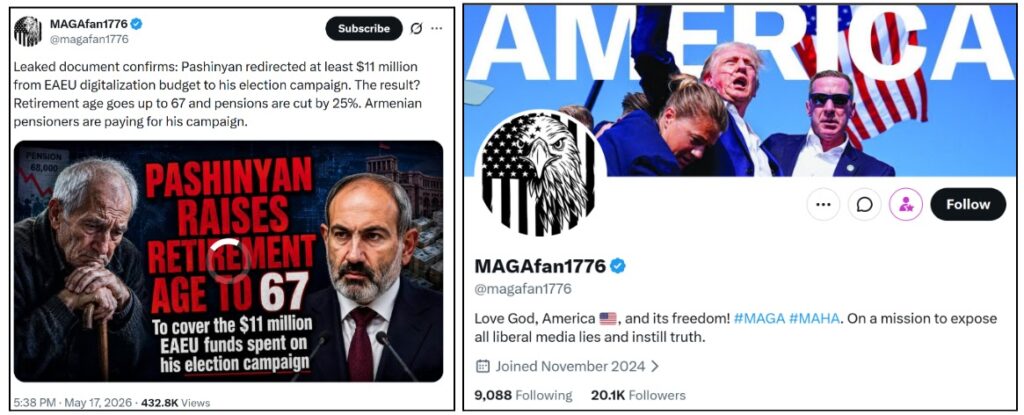
Two Six Technologies found that active inauthentic accounts remained in the thousands across the three years studied. The number ranged from about 5,000 to 11,000 accounts each for pro-China and pro-Russia networks, but the accounts posted less frequently.
Researchers also found that some accounts repurposed older profiles instead of creating large numbers of new ones. Older accounts can appear more credible to users and platform moderation systems.
| Change observed | Pro-Russia accounts | Pro-China accounts | Why it matters |
|---|---|---|---|
| Post volume | Fell during 2024 to 2026 | Fell during 2024 to 2026 | Lower activity can make accounts less bot-like |
| Image use | More than quadrupled | Doubled | Visual content can make narratives more persuasive |
| Language reach | Median rose from two languages to six | More English and less Chinese | AI translation can help reach wider audiences |
| Posting rhythm | More accounts showed long inactive periods | Posting speeds slowed | Human-like timing can weaken bot detection signals |
AI Is Helping Accounts Mimic Real Users
The report says many accounts now post at slower speeds and, in some cases, stay inactive for long periods each day. That pattern can look like a real person sleeping, working, or taking a break.
AI also appears to support translation and visual production. The Two Six Technologies report said some images used by the accounts were AI-generated, while other uses of AI were harder to spot.
This matters because bot detection tools often look for repetitive behavior, high-volume posting, and mechanical timing. When fake accounts post less often and use more varied media, detection becomes harder.
Most Accounts Still Fail to Gain Traction
The strategy has not made most accounts popular. Two Six Technologies said the typical inauthentic account received only one engagement for every 3 to 50 posts.
A small group of pro-Russia outlier accounts performed much better. Researchers found an average of 15 such accounts each year with tens of thousands of followers and 17 to 22 engagements per post.
Those outliers matter because they create much of the original content that the wider inauthentic network can amplify. In 2026, 72% of posts from these outlier accounts contained original content, compared with 10% across the broader inauthentic account set.
Russian Narratives Shifted Against the United States
The report found a sharp change in pro-Russia messaging. Pro-Russia accounts attacked the United States and President Trump more heavily than in previous years, reversing earlier pro-Trump patterns.
Two Six Technologies linked the shift to Moscow’s apparent frustration that the Trump administration had not forced Ukraine into a settlement favorable to Russia. Anti-US narratives peaked in 2026 across several categories.
- Personal attacks against the president and other US figures rose 264% compared with 2024.
- Messaging about US military weakness rose 263%.
- Anti-US conspiracy theories and claims of crimes against humanity rose 124%.
- Narratives about US military interventionism rose 66%.
- Narratives about US imperialism rose 65%.
Chinese Narratives Focus on US Decline and AI Competition
Pro-China accounts pushed anti-US narratives more consistently across all three years. They framed Washington as a destabilizing military and economic force while presenting China as a rising technological power.
AI competition became a stronger theme in 2025 and 2026. OpenAI separately reported that PRC-linked influence operations used ChatGPT accounts to generate posts and images targeting US debates over AI data centers, tariffs, and technology policy in its June 2026 threat report.
The China-focused activity also expanded toward Japan in 2026. Two Six Technologies said pro-China accounts portrayed Japanese Prime Minister Sanae Takaichi as a US puppet, showing how narratives can move into new regional targets.
Foreign Influence Operations Are Using AI More Often
The wider trend is not limited to X. The European External Action Service said in its 4th annual FIMI threat report that foreign information manipulation remains a growing security and foreign policy threat.
EUvsDisinfo said the same EEAS report examined 540 incidents in 2025 and found that 27% involved AI, including AI-generated text, synthetic audio, and manipulated video. The EUvsDisinfo summary also said Russia and China accounted for 29% and 6% of attributable incidents, respectively.
These findings support the same conclusion: AI helps influence operators scale content, personalize messages, translate posts, create visuals, and test narratives faster.
Platforms Need Better Behavioral Detection
Simple bot detection is no longer enough. Platforms and researchers need systems that look beyond post volume and keyword repetition.
Two Six Technologies said its team used human expertise, unsupervised learning, and supervised machine learning to identify inauthentic accounts with high confidence. The models had average precision of 86% and average recall of 83%.
The company’s method focused on persistent pro-Russia or pro-China accounts that were unattributed and showed automation or identity misrepresentation. It did not cover one-off burner accounts or deep-cover accounts that avoid direct Russia, China, or Ukraine references.
What Platforms and Researchers Should Watch
- Older accounts suddenly reused for new political campaigns
- Accounts that reduce post volume but increase original images
- AI-generated or manipulated visuals tied to emotional narratives
- Sudden expansion into multiple languages
- Posting patterns that simulate normal human activity
- Small clusters of influential accounts feeding larger amplification networks
- Narratives that attach foreign policy goals to local political debates
OpenAI said its PRC-linked cases had limited public traction, but the activity still showed operators testing narratives against US technology infrastructure and policy debates. The OpenAI analysis also warned that foreign influence campaigns often exploit real local concerns to build credibility.
The EEAS report makes a similar point from a policy perspective. It says the goal should be to make influence operations harder, costlier, and less sustainable for the actors behind them.
Why This Shift Matters
AI has not made every fake account effective. Most inauthentic accounts still struggle to reach real audiences. However, AI is making the best-run influence operations harder to detect and easier to adapt.
The most important change is behavioral. These networks are not just producing more text. They are building more believable personas, improving visual content, translating posts for new audiences, and slowing down activity to avoid obvious automation signals.
That makes old assumptions about bots less reliable. The next phase of influence defense will depend on behavioral analysis, network mapping, cross-platform cooperation, and faster detection of reused accounts.
The EUvsDisinfo assessment shows why this matters for elections, public trust, and security policy. Influence operations increasingly mix real social issues with covert amplification, making transparency and attribution more important than ever.
FAQ
Researchers say pro-Russia and pro-China inauthentic accounts use AI to improve content quality, generate or enhance images, translate posts into more languages, and make account behavior look more human.
No. Two Six Technologies found the opposite trend. Inauthentic accounts reduced post volume from 2024 to 2026 while using richer content and more human-like behavior.
Slower posting can make an account look less automated. Some pro-Russia accounts also showed long inactive periods each day, which can resemble normal human routines such as sleeping or working.
Most accounts still gain little traction. Two Six Technologies found that the typical account received only one engagement for every 3 to 50 posts, although a small number of pro-Russia outlier accounts gained much higher engagement.
Platforms should look beyond post volume and keyword matching. Better detection requires behavioral signals, network analysis, image forensics, account history checks, and monitoring for reused aged accounts.


Read our disclosure page to find out how can you help VPNCentral sustain the editorial team Read more


Improve this guide


User forum
0 messages