
Eleven Old Microsoft-Signed UEFI Shims Can Bypass Secure Boot


 11 min. read
  Published on
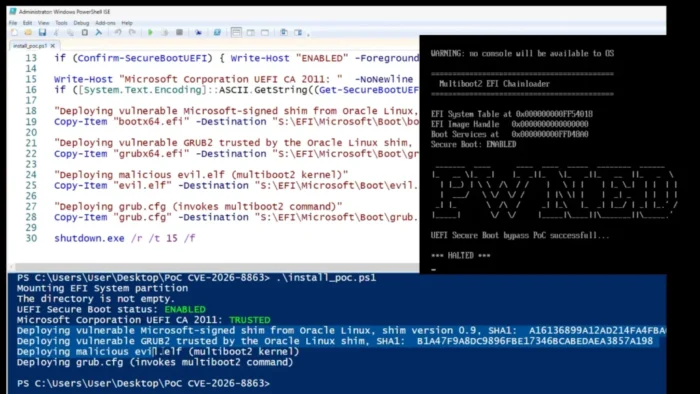
Eleven outdated UEFI shim bootloaders signed by Microsoft could allow attackers to bypass Secure Boot and execute untrusted code before the operating system starts. The affected binaries primarily use shim version 0.9 or earlier and remained trusted because their signatures had not been added to the UEFI forbidden-signature database.
The issue affects unpatched systems that trust the Microsoft Corporation UEFI CA 2011 certificate for third-party boot software. It is not limited to computers running the Linux distributions or utilities that originally shipped the vulnerable files. An attacker with administrative privileges or another way to modify the boot process can supply a vulnerable shim directly.

Access content across the globe at the highest speed rate.
🔥 Save 81% + 2 bonus months! 🔥
70% of our readers choose Private Internet Access
70% of our readers choose Private Internet Access
2
Browse the web from multiple devices with industry-standard security protocols.
🔥 Save 73%! 🔥

Faster dedicated servers for specific actions (currently discounted)
🔥 Save 69%! 🔥
ESET Research reported the shims to CERT/CC in February 2026. Microsoft revoked their Authenticode hashes through a dbx update released with the June 9, 2026 security updates.
Who Is Affected by the UEFI Shim Secure Boot Bypass?
A system is exposed when Secure Boot is enabled, the firmware trusts Microsoft’s third-party UEFI certificate, and the latest dbx revocations have not been applied.
The installed operating system does not determine exposure. The same vulnerable shim can be brought to a Windows or Linux device if its firmware accepts the Microsoft signature and does not contain the new hash-based revocation.
Windows 11 Secured-core PCs should disable trust in Microsoft’s third-party UEFI certificate by default. Administrators should still verify the actual firmware configuration because device vendors and enterprise policies can change default settings.
| Condition | Required for this attack path? |
|---|---|
| UEFI-based system | Yes |
| Secure Boot enabled | Yes, because the technique targets Secure Boot validation |
| Microsoft third-party UEFI certificate trusted | Yes |
| June 2026 dbx revocations missing | Yes |
| Affected Linux distribution installed | No |
| Attacker can modify the boot process or EFI System Partition | Yes |
What Is a Linux UEFI Shim?
A shim is a small first-stage bootloader that helps Linux distributions work with UEFI Secure Boot. Microsoft signs the shim, allowing firmware that trusts Microsoft’s third-party certificate to load it.
The shim then creates another trust layer for distribution-specific components. It usually verifies GRUB 2 using a certificate embedded by the Linux vendor, while GRUB verifies the operating-system kernel before transferring control.
This design avoids requiring every hardware manufacturer to include certificates for every Linux distribution in firmware. It also means that one trusted shim can approve numerous second-stage bootloaders and utilities.
How the Secure Boot Bypass Works
The attacker places an old Microsoft-signed shim on the EFI System Partition together with a compatible second-stage bootloader, often a vulnerable version of GRUB 2. The firmware accepts the shim because its Microsoft signature remains trusted.
The old shim then validates the second-stage component using an embedded vendor certificate. Because early shim versions lack newer revocation protections, they may load boot components that a modern shim would reject.
The attacker can exploit a weakness in the trusted second-stage bootloader to execute unsigned code. This can provide control before the operating system and many endpoint-security products begin running.
- The attacker gains administrative privileges or another way to modify the boot files.
- The attacker copies a vulnerable Microsoft-signed shim to the EFI System Partition.
- A compatible and vulnerable second-stage bootloader is added.
- UEFI firmware accepts the shim because the signature is trusted and its hash is absent from dbx.
- The shim loads the second-stage component without enforcing newer revocation policies.
- The attacker uses the second-stage weakness to run untrusted pre-boot code.
The Technique Resembles Bring Your Own Vulnerable Driver
CERT/CC compares the method to a Bring Your Own Vulnerable Driver attack. Instead of relying on a bootloader already installed on the victim’s system, the attacker supplies a legitimately signed but vulnerable component.
The CERT/CC vulnerability note VU#616257 states that exploitation can allow arbitrary code to run during the early boot phase. The code may load unsigned kernel components and create persistence that survives reboots and, in some cases, operating-system reinstallation.
This is not a remote attack by itself. The attacker must first obtain sufficient access to change the boot environment or otherwise control what the firmware loads.
Old Shims Ignore Modern Revocation Protections
The affected shims predate several protections added to the upstream shim project. Machine Owner Key revocation through MokListX began receiving enforcement in shim version 0.9, while Secure Boot Advanced Targeting arrived in version 15.3.
Shims older than these protections do not understand the newer policies. An attacker can therefore replace a current shim with an older signed version that ignores revocations intended to block compromised keys or vulnerable bootloader generations.
The weakness becomes more serious because one shim may trust many vendor-signed files. ESET found that the number ranged from fewer than 10 components in specialized software to nearly 100 in major Linux distributions.
| Protection | Purpose | Why old shims are vulnerable |
|---|---|---|
MokListX | Rejects revoked Machine Owner Keys | Shims before enforcement support may ignore the denylist |
| SBAT | Blocks vulnerable generations of boot components | Pre-15.3 shims do not evaluate SBAT policy |
| UEFI dbx | Blocks forbidden certificates and binary hashes | The 11 shim hashes remained absent until the June 2026 update |
Two CVEs Track the UEFI Shim Problems
Two CVE identifiers cover the disclosed shim issues. They describe related but distinct parts of the broader Secure Boot bypass risk.
| CVE | Scope |
|---|---|
| CVE-2026-8863 | Multiple Microsoft-signed shims that can be used to bypass Secure Boot because they lack or fail to enforce modern protections |
| CVE-2026-10797 | A certificate-revocation bypass caused by inconsistent handling of PE signature-size fields |
CVE-2026-8863 covers the main group of old, trusted shims and the Secure Boot bypass conditions documented through the coordinated disclosure.
CVE-2026-10797 tracks a flaw that upstream shim developers fixed nearly a decade earlier. The old Microsoft-signed binaries containing that code were never revoked until this investigation.
CVE-2026-10797 Bypasses Certificate Revocation Checks
An Authenticode-signed PE file records the signature length in two places: the PE header’s security-data directory and the WIN_CERTIFICATE structure.
In the affected shims, the revocation-check function and signature-verification function used different size values. An attacker could modify the second-stage bootloader’s certificate structure so the revocation check examined the wrong data.
The flaw can bypass certificate-based revocations in dbx or MokListX. It does not bypass hash-based revocation, and the second-stage bootloader must use a certificate embedded in the vulnerable shim.
Eleven UEFI Shims Were Added to the Forbidden List
The affected files came from Linux distributions, diagnostic software, secure-erasure products, management tools, and other UEFI applications. This shows that shim security extends beyond mainstream Linux installation media.
The updated CERT/CC advisory identifies the following products and shim versions.
| Vendor or project | Product | Reported shim version |
|---|---|---|
| Spyrus | WTGCreator 4.2 | 0.7 or earlier |
| Red Hat | Red Hat Enterprise Linux 7.2 | 0.9 |
| CentOS | CentOS 7.2 | 0.9 |
| baramundi software | baramundi Management Suite through 2024 R1 | 0.8 |
| WhiteCanyon and Blancco | WipeDrive 8.0.0 through 8.1.3 | 0.7 |
| Finland’s Matriculation Examination Board | Abitti 1 | 0.8 |
| NTC IT ROSA | ROSA Linux R9 and R10 | 0.9 |
| Oracle | Oracle Linux 7.2 | 0.9 |
| PC-Doctor | PC-Doctor Service Center 15 and 16 | 0.9 |
| openSUSE | openSUSE UEFI shim loader | 0.9 |
| openSUSE | openSUSE Shim 2.1 | 0.9 |
A Vulnerable Oracle Linux Chain Shows the Practical Risk
ESET demonstrated the attack using an old Oracle Linux shim and a GRUB 2 binary from Oracle Linux 7.1 installation media. The GRUB binary was vulnerable to CVE-2015-5281.
That GRUB flaw allows unsigned code to load through the multiboot or multiboot2 commands. The attacker can build a custom unsigned kernel image, place it beside the shim and GRUB files, and execute it during startup.
The attack does not require a memory-corruption exploit, return-oriented programming chain, or forged Microsoft signature. It relies on old components that the firmware and shim still consider trustworthy.
Secure Boot Bypass Can Enable UEFI Bootkits
Code running before the operating system can interfere with the kernel, security controls, and the boot chain. It may also establish persistence below the level normally inspected by endpoint detection tools.
Researchers warn that the bypass could support bootkits such as Bootkitty, HybridPetya, or BlackLotus. Their inclusion illustrates the type of malware the bypass could enable and does not establish that attackers have used these 11 shims to deploy those bootkits in the wild.
Neither ESET nor CERT/CC reported confirmed malicious exploitation of these specific 11 binaries. Their presence on a system is also not proof of compromise because they were distributed as legitimate software.
Microsoft Revoked the Shims in June 2026
Microsoft added the 11 PE Authenticode hashes to the UEFI Forbidden Signature Database, known as dbx, through its June 9, 2026 security release.
The Microsoft June 2026 security release distributes the relevant Secure Boot revocations for supported Windows systems. Once the firmware contains those hashes in dbx, it should reject the vulnerable shims even though Microsoft originally signed them.
The patch revokes the specific identified binaries. It does not automatically identify every forgotten Microsoft-signed shim created before the current public review process.
Certificate Expiration Does Not Remove Secure Boot Trust
The Microsoft Corporation UEFI CA 2011 certificate expired on June 27, 2026. That expiration does not cause UEFI firmware to reject every binary previously signed with the certificate.
Secure Boot continues trusting a correctly signed binary while its signing certificate remains in the authorized database and the binary or certificate is not present in dbx.
This makes explicit revocation essential. Waiting for the signing certificate to expire does not protect systems from old signed boot components.
How Windows and Linux Administrators Should Respond
Administrators should test UEFI revocation updates on representative hardware before broad deployment. Firmware and boot configurations vary, and a revocation can cause startup failures when a system still depends on a blocked bootloader.
For this disclosure, the required protection is the latest dbx update containing the 11 revoked hashes. Organizations should follow their operating-system and device vendors’ instructions instead of manually changing Secure Boot databases without a tested recovery plan.
- Install current operating-system and Secure Boot security updates.
- Confirm that the June 2026 or later dbx data reached the device firmware.
- Update legitimate bootloaders and recovery media before enforcing revocations.
- Test updates on non-critical systems using the same hardware and boot configuration.
- Keep recovery keys, approved boot media, and rollback procedures available.
- Inspect the EFI System Partition for unauthorized boot entries and unfamiliar files.
- Restrict administrative access and monitor changes to EFI boot variables.
- Review dual-boot, recovery, diagnostic, and disk-erasure tools for old shims.
Windows administrators can use elevated PowerShell commands to read the firmware’s dbx variable and compare it with the 11 revoked Authenticode hashes. The Microsoft Security Update Guide should be used to confirm applicable updates for supported Windows releases.
Linux administrators should obtain the latest UEFI revocation updates through their distribution or the Linux Vendor Firmware Service. They can use the uefi-dbx-audit project to examine whether the required revocations are installed.
Why Applying dbx Updates Requires Care
A dbx update is designed to make a previously trusted bootloader unbootable. If a computer, recovery disk, installation image, or diagnostic tool still relies on one of the revoked files, the firmware may refuse to start it after the update.
Organizations should update legitimate boot media first and verify that current replacements boot successfully. They should also test operating-system recovery, full-disk encryption recovery, network booting, and hardware-diagnostic workflows.
Broader Microsoft Secure Boot certificate transitions may include separate sequencing requirements for new authorized certificates and later revocations. Administrators should not apply those instructions to unrelated dbx changes without checking the vendor’s documentation for the exact update.
Pre-2017 Shim Visibility Remains Incomplete
The public shim-review process began improving transparency in 2017 by recording vendor submissions before Microsoft signed them. Older submissions do not have the same complete public inventory.
As a result, researchers cannot say with certainty how many pre-2017 Microsoft-signed shims remain trusted and unrevoked. Additional obsolete binaries may exist outside the 11 files addressed in June.
ESET’s shim investigation concludes that revoking these binaries resolves the immediate findings but not the wider visibility problem. Defenders need accurate inventories, current dbx data, monitored EFI partitions, and stronger controls over boot-chain changes.
FAQ
Eleven old shim bootloaders, primarily version 0.9 or earlier, remained trusted by Secure Boot despite lacking modern revocation protections or containing known flaws. Attackers can combine them with vulnerable second-stage bootloaders to execute untrusted pre-boot code.
No. It affects unpatched UEFI systems that trust Microsoft’s third-party UEFI certificate and have not received the June 2026 dbx revocations. The attacker also needs administrative privileges or another way to control the boot process.
No. An attacker can bring a vulnerable Microsoft-signed shim and compatible second-stage bootloader to any exposed system. The installed operating system does not need to match the product that originally distributed the shim.
CVE-2026-8863 covers the broader group of Microsoft-signed shim Secure Boot bypasses. CVE-2026-10797 covers an older PE signature-size handling flaw that can bypass certificate-based revocation checks.
Microsoft added the 11 affected Authenticode hashes to the UEFI Forbidden Signature Database, or dbx, in the June 9, 2026 security updates. Updated firmware should refuse to execute those specific binaries.
No. Secure Boot can continue trusting binaries signed before the certificate expired. The binary or its signing certificate must be explicitly revoked through dbx to stop firmware from loading it.


Read our disclosure page to find out how can you help VPNCentral sustain the editorial team Read more


Improve this guide




User forum
0 messages