
Darkhub hacking-for-hire portal advertises account theft, surveillance, and crypto fraud services


 6 min. read
  Published on
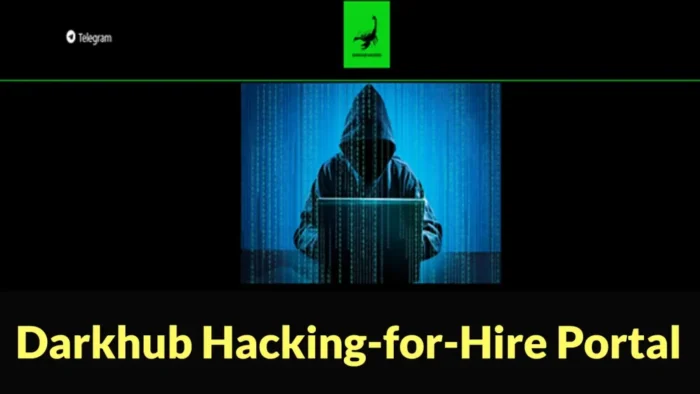
A dark web platform called Darkhub is advertising hacking-for-hire services, including account compromise, message interception, mobile monitoring, location tracking, cryptocurrency-related fraud, and financial manipulation. Oasis Security identified the service and said its infrastructure analysis exposed signs that parts of the operation may reach beyond Tor.
The platform presents itself as a polished marketplace for illegal cyber services. Its listed offerings target both individuals and organizations, with claims involving social media accounts, messaging apps, email access, financial accounts, and crypto-related activity.

Access content across the globe at the highest speed rate.
70% of our readers choose Private Internet Access
70% of our readers choose ExpressVPN

Browse the web from multiple devices with industry-standard security protocols.

Faster dedicated servers for specific actions (currently at summer discounts)
Oasis Security also warned that the platform’s actual hacking capability cannot be confirmed through external observation. Some of its listed services, especially fund recovery and credit score manipulation, match common advance-fee scam patterns that target people who already lost money.
Why Darkhub matters
Darkhub shows how hacking-for-hire services package cybercrime like a normal online business. Instead of requiring technical knowledge, these platforms claim to let buyers order digital intrusion, surveillance, or fraud services directly.
That creates risk for victims named in the advertised services. It also creates risk for the buyers, because many dark web hacking services collect payment without delivering anything real.
The presence of fund recovery claims is especially important. Fraud victims searching for help after losing money to crypto scams may become targets again if they trust a platform promising fast recovery for a fee.
At a glance
| Detail | What researchers found |
|---|---|
| Platform name | Darkhub |
| Environment | Tor hidden service |
| Reported by | Oasis Security Threat Intelligence Unit |
| Advertised services | Account compromise, surveillance, location tracking, financial account access, crypto services, fund recovery, and credit score manipulation |
| Infrastructure finding | Oasis Security identified a publicly routable IP address linked to the service |
| Hosting context | The linked host provider was associated with ASN AS44259 |
| Main concern | The site may enable cybercrime while also defrauding would-be buyers or prior scam victims |
What Darkhub claims to offer
Oasis Security said Darkhub lists several categories of illegal services. These include social media account compromise, email access, mobile phone monitoring, message interception, and location tracking.
The platform also claims to provide unauthorized access to financial accounts, cryptocurrency-related services, credit score manipulation, and fund recovery. These claims make the site more than a simple account-hacking storefront.
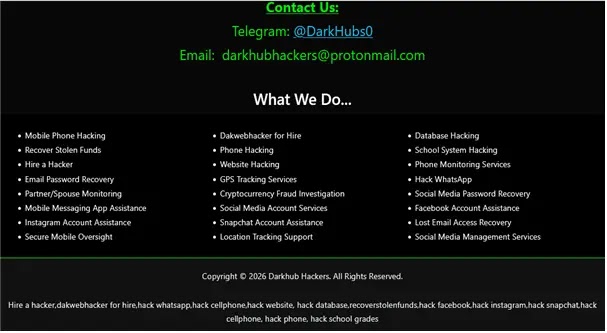
The fund recovery angle stands out because it overlaps with known recovery scams. These schemes promise to recover stolen money, usually from crypto fraud, then demand upfront fees or personal information from victims.
Why fund recovery claims are a red flag
The FBI warns that cryptocurrency recovery fraud targets people who already lost crypto to scams, theft, or fraud. These operators often charge upfront fees and then disappear or keep asking for more money.
The FTC gives similar guidance for refund and recovery scams. It says people should not trust anyone who claims they can recover lost money for a fee, especially when they ask for payment through cryptocurrency, wire transfer, payment apps, or gift cards.
This makes Darkhub’s recovery-related offerings suspicious on two levels. The platform may advertise illegal services, but it may also use those promises to scam the people trying to buy them.
Infrastructure exposure raises questions
Dark web services usually rely on Tor to hide their servers. Oasis Security said its investigation found a publicly routable IP address associated with Darkhub, which suggests some backend infrastructure may not have stayed fully hidden inside Tor-only access.
Researchers linked the infrastructure to a U.S.-based hosting provider under AS44259. Oasis Security said the provider had appeared in third-party reporting related to bulletproof hosting characteristics.
This does not prove that the hosting provider knowingly supported the service. It does show why threat intelligence teams track exposed infrastructure, hosting history, and network patterns around dark web operations.
Who faces the most risk?
- People who have already lost money to crypto scams and search for recovery help.
- Users whose social media, messaging, or email accounts are targeted by others.
- Organizations named in account compromise or surveillance requests.
- Buyers who believe dark web hacking-for-hire claims and send money upfront.
- Security teams monitoring Tor-linked infrastructure and suspicious outbound traffic.
What users should do
Anyone contacted by a service claiming it can recover stolen crypto should be careful. Legitimate law enforcement agencies and regulators do not ask victims to pay crypto upfront to recover stolen money.
People who lost money should collect wallet addresses, transaction IDs, screenshots, usernames, emails, phone numbers, and domain names connected to the scam. They should then report the incident through official channels rather than hiring an anonymous recovery service.
Users should also secure their main accounts with strong passwords, phishing-resistant multi-factor authentication, and regular session reviews. Social media, email, and messaging accounts remain high-value targets for services like the ones Darkhub claims to sell.
What security teams should monitor
- Mentions of executives, employees, or company domains on hacking-for-hire markets.
- Suspicious login attempts against email, messaging, and social media accounts.
- Credential stuffing attempts following public or dark web exposure.
- Unusual account recovery requests or MFA reset attempts.
- Dark web infrastructure references tied to exposed public IP addresses.
- Employee reports of blackmail, surveillance threats, or account compromise offers.
- Fraud attempts targeting customers who recently reported crypto theft.
Why this is also a buyer scam risk
Darkhub’s catalog may look professional, but that does not mean its operators can deliver the services they advertise. Oasis Security said many dark web hacking-for-hire platforms operate mainly as advance-fee scams.
This means the people trying to buy illegal services may also lose money. They may pay for account hacking, fund recovery, or financial manipulation and receive nothing in return.
That does not reduce the danger to potential victims. Platforms like Darkhub still normalize cybercrime, encourage abuse, and create markets for account theft, fraud, harassment, and surveillance.
FAQ
Darkhub is a dark web platform identified by Oasis Security that advertises hacking-for-hire services through a Tor hidden service.
It claims to offer account compromise, message interception, mobile monitoring, location tracking, unauthorized financial account access, crypto-related services, fund recovery, and credit score manipulation.
No. Oasis Security said the true technical capability behind the platform cannot be confirmed through external observation alone.
Fund recovery claims often appear in advance-fee scams. Fraudsters promise to recover lost money, ask for an upfront payment, and then disappear or demand more money.


Read our disclosure page to find out how can you help VPNCentral sustain the editorial team Read more


Improve this guide



User forum
0 messages