
JADEPUFFER Exploits Langflow Flaw to Deploy AI-Focused ENCFORGE Ransomware


 10 min. read
  Published on
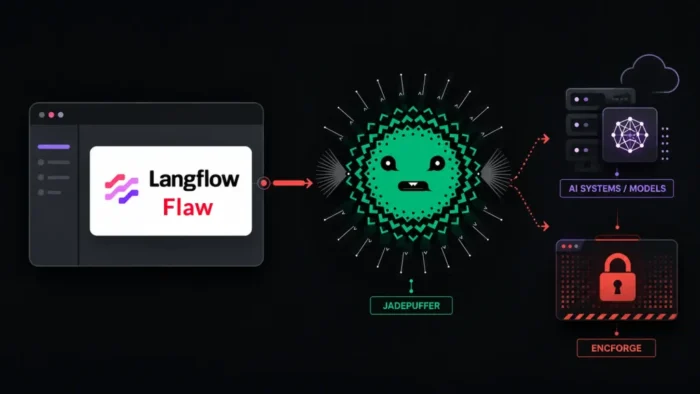
The agentic threat actor JADEPUFFER is exploiting a critical Langflow vulnerability to deploy ENCFORGE, ransomware designed to encrypt AI models, training datasets, vector indexes, and other machine-learning assets.
According to Sysdig’s investigation, the operator returned to a previously compromised Langflow server with a compiled ransomware binary and an adaptable container escape process.

Access content across the globe at the highest speed rate.
🔥 Save 81% + 2 bonus months! 🔥
70% of our readers choose Private Internet Access
70% of our readers choose Private Internet Access
2
Browse the web from multiple devices with industry-standard security protocols.
🔥 Save 73%! 🔥

Faster dedicated servers for specific actions (currently discounted)
🔥 Save 69%! 🔥
Sysdig assesses that an AI agent handled reconnaissance, credential collection, internal service testing, payload deployment, and troubleshooting. Researchers observed it produce six scripts in five minutes and 24 seconds after its first attempt to deliver ENCFORGE failed.
JADEPUFFER exploits CVE-2025-3248 in Langflow
The attack begins with CVE-2025-3248, a critical missing-authentication vulnerability affecting the Langflow code-validation endpoint. Langflow provides an open-source platform for building applications and workflows powered by large language models.
Before the patch, remote attackers could send crafted requests to /api/v1/validate/code without authenticating. The endpoint could then execute attacker-controlled Python code on the server.
The official Langflow security advisory identifies versions before 1.3.0 as vulnerable. Version 1.3.0 added the protection needed to close this specific entry point.
| Vulnerability detail | Information |
|---|---|
| CVE | CVE-2025-3248 |
| Affected product | Langflow |
| Affected versions | Versions before 1.3.0 |
| Patched version | 1.3.0 for this vulnerability |
| Vulnerable endpoint | /api/v1/validate/code |
| Required authentication | None on vulnerable versions |
| Impact | Remote execution of arbitrary Python code |
CISA previously confirmed active exploitation
CISA added CVE-2025-3248 to its Known Exploited Vulnerabilities catalog on May 5, 2025. The listing confirmed that attackers were already exploiting the flaw in real environments.
The agency’s security alert instructed federal organizations to apply vendor mitigations or discontinue affected products when protections were unavailable.
Internet-accessible Langflow deployments create an attractive entry point because they may contain AI provider keys, database credentials, cloud tokens, object-storage connections, and access to vector databases.
JADEPUFFER searched for credentials and internal services
After obtaining code execution, JADEPUFFER ran basic discovery commands to identify the user, processor architecture, hostname, and operating environment.
The actor searched for cloud keys, API tokens, database connection strings, and other credentials available to the Langflow process. It also probed reachable internal databases and cache services.
Researchers then observed JADEPUFFER locate /var/run/docker.sock and confirm that the Docker daemon responded. Access to this socket can allow a containerized process to create privileged containers and reach the underlying host.
- Collected information about the compromised server
- Searched the environment for credentials and API keys
- Tested internal databases and cache services
- Located and accessed the Docker socket
- Attempted to retrieve the ENCFORGE ransomware binary
- Adapted its deployment method when the initial transfer failed
Docker socket access provided a route to the host
The unrestricted Docker socket gave JADEPUFFER a powerful route outside the original Langflow container. This behavior did not require a separate Docker vulnerability.
A process with write access to the socket can instruct Docker to create a privileged container, share the host process namespace, and mount the host filesystem with write access.
JADEPUFFER used these capabilities to build a process for copying ENCFORGE through /proc/<pid>/root, launching it on the host, and checking whether encrypted files appeared.
| Container setting | Security impact |
|---|---|
Privileged: true | Grants extensive host-level capabilities |
PidMode: host | Shares the host process namespace |
NetworkMode: host | Shares the host network namespace |
/:/host:rw | Mounts the host root filesystem with write access |
nsenter --target 1 | Enters host namespaces from the container |
The AI agent created six scripts in minutes
JADEPUFFER’s initial attempt to download the ransomware did not place the expected file in its target directory. Rather than abandoning the operation, the actor changed its delivery plan.
The first script issued Docker commands through the socket. Later versions added process-filesystem copying, helper functions, temporary privileged containers, raw Unix socket communication, dynamic process discovery, and execution checks.
The completed script copied ENCFORGE to the host, performed a scan-only test, started live encryption, and counted files ending in .locked to verify the result.
- Discover the target container’s host process ID.
- Create a privileged container with host namespaces and filesystem access.
- Copy ENCFORGE through the container process filesystem.
- Run the ransomware in scan-only mode.
- Launch the live encryption process on the host.
- Search for
.lockedfiles to confirm execution.
What is ENCFORGE ransomware?
ENCFORGE is a statically compiled Go ransomware binary delivered under the name lockd. The observed sample used UPX 5.20 packing and contained the internal project name encfile.
The binary also references a companion key-generation program called keyforge. These internal names provide potential detection strings that may survive recompilation of the same codebase.
The ENCFORGE analysis found that the malware uses AES-256 in counter mode for file encryption and wraps the symmetric key with an embedded RSA-2048 public key.
| ENCFORGE capability | Observed behavior |
|---|---|
| Programming language | Go 1.22.12 |
| Packer | UPX 5.20 |
| File encryption | AES-256-CTR |
| Key protection | RSA-2048 |
| Encrypted extension | .locked |
| Target extension count | Approximately 180 |
| Data theft component | Not found in the analyzed binary |
ENCFORGE deliberately targets AI and ML files
The ransomware’s default extension list covers approximately 180 file types. The selection includes model weights, checkpoints, vector indexes, training datasets, embeddings, and data-science project files.
Its command-line interface also allows operators to add extensions and glob patterns. The built-in help text uses LoRA fine-tuning files and legacy GGML model weights as examples.
This focus separates ENCFORGE from ransomware that simply encrypts every common business document. The malware specifically recognizes formats used throughout modern AI development and deployment.
| Asset category | Targeted examples |
|---|---|
| Model checkpoints | .ckpt, .pt, .pth, .h5 |
| Model interchange and weights | .onnx, .safetensors, .pb |
| Local LLM formats | .gguf, .ggml |
| Vector indexes | .faiss |
| Training datasets | .parquet, .arrow, .tfrecord |
| Serialized data and arrays | .pkl, .pickle, .npy, .npz |
| Embedding data | .vec |
| Analytics databases | .duckdb |
Ransomware can disrupt entire AI pipelines
A production model may represent repeated training runs, fine-tuning, testing, data preparation, and engineering work. Encrypting its stored artifacts can interrupt both model development and live inference services.
Clean backups can restore files, but the organization may still lose work completed after its most recent snapshot. Recovery becomes harder when the attacker also encrypts the proprietary datasets needed to rebuild models and vector indexes.
Sysdig estimated that recreating a production-grade fine-tuned model could cost between $75,000 and $500,000 in cloud computing and engineering work. Actual losses will depend on model size, data availability, and backup quality.
ENCFORGE uses encryption without a leak site
Researchers found no network functionality, cloud-storage client, or data-staging code inside the analyzed ENCFORGE binary. They also found no evidence of data exfiltration during the observed session.
The campaign therefore uses a single-extortion model based on file encryption. Sysdig did not identify a Tor payment portal or public leak site connected to ENCFORGE.
The ransomware kills processes that hold targeted files open, supports resuming interrupted encryption, and can delete itself after execution. Its notes instruct victims to contact [email protected].
READMEHOW_TO_DECRYPTREADME_DECRYPT
The ransom email links ENCFORGE to JADEPUFFER
The email address embedded in ENCFORGE matches the contact used during Sysdig’s earlier JADEPUFFER database-extortion investigation.
Sysdig considers the reused address its strongest continuity indicator because it does not depend on infrastructure or source IP addresses that operators can quickly replace.
The new campaign also retained the previous Langflow entry point and adaptive behavior. However, it replaced temporary database scripts with a reusable ransomware tool designed for filesystem-wide encryption.
| Earlier JADEPUFFER activity | ENCFORGE campaign |
|---|---|
| Temporary Python scripts | Compiled Go ransomware |
| Database-focused destruction | Filesystem-wide encryption |
| MySQL encryption functions | AES-256-CTR and RSA-2048 |
| Database and Nacos targets | AI models, vector indexes, datasets, and other files |
| No observed campaign task ID | gcp_h1 and gcp_test |
Langflow users should install a current release
Version 1.3.0 fixed CVE-2025-3248 by adding authentication to the vulnerable validation endpoint. However, stopping at that release may leave installations exposed to vulnerabilities disclosed later.
The vendor advisory confirms the original fix, while Sysdig recommends upgrading to version 1.9.1 or a newer supported release.
CISA’s inclusion of the flaw in its Known Exploited Vulnerabilities update means administrators should also investigate possible compromise instead of treating patch installation as the only required action.
- Upgrade Langflow to version 1.9.1 or the latest supported release.
- Remove unnecessary public access to Langflow deployments.
- Review logs for requests to
/api/v1/validate/code. - Rotate credentials accessible to the Langflow process.
- Inspect containers and hosts for persistence or unexpected files.
- Review activity involving the known source and delivery addresses.
How organizations can protect AI assets
Administrators should not mount the Docker socket inside Langflow containers unless a documented function requires it. If access cannot be removed, a restrictive socket proxy should limit the permitted Docker operations.
Langflow should run without root privileges and with minimal access to the host filesystem, model storage, cloud credentials, and internal services. Model directories should not be writable by unrelated web applications.
Organizations should maintain offline or immutable backups of model weights, datasets, fine-tuning artifacts, vector indexes, and pipeline configurations. Recovery tests should confirm that these assets can restore together in the correct versions.
- Alert when a web application accesses the Docker socket.
- Detect containers launched with privileged mode.
- Monitor host PID namespace sharing and root filesystem mounts.
- Alert on
nsenter --target 1inside application containers. - Monitor mass creation of
.lockedfiles. - Track changes to model and training-data directories.
- Keep provider API keys outside the Langflow runtime where possible.
Corrected ENCFORGE indicators of compromise
| Type | Indicator | Description |
|---|---|---|
| Source IP | 45.131.66[.]106 | Observed JADEPUFFER source address |
| Delivery server | 34.153.223[.]102:9191 | ENCFORGE and staged interpreter server |
| Payload URL | hxxp://34.153.223[.]102:9191/.lockd | ENCFORGE download location |
| Interpreter path | /pv/bin/python | Staged CPython path |
| Interpreter path | /pv/bin/python3 | Staged CPython path |
| File name | .lockd or lockd | ENCFORGE ransomware payload |
| SHA-256 | 8cb0c223b018cecef1d990ec81c67b826eb3c30d54f06193cf69969e9a8baea2 | Packed UPX ENCFORGE binary |
| SHA-256 | ea7822eac6cecef7746c606b862b4d3034856caf754c4cf69533662637905328 | Unpacked ENCFORGE binary |
| SHA-256 | ab9824b61587c77a8d8649545cdbdc63ed2c384e45c9aba534e3f457f96efa7a | Staged CPython 3.14 binary |
| SHA-256 | 2378bf45bb54fb2defc460063c9b43e09870741b62692b7f6acbc3cd7898bb3 | Embedded RSA-2048 DER public-key indicator |
[email protected] | Embedded ransom contact | |
| Encrypted extension | .locked | Extension added to encrypted files |
| Ransom notes | README, HOW_TO_DECRYPT, README_DECRYPT | ENCFORGE ransom-note names |
| Internal names | encfile, keyforge | Ransomware project and companion key tool |
| Task IDs | gcp_h1, gcp_test | Observed ENCFORGE campaign identifiers |
FAQ
JADEPUFFER is the name Sysdig assigned to a threat actor whose attack behavior it assesses as driven by an AI agent. The operator exploits exposed infrastructure, collects credentials, and conducts extortion activity.
ENCFORGE is Go-based ransomware designed to encrypt files used by AI and machine-learning systems, including model checkpoints, training datasets, vector indexes, and embeddings.
JADEPUFFER exploits CVE-2025-3248, a critical missing-authentication flaw that allows remote attackers to execute Python code through Langflow’s code-validation endpoint.
Versions before Langflow 1.3.0 are vulnerable. Version 1.3.0 fixed this specific flaw, but administrators should install version 1.9.1 or the latest supported release to address later vulnerabilities.
The compromised Langflow container could access the Docker socket. JADEPUFFER used it to create privileged containers with host process and filesystem access, providing a route to execute ENCFORGE on the host.
Its target list includes CKPT, SafeTensors, ONNX, GGUF, GGML, FAISS, Parquet, Pickle, PyTorch, NumPy, TensorFlow, and other AI or data-science formats.
Sysdig found no data-theft or staging capability inside the analyzed binary and observed no exfiltration during the session. The documented campaign relied on encryption rather than a leak site.
They should update Langflow, restrict public access, remove unnecessary Docker socket mounts, rotate exposed credentials, limit model-storage permissions, and maintain offline or immutable backups of AI assets.


Read our disclosure page to find out how can you help VPNCentral sustain the editorial team Read more


Improve this guide




User forum
0 messages