
Massive 2.45 billion request DDoS attack used 1.2 million IPs to evade rate limits


 5 min. read
  Published on

A massive application-layer DDoS attack sent more than 2.45 billion malicious requests to a large user-generated content platform in just five hours. DataDome said the campaign peaked at 205,344 requests per second and sustained an average of about 136,000 requests per second.
The attack stood out because it did not rely on a few noisy sources. Instead, it spread traffic across more than 1.2 million unique IP addresses and 16,402 autonomous systems, which helped the attackers stay below normal per-IP rate limits.

Access content across the globe at the highest speed rate.
70% of our readers choose Private Internet Access
70% of our readers choose ExpressVPN

Browse the web from multiple devices with industry-standard security protocols.

Faster dedicated servers for specific actions (currently at summer discounts)
Each source averaged roughly one request every nine seconds. That made individual IPs look harmless on their own, while the combined botnet still created enormous pressure on the target.
Why the attack bypassed normal rate limits
Traditional rate limiting often focuses on how many requests come from one IP address in a set period. That works against simple floods, scrapers, and abusive clients that send too many requests from the same source.
This attack used a different strategy. The botnet spread requests across so many IP addresses that no single source had to send much traffic.
DataDome said this exposed a structural weakness in static rate-limit rules. A request pattern can look normal at the source level while still becoming destructive at the platform level.
At a glance
| Detail | What DataDome observed |
|---|---|
| Target | A large user-generated content platform |
| Attack window | Five hours in mid-April 2026 |
| Total malicious requests | More than 2.45 billion |
| Unique IP addresses | More than 1.2 million |
| Autonomous systems | 16,402 ASNs |
| Peak traffic | 205,344 requests per second |
| Average traffic | About 136,000 requests per second |
| Per-source rate | Roughly one request every nine seconds |
The botnet used a flat traffic pattern
The botnet’s distribution made simple blocking less effective. DataDome said the top contributing autonomous system accounted for only about 3% of the total attack traffic.
That flat structure means defenders could not stop the campaign by blocking one provider, one region, or one network. The attackers mixed traffic through privacy-focused infrastructure and legitimate cloud providers.
This helped the malicious requests blend into normal internet traffic. It also made broad blocking risky because defenders could accidentally affect real users and business traffic.
The campaign used wave-like pressure
DataDome observed a wave pattern rather than one constant flood. The attack intensity rose and fell over time, which suggests the operators or orchestration system adjusted traffic during the campaign.
Those pauses gave some aggregate counters time to reset. The attackers then returned with changed IPs, user agents, headers, cookies, and URL parameters.
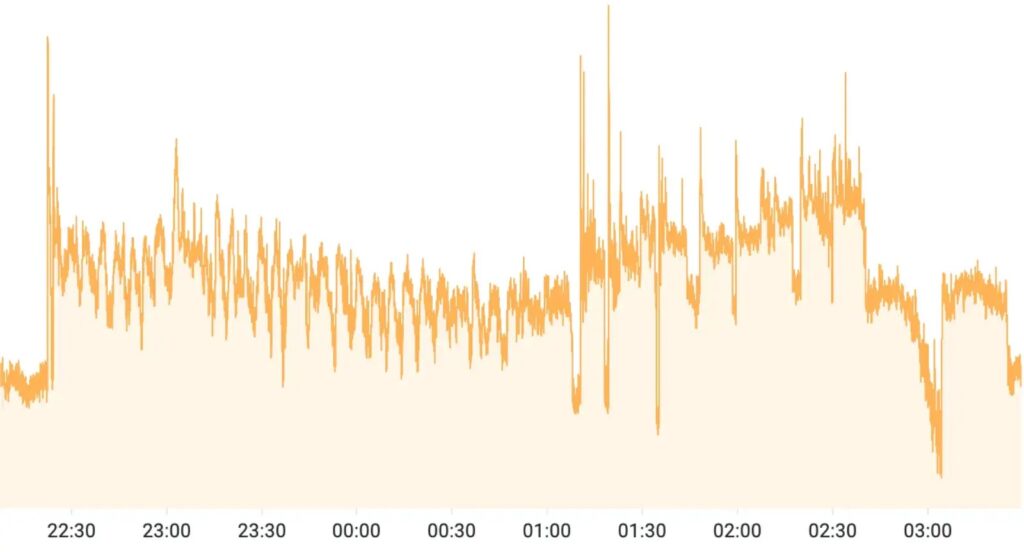
This made the campaign more adaptive than a basic HTTP flood. It also forced defenders to evaluate behavior across sessions and time, not only request volume at one moment.
What made the attack detectable
The campaign was large and well distributed, but it was not perfect. DataDome said the attackers forged headers, cookies, and URL parameters, but they did not maintain consistent browser behavior across sessions.
Real users tend to keep stable browser and session signals. Automated traffic often shifts those signals in unnatural ways, especially when operators rotate tools, identities, and network paths.
DataDome said its Galileo threat research team used server-side fingerprinting, behavioral analysis, and threat intelligence to identify and block the attack in real time.
Why application-layer DDoS is hard to stop
Application-layer DDoS attacks target the web application itself, not only the network pipe. They can send requests that look closer to normal user activity than raw network floods.
Cloudflare explains that application-layer attacks can be efficient because they force the target to spend more resources processing requests than the attacker spends sending them.
This is why the 2.45 billion request campaign matters. The attackers did not need every IP to send huge volumes. They used scale, timing, and distribution to create pressure while avoiding simple thresholds.
Defender checklist
- Do not rely only on per-IP rate limits for DDoS protection.
- Track request behavior across sessions, user agents, fingerprints, and time windows.
- Build baselines for normal traffic before an attack begins.
- Monitor ASN, hosting provider, and cloud provider distribution during traffic spikes.
- Use bot detection signals in addition to network and volume controls.
- Watch for unstable client identities inside the same session.
- Prepare an incident response plan for application-layer DDoS attacks.
- Coordinate early with CDN, hosting, DNS, and DDoS mitigation providers.
Why businesses should care
Large user-generated content platforms depend on availability. If the service becomes slow or unreachable, users leave, moderation queues pile up, and revenue can drop quickly.
Attackers may also use a DDoS attack as cover. While defenders focus on traffic pressure, another part of the operation may attempt account abuse, scraping, fraud, or intrusion activity.
CISA advises organizations to prepare for DDoS incidents before they happen, including response planning, coordination with service providers, and documented mitigation steps.
FAQ
The campaign was an application-layer DDoS attack focused on HTTP requests against a web platform.
A large user-generated content platform received more than 2.45 billion malicious requests in five hours. The attack peaked at 205,344 requests per second.
They used more than 1.2 million unique IP addresses and kept each source at a very low request rate. Each IP averaged roughly one request every nine seconds.
Per-IP rate limiting checks individual sources. In this attack, each source looked low volume, but the combined traffic across the botnet was massive.


Read our disclosure page to find out how can you help VPNCentral sustain the editorial team Read more


Improve this guide




User forum
0 messages