
Microsoft Details Kazuar Malware’s Shift Into a Modular P2P Botnet


 8 min. read
  Published on
Microsoft says Kazuar, a malware family linked to the Russian state actor Secret Blizzard, has evolved from a traditional backdoor into a modular peer-to-peer botnet built for long-term espionage.
The upgraded malware uses separate Kernel, Bridge, and Worker modules to reduce its network footprint, spread tasks across infected hosts, and keep access to targeted environments even when individual systems go offline.

Access content across the globe at the highest speed rate.
70% of our readers choose Private Internet Access
70% of our readers choose ExpressVPN

Browse the web from multiple devices with industry-standard security protocols.

Faster dedicated servers for specific actions (currently at summer discounts)
Microsoft’s analysis shows that Secret Blizzard uses Kazuar to support covert intelligence collection against government, diplomatic, defense, and foreign policy-related targets, especially across Europe, Central Asia, and Ukraine.
Kazuar has become a stealth-focused espionage platform
Kazuar is not ordinary commodity malware. It is a long-running espionage tool designed for persistence, quiet data collection, and flexible command execution inside high-value networks.
Microsoft says the malware now works as a structured botnet ecosystem instead of a single backdoor. That change makes detection harder because not every infected machine needs to contact attacker infrastructure directly.
The malware can stage stolen data locally, route commands through internal communication channels, and use carefully timed exfiltration settings to blend into normal business activity.
| Area | Microsoft’s finding |
|---|---|
| Threat actor | Secret Blizzard |
| Malware family | Kazuar |
| Main purpose | Long-term cyberespionage and intelligence collection |
| Architecture | Modular peer-to-peer botnet |
| Main modules | Kernel, Bridge, and Worker |
| Known targets | Government, diplomatic, defense, and related organizations |
How Kazuar reaches infected systems
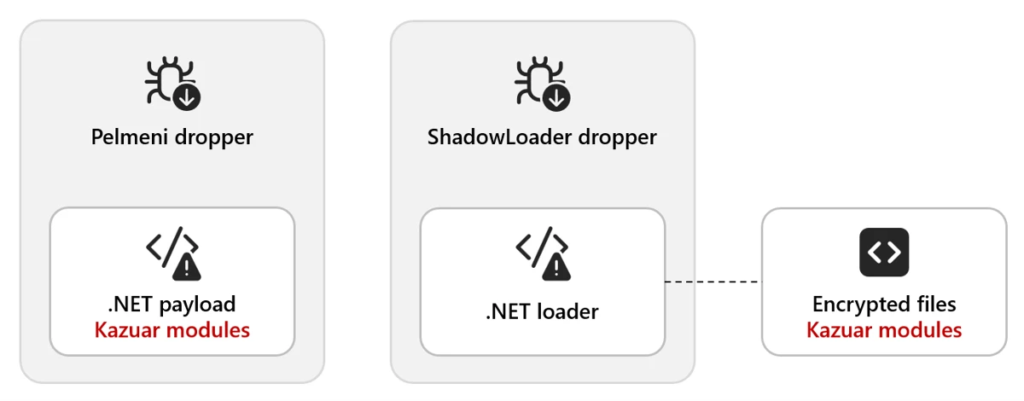
Microsoft says Kazuar can arrive through several dropper variants. One observed method uses a dropper called Pelmeni, which stores an encrypted second-stage payload inside the dropper itself.
In some cases, the payload is tied to the target environment. For example, Microsoft said the payload can be encrypted with information such as the target hostname, which means it only decrypts and runs on the intended machine.
Another delivery path uses a small .NET loader placed alongside the final payload. The dropper then invokes the loader and supplies the decrypted Kazuar modules for execution.
The three Kazuar modules have separate jobs
Kazuar’s current architecture splits major functions across three module types. This design gives the malware flexibility and reduces the chance that one detected component reveals the whole operation.
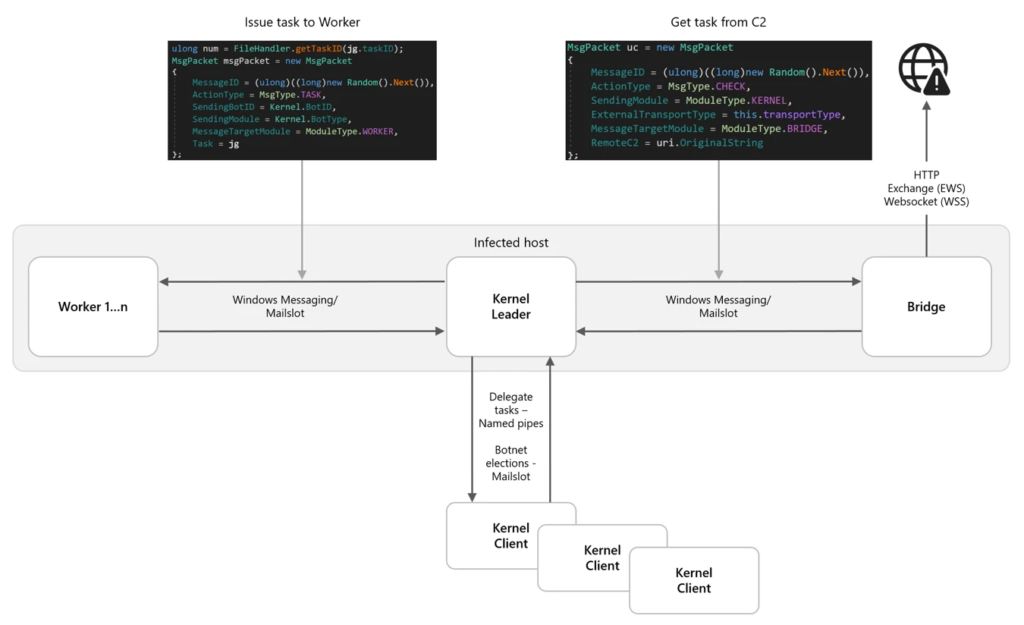
The Kernel module acts as the coordinator. It manages tasks, communicates with other modules, keeps logs, handles internal routing, and performs anti-analysis checks before the malware continues running.
The Bridge module handles outside communication. It relays traffic between the elected Kernel leader and attacker-controlled command-and-control infrastructure through supported channels such as HTTP, WebSocket, or Exchange Web Services.
| Module | Role in Kazuar |
|---|---|
| Kernel | Coordinates tasks, manages logs, handles internal routing, and controls botnet behavior. |
| Bridge | Connects the botnet to external command-and-control infrastructure. |
| Worker | Collects data, runs assigned tasks, captures screenshots, and performs host reconnaissance. |
The leader election system reduces external traffic
The most important stealth feature is Kazuar’s leader election system. Instead of every infected host contacting the attacker’s server, one Kernel module becomes the leader and communicates outward on behalf of the others.
Microsoft says this reduces visibility because defenders see less external traffic from infected systems. Non-leader hosts can remain quieter while still receiving commands and forwarding collected data through internal channels.
If the leader disappears, Kazuar can elect a new leader. This design helps the botnet remain operational even when a defender isolates or removes one infected machine.
- Only the elected leader communicates externally.
- Other infected hosts route activity through internal peer communication.
- The botnet can continue operating if one host goes offline.
- Lower external traffic makes network detection harder.
- Internal communication can use Windows messaging, mailslots, and named pipes.
What Kazuar collects from infected machines
Kazuar’s Worker module performs the hands-on collection work. Microsoft said the malware can gather broad system details, take screenshots, collect files, inspect running processes, and capture information useful for espionage operations.
The system information gathered can include antivirus details, AppLocker settings, network adapters, ARP tables, network shares, running processes, active windows, recent documents, Outlook downloads, USB devices, local users, logon sessions, DNS cache, services, drivers, and update history.
Earlier Unit 42 research also described Kazuar as an advanced .NET backdoor with extensive commands for host profiling, credential theft, file manipulation, arbitrary command execution, registry activity, scripts, and sensitive application data theft.
| Collection area | Examples |
|---|---|
| System profile | OS details, security tools, services, drivers, update history, and hardware details. |
| User activity | Active windows, recent documents, Explorer history, and Outlook downloads. |
| Network data | Network adapters, ARP tables, DNS cache, network shares, and active connections. |
| Files and screenshots | Automated file harvesting and screenshot capture. |
| Execution tasks | Command execution, scripts, registry operations, and custom network requests. |
Configuration depth makes Kazuar harder to hunt
Microsoft said Kazuar now supports around 150 configuration types across communication, execution, security bypass, tasking, data exfiltration, file collection, and operational state management.
This lets operators change how the malware behaves without rebuilding the entire tool. They can adjust communication methods, task timing, file collection rules, process injection settings, and exfiltration windows.
That flexibility makes static indicators less reliable. A hash or filename may help in one incident, but defenders also need behavioral detection focused on how Kazuar stages data, routes messages, and communicates internally.
Secret Blizzard’s targets and attribution
Microsoft attributes Kazuar activity to Secret Blizzard, a Russian state actor also tracked by other vendors under names such as Turla, Uroburos, Venomous Bear, Blue Python, WRAITH, and ATG26.
Microsoft said CISA has attributed Secret Blizzard to Center 16 of Russia’s Federal Security Service. The group has a long record of targeting ministries of foreign affairs, embassies, government offices, defense departments, and defense-related companies.
Microsoft also noted that Secret Blizzard has targeted systems in Ukraine previously compromised by Aqua Blizzard, likely to support Russia’s foreign policy and military objectives.
Why defenders should focus on behavior
Kazuar’s modular design makes single-sample analysis less useful. Defenders should look for patterns that keep the botnet working, including leader election behavior, inter-process communication, encrypted local staging, and periodic exfiltration.
Microsoft recommends hardening endpoint protection, enabling network protection, using attack surface reduction rules, blocking potentially obfuscated scripts, monitoring PowerShell activity, and running endpoint detection and response in block mode.
Organizations at higher risk should also monitor named pipes, unusual internal communication between hosts, unexpected hidden windows, suspicious working directories, and encrypted data staging files.
- Enable endpoint detection and response in block mode.
- Turn on tamper protection and real-time antivirus protection.
- Use attack surface reduction rules against suspicious scripts and process creation.
- Monitor PowerShell module and script block logging.
- Look for unusual named pipe and inter-process communication activity.
- Review unexpected local data staging and encrypted files.
- Watch for suspicious Exchange Web Services, WebSocket, or HTTP-based C2 traffic.
Known Kazuar indicators
Microsoft published several indicators tied to the analyzed Kazuar components. Security teams can use these indicators as part of a wider detection strategy, but they should not rely on hashes alone.
| SHA-256 | Description |
|---|---|
| 69908f05b436bd97baae56296bf9b9e734486516f9bb9938c2b8752e152315d4 | hpbprndiLOC.dll, Kazuar loader |
| c1f278f88275e07cc03bd390fe1cbeedd55933110c6fd16de4187f4c4aaf42b9 | Decrypted Kernel module |
| 6eb31006ca318a21eb619d008226f08e287f753aec9042269203290462eaa00d | Decrypted Bridge module |
| 436cfce71290c2fc2f2c362541db68ced6847c66a73b55487e5e5c73b0636c85 | Decrypted Worker module |
Kazuar shows how espionage malware is changing
Kazuar’s evolution shows how nation-state malware is moving toward resilience by design. The tool does not only hide from antivirus scans. It reduces the number of infected hosts that speak to external infrastructure and keeps activity distributed inside the network.
That approach creates a harder problem for defenders. Blocking one command-and-control path or removing one infected host may not fully disrupt the operation if other nodes can continue routing tasks.
For government, defense, diplomatic, and high-risk research organizations, Kazuar should trigger a wider review of endpoint visibility, internal traffic monitoring, credential hygiene, and incident response readiness.
FAQ
Kazuar is a sophisticated malware family linked to Secret Blizzard, a Russian state actor. Microsoft says it has evolved from a traditional backdoor into a modular peer-to-peer botnet used for long-term espionage and data collection.
Microsoft attributes Kazuar activity to Secret Blizzard, a Russian state actor that overlaps with groups tracked as Turla, Uroburos, Venomous Bear, Blue Python, WRAITH, and ATG26.
Kazuar uses three main module types: Kernel, Bridge, and Worker. The Kernel coordinates activity, the Bridge handles external command-and-control communication, and the Worker collects data and performs assigned tasks on infected hosts.
Kazuar’s peer-to-peer design lets only one elected leader communicate externally while other infected systems stay quieter. This reduces visible command-and-control traffic and helps the botnet keep working if one infected host is removed.
Organizations should focus on behavior such as unusual named pipe activity, hidden windows, encrypted local staging files, suspicious internal host communication, PowerShell activity, and unusual WebSocket, HTTP, or Exchange Web Services traffic. Hash indicators can help, but behavioral detection is more important.


Read our disclosure page to find out how can you help VPNCentral sustain the editorial team Read more


Improve this guide




User forum
0 messages