
Pentest Swarm AI Brings Agent-Based Security Testing to Open-Source Pentesting


 9 min. read
  Published on
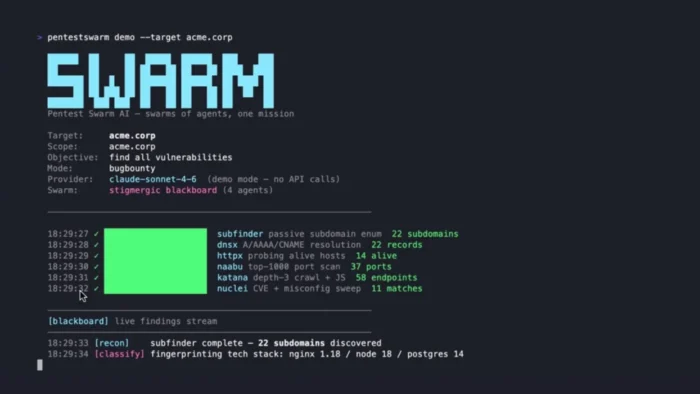
Pentest Swarm AI is an open-source autonomous penetration testing project that uses multiple AI-driven agents to coordinate reconnaissance, vulnerability classification, exploitation decisions, and reporting. The Pentest Swarm AI GitHub repository describes the tool as a swarm-based alternative to traditional multi-agent pentesting pipelines.
The project, developed by Armur AI, is aimed at security teams, bug bounty hunters, and internal red teams that want AI-assisted testing inside authorized environments. It supports Claude, local models through Ollama, and OpenAI-compatible models, giving teams flexibility between cloud-based and local deployments.

Access content across the globe at the highest speed rate.
70% of our readers choose Private Internet Access
70% of our readers choose ExpressVPN

Browse the web from multiple devices with industry-standard security protocols.

Faster dedicated servers for specific actions (currently at summer discounts)
The tool’s main pitch is coordination. Instead of asking a single planner model to run a fixed sequence of steps, Pentest Swarm AI uses a shared blackboard model where agents react to findings, update priorities, and hand off work through the state of the system.
What Makes Pentest Swarm AI Different
Many AI pentesting tools work like pipelines. A planner sends work to a recon agent, then to a classifier, then to an exploit agent, and finally to a reporting agent. Pentest Swarm AI presents a different model built around stigmergy, emergence, and decentralization.
The project’s implementation plan explains that the system uses a Postgres-backed blackboard with pgvector as the coordination layer. Agents read findings from the blackboard and write new ones back into it, rather than waiting for a central controller to tell every agent what to do next.
That means a new HTTP endpoint can trigger classification, a high-risk finding can trigger deeper validation, and confirmed results can feed the report agent. The order emerges from the findings, not from a hard-coded sequence.
| Swarm concept | How Pentest Swarm AI uses it | Security testing impact |
|---|---|---|
| Stigmergy | Agents coordinate through a shared blackboard | Findings guide the next actions without a central planner |
| Emergence | Attack paths form from agent reactions | Testing can adapt as new evidence appears |
| Decentralization | Each agent has its own trigger logic | New agents can join without rewriting the full orchestrator |
| Pheromone weighting | High-value findings receive more attention and stale paths decay | Agents can prioritize stronger leads and reduce wasted work |
Tool Access Is Expanding, but Some Integrations Are Still Roadmap Items
The project markets itself as a way to give AI agents access to standard offensive security tooling, including nmap, sqlmap, Burp Suite, ZAP, Metasploit, and ProjectDiscovery tools. That positioning puts it in the growing category of AI-assisted security orchestration platforms.
However, the current README comparison table is more precise: it says Pentest Swarm AI has 8 ProjectDiscovery tools plus nmap wired, while sqlmap, Burp MCP, and Metasploit are listed as roadmap integrations. That matters for teams evaluating whether it is ready for their specific testing workflow.
The Homebrew tap for Pentest Swarm AI lists supported tool calls such as nmap, subfinder, httpx, nuclei, ffuf, sqlmap, amass, dnsx, naabu, katana, gau, gobuster, gowitness, trufflehog, gitleaks, and semgrep. Teams should still verify which adapters are stable in the main project before using it in production testing.
Where the Swarm Fits in a Pentest Workflow
Pentest Swarm AI is designed to help with repeatable security testing tasks. These include recon, service discovery, web endpoint collection, vulnerability classification, evidence capture, deduplication, and report generation.
The tool is not a replacement for an experienced tester. It can help organize and run parts of a test, but human review still matters for scope, legal authorization, exploit safety, false positives, business impact, and final reporting.
This is especially important because the project can execute security tools. Any use should stay within systems the tester owns or has explicit written permission to assess.
| Workflow area | How the tool can help | Human review still needed |
|---|---|---|
| Reconnaissance | Collects domains, endpoints, ports, and technologies | Confirm scope and avoid unauthorized targets |
| Classification | Groups findings and raises likely high-value paths | Check false positives and business context |
| Validation | Can help test whether findings are real | Prevent unsafe or disruptive actions |
| Reporting | Produces structured outputs for review | Verify evidence, severity, and remediation advice |
Reports, Scope Controls, and CI/CD Use
The project says campaigns can generate Markdown, HTML, JSON, and SARIF outputs. SARIF support matters because security teams can feed results into systems that already understand static analysis and vulnerability findings.
GitHub’s SARIF upload documentation explains how teams can upload SARIF files into GitHub code scanning. That makes the format useful for CI/CD workflows where findings need to appear alongside code security alerts.
The project also emphasizes scope enforcement. Its documentation describes scope validation at tool and executor layers, which is important for bug bounty programs, internal testing, and CI/CD environments where accidental out-of-scope scanning can create legal and operational problems.
Model and MCP Integration
Pentest Swarm AI supports multiple model choices. The project points to Claude by default, while also supporting Ollama for local deployments and OpenAI-compatible model endpoints for teams with different privacy, cost, or capability requirements.
The project also exposes MCP server support. The Model Context Protocol documentation describes MCP as a standard way for AI applications to connect with external tools and data sources, which helps explain why security tools are increasingly being wrapped for AI-driven workflows.
In practice, MCP support could make Pentest Swarm AI more useful inside developer tools and AI clients that already support the protocol. The benefit is not just automation, but easier integration into the tools security teams already use.
How It Compares With Other AI Pentesting Tools
The project compares itself with tools such as PentestGPT, PentAGI, HexStrike, HackingBuddyGPT, Shannon, and Pentest-R1. The main claimed difference is the swarm coordination layer.
Where some tools suggest steps and others delegate tool use through a planner, Pentest Swarm AI focuses on shared state, pheromone-weighted findings, and decentralized agent triggers. That design may help complex campaigns, but it also makes operational guardrails more important.
| Tool | General approach | Execution model | Main differentiator |
|---|---|---|---|
| Pentest Swarm AI | Swarm-style agents with blackboard memory | Can execute tools within scope | Stigmergic coordination and report output |
| PentestGPT | Single-agent reasoning workflow | Primarily suggests steps | Guided pentesting assistant |
| PentAGI | Multi-agent system with planner | Can execute tools | Planner-led agent pipeline |
| HexStrike | MCP tool wrapper | Delegates tool calls | Broad tool exposure through MCP |
Security and Legal Guardrails Matter
The repository includes a legal disclaimer that limits use to authorized testing, bug bounty programs, CTFs, and educational research. That warning should not be treated as boilerplate. A tool that can coordinate recon and testing across external targets can create legal risk if users run it outside a permitted scope.
The GitHub project page also states that users must obtain explicit written permission from the target system owner before running scans. This point belongs in any enterprise deployment policy, especially if teams connect the tool to CI/CD or bug bounty workflows.

Security leaders should treat AI pentesting tools the same way they treat scanners and exploit frameworks. They need approval workflows, network boundaries, logging, role-based access, and clear rules for who can launch tests.
What Teams Should Evaluate Before Using It
Organizations should test the platform in a lab before using it on live assets. They should confirm which adapters work, what the tool can execute, how scope validation behaves, and how reports map to their internal risk process.
The technical roadmap shows that the project is still evolving, with additional integrations and workflow improvements planned. That makes it promising, but teams should separate current capabilities from future roadmap claims.
- Verify which tool adapters are stable before production use.
- Run first tests only in a lab or authorized internal range.
- Confirm that scope enforcement works for your program rules.
- Review generated findings for false positives and unsafe assumptions.
- Check how secrets, logs, and evidence are stored.
- Limit who can run scans and which targets they can reach.
- Document written authorization before testing any third-party system.
Why AI Pentesting Tools Are Getting Attention
Security teams face growing attack surfaces, faster release cycles, and a shortage of experienced testers. AI-assisted tools promise to reduce repetitive work and help analysts focus on validation, impact, and remediation.
At the same time, the risk is real. Giving an AI system tool access requires careful design because mistakes can trigger noisy scans, break systems, or cross scope boundaries.
That is why structured outputs such as SARIF and tool protocols such as MCP are becoming more important. The GitHub SARIF workflow gives teams one way to bring machine-readable findings into existing security pipelines, while the MCP introduction shows how AI systems are moving toward standardized tool connections.
Availability and Licensing
Pentest Swarm AI is published as an open-source project under the AGPL-3.0 license. That license choice matters for companies planning to modify or host the software as a service, because AGPL includes network-use obligations.
The project also has a Homebrew distribution path, which makes installation simpler for macOS users and helps the project fit into developer-oriented security workflows.
For now, the strongest use case is controlled, authorized testing where a security team wants to experiment with agent coordination, structured reporting, and AI-assisted triage while keeping a human in the approval loop.
The Bottom Line
Pentest Swarm AI is an ambitious open-source attempt to bring swarm-style AI coordination to penetration testing. Its blackboard architecture, scope controls, reporting formats, and tool integrations make it worth watching for red teams and security engineering groups.
Teams should also evaluate it carefully. Some advertised integrations are still on the roadmap, and autonomous security testing requires strong guardrails. Used responsibly, it may help automate parts of authorized testing. Used carelessly, it can create the same risks as any offensive security tool with live execution access.
FAQ
Pentest Swarm AI is an open-source autonomous penetration testing project that uses multiple AI agents, a shared blackboard, and standard security tools to assist with authorized recon, classification, validation, and reporting.
The project markets support for a broad offensive security stack, but its current comparison table says 8 ProjectDiscovery tools plus nmap are wired, while sqlmap, Burp MCP, and Metasploit are listed as roadmap integrations. Teams should verify current adapter status before use.
The project uses a shared blackboard where agents write findings and react to findings from other agents. Its design is based on stigmergy, emergence, decentralization, and pheromone-weighted prioritization rather than one central planner issuing fixed steps.
No. Pentest Swarm AI should only be used against systems the tester owns or has explicit written permission to test. Unauthorized scanning or exploitation can violate laws and program rules.
The best fit is security teams, red teams, bug bounty participants, and security engineers who want to experiment with AI-assisted testing in controlled, authorized environments while keeping human review in the workflow.


Read our disclosure page to find out how can you help VPNCentral sustain the editorial team Read more


Improve this guide




User forum
0 messages