
AZUREVEIL Malware Campaign Uses Azure Blob Storage to Hide Adaptix C2 Traffic


 7 min. read
  Published on
A China-linked espionage campaign is using spearphishing emails to deliver AZUREVEIL, a malware payload based on the AdaptixC2 agent. The campaign targets the Czech Republic and Taiwan and uses Microsoft Azure Blob Storage to make command-and-control traffic look like normal cloud activity.
The operation, tracked as Operation Dragon Weave by Seqrite researchers, starts with a ZIP archive that contains files disguised as official documents. Once opened, the archive can launch a multi-stage infection chain that drops a Rust-based loader and then executes AZUREVEIL in memory.

Access content across the globe at the highest speed rate.
70% of our readers choose Private Internet Access
70% of our readers choose ExpressVPN

Browse the web from multiple devices with industry-standard security protocols.

Faster dedicated servers for specific actions (currently at summer discounts)
Seqrite said the campaign focuses on the Czech Republic and Taiwan, with affected sectors including government, public sector, research, academia, technology, software, and financial services. The earliest known sample was submitted from Taiwan on March 26, 2026.
Operation Dragon Weave uses fake official documents
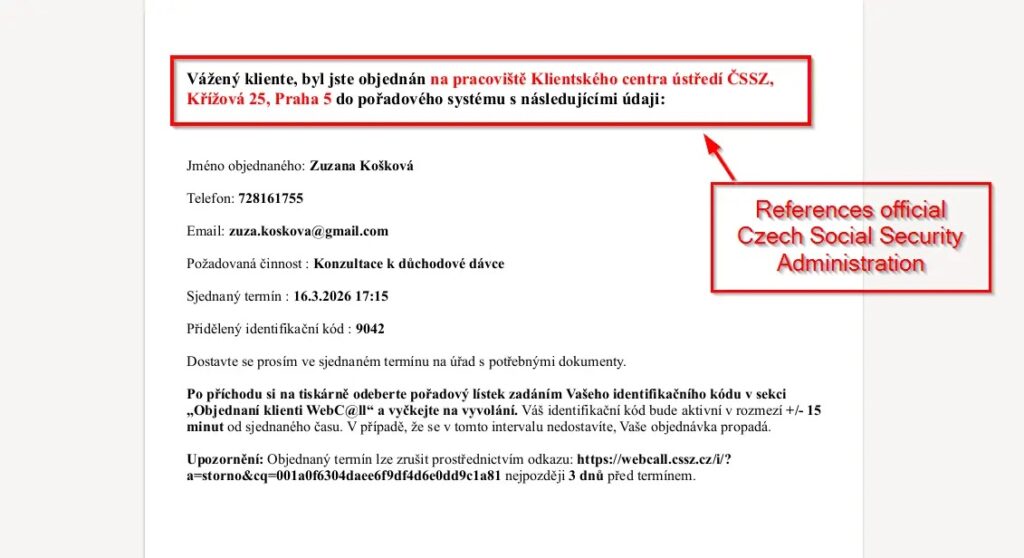
The phishing lure uses Traditional Chinese file names and document themes that appear to mimic official communications. In one case, the decoy document looked like an appointment notice from the Czech Social Security Administration.
The delivery method matches the MITRE ATT&CK spearphishing attachment technique, where attackers send malicious files to targeted users. This campaign uses that initial access method to move victims into a hidden script and loader chain.
The ZIP archive contains two possible execution paths. One path uses a malicious Windows shortcut file that looks like a PDF. The other uses a Rust-compiled executable that acts as a self-contained dropper. Both paths eventually reach the same payload.
| Campaign detail | Information |
|---|---|
| Campaign name | Operation Dragon Weave |
| Final payload | AZUREVEIL AdaptixC2 agent |
| Target regions | Czech Republic and Taiwan |
| Initial delivery | ZIP archive with malicious LNK and executable files |
| Command-and-control channel | Microsoft Azure Blob Storage |
| Attribution | China-linked threat actor, moderate confidence |
RUSTCLOAK loads AZUREVEIL in memory
After the first stage runs, the attack uses a VBScript and PowerShell chain to decrypt and execute RuntimeBroker_update.exe. That file then sideloads a malicious UnityPlayer.dll, which Seqrite tracks as RUSTCLOAK.
RUSTCLOAK performs several checks before launching the final payload. It compares the infected computer’s name against a hardcoded list of more than 100 sandbox and analyst machine names. If it finds a match, it exits without running the malware.
The loader then decrypts the payload through several layers. Seqrite reported a modified RC4 stage, Base64 decoding, and SM4-CBC decryption before the final AZUREVEIL payload runs in memory.
- The victim opens a ZIP attachment from a spearphishing email.
- A fake PDF shortcut or Rust executable starts the infection chain.
- VBScript and PowerShell prepare the next payload.
- RuntimeBroker_update.exe sideloads a malicious UnityPlayer.dll.
- RUSTCLOAK decrypts and runs AZUREVEIL in memory.
AZUREVEIL hides inside trusted cloud traffic
AZUREVEIL is a 64-bit DLL based on AdaptixC2, an open-source post-exploitation framework used for authorized security testing. Threat actors often abuse legitimate red-team tools because they provide ready-made capabilities for remote control, command execution, and post-compromise activity.
Instead of calling a traditional attacker-controlled C2 server, AZUREVEIL uses Azure Blob Storage as a shared communication channel. Microsoft describes Blob Storage as cloud object storage for large amounts of unstructured data, which makes it common in enterprise environments.
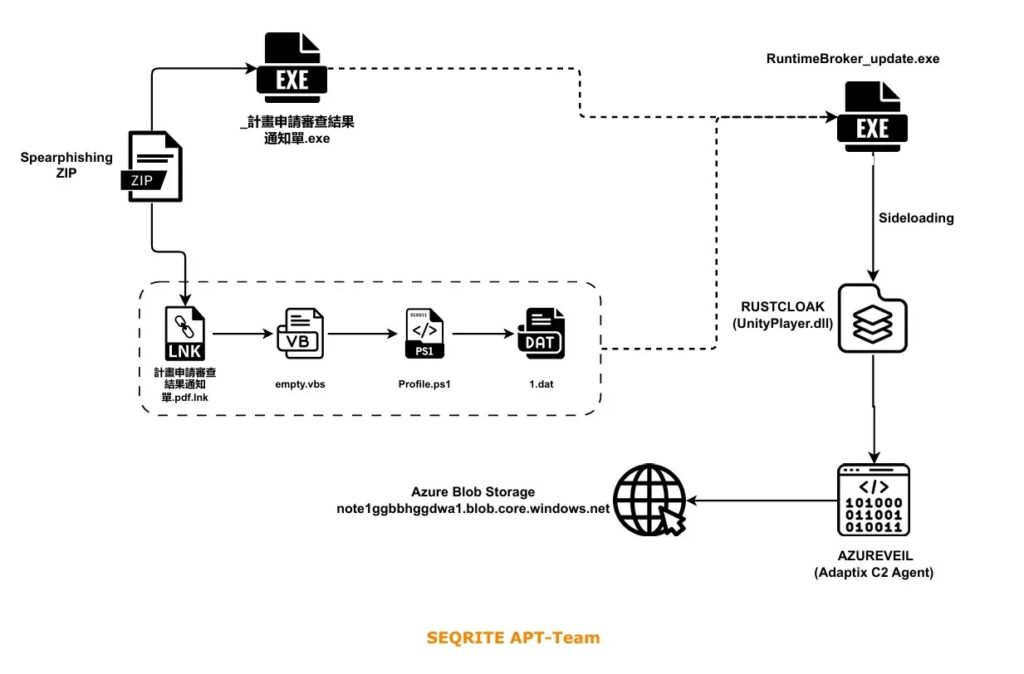
This approach resembles a dead drop resolver technique. The infected machine and the attacker do not need to talk directly. Instead, both sides use the same cloud storage location to exchange encrypted commands and results.
Why Azure Blob Storage makes detection harder
Cloud-based C2 can make network monitoring more difficult because traffic to blob.core.windows.net may look normal inside companies that already use Microsoft cloud services. Blocking the entire service can break legitimate business applications.
The malware used a hardcoded shared access signature token to interact with the Azure storage container. Microsoft says SAS tokens can delegate access to Azure Storage resources with specific permissions and time limits.
Seqrite found that the token was valid from March 19, 2026, to March 19, 2027. It granted broad access, including read, write, delete, and upload permissions, suggesting the attackers planned for long-term use of the infrastructure.
| Technical component | Role in the attack |
|---|---|
| Malicious ZIP archive | Initial delivery container |
| LNK file | Starts the script-based path |
| Profile.ps1 | Decrypts and launches the next stage |
| RuntimeBroker_update.exe | Legitimate-looking sideloading executable |
| UnityPlayer.dll | Malicious RUSTCLOAK loader |
| Com.dat | Encrypted AZUREVEIL payload container |
AZUREVEIL supports 36 post-exploitation commands
Seqrite’s analysis found that AZUREVEIL can run 36 commands after infection. These commands cover file operations, shell execution, process listing, network pivoting, SOCKS proxy control, port forwarding, and in-memory Beacon Object File execution.
The AdaptixC2 framework is designed for post-exploitation and adversarial emulation, but AZUREVEIL shows how attackers can repurpose this kind of tooling for covert access. The malware also resolves around 87 Windows APIs at runtime using a djb2-based hashing method.
In-memory execution raises the risk for defenders because the malware can run additional code without dropping many new files to disk. That reduces the evidence available to traditional file-based antivirus tools and makes endpoint behavior monitoring more important.
Indicators defenders should watch
Organizations in government, research, technology, and finance should treat unexpected ZIP attachments with extra caution, especially when they include shortcut files, script files, or executables disguised as documents.
Security teams should monitor unusual HTTPS activity to Azure Blob Storage, especially when endpoints that do not normally use Azure begin making regular connections to blob.core.windows.net. Monitoring should focus on behavior, frequency, destination patterns, and the process responsible for the traffic.
Teams should also review any exposed SAS tokens. Long-lived tokens with broad permissions create risk if attackers steal or hardcode them inside malware.
| Type | Indicator | Description |
|---|---|---|
| Network | note1ggbbhggdwa1[.]blob[.]core[.]windows[.]net | Azure Blob Storage C2 endpoint |
| SHA-256 | 096372d19b4787e989f44e04c5ecc29885aa927c34ae8666628d6c0eb20bb447 | Malicious LNK file |
| SHA-256 | 1c56228cbd1bdebb9e5ea55c2749150fee06c865ede4a3754e8bd6843e51d2d4 | Executable dropper |
| SHA-256 | 080ab9bc2893ba7bad354551604a667af40ed2ae2d042d2323c2bd9ad3122192 | UnityPlayer.dll RUSTCLOAK loader |
| SHA-256 | 61f7d9cd2d8ce7df950639b23ce90085b300b0c6dd0d8d934bba8fdecb670f15 | RuntimeBroker_update.exe |
| SHA-256 | 24aa4e780ccd66cef13da9ef98c32954105cf2a32ec643efab0ba1aa2d6352f4 | Com.dat encrypted payload container |
How organizations can reduce risk
Operation Dragon Weave shows why defenders need to inspect both email attachments and cloud service traffic. A campaign can begin with a familiar phishing technique, then hide its later activity inside a service that many organizations already trust.
Defenders should map this campaign against the spearphishing attachment technique and use attachment sandboxing, file extension controls, and user reporting workflows to catch the earliest stage. LNK files inside compressed archives deserve special scrutiny.
Security teams should also hunt for patterns linked to the dead drop resolver technique, including unusual cloud storage access from non-browser processes. Endpoint tools should detect hidden PowerShell execution, DLL sideloading, in-memory payload execution, and suspicious named pipe behavior.
- Block or warn on LNK files inside ZIP archives.
- Restrict PowerShell and VBScript execution where possible.
- Monitor unusual outbound HTTPS traffic to blob.core.windows.net.
- Review long-lived Azure SAS tokens and reduce token permissions.
- Use endpoint tools that detect DLL sideloading and in-memory execution.
- Train high-risk users to report unexpected government-themed attachments.
FAQ
AZUREVEIL is a malware payload based on the AdaptixC2 agent. Seqrite found it in Operation Dragon Weave, where it was used for remote control, command execution, file operations, network pivoting, and in-memory payload execution.
Operation Dragon Weave targeted the Czech Republic and Taiwan. Seqrite said affected sectors included government, public sector, research, academia, technology, software, and financial services.
The campaign starts with a spearphishing email carrying a ZIP archive. The archive contains files disguised as official documents, including a malicious shortcut and a Rust-based executable dropper.
AZUREVEIL uses Azure Blob Storage to make its command-and-control traffic blend in with normal enterprise cloud activity. This can make network-level detection harder in organizations that already use Microsoft cloud services.
Organizations should inspect ZIP attachments, block risky LNK execution, restrict PowerShell and VBScript, monitor unusual Azure Blob Storage traffic, review SAS token exposure, and deploy endpoint detection for DLL sideloading and in-memory execution.


Read our disclosure page to find out how can you help VPNCentral sustain the editorial team Read more


Improve this guide




User forum
0 messages