
Hackers Could Abuse WM_COPYDATA Callback Path to Execute Code Through Win32k Dispatch


 6 min. read
  Published on

A newly documented Windows injection technique shows how attackers could abuse a legitimate win32k.sys callback path to run code inside another GUI process. The method was detailed by security researcher n0qword in a Win32k Callback Detouring write-up published in April 2026.
The technique focuses on the KernelCallbackTable, a structure found in GUI-enabled Windows processes. Windows uses this table during normal graphical subsystem operations, which makes the path attractive for stealthy abuse if an attacker already has the access needed to tamper with a target process.

Access content across the globe at the highest speed rate.
🔥 Save 81% + 2 bonus months! 🔥
70% of our readers choose Private Internet Access
70% of our readers choose ExpressVPN
2
Browse the web from multiple devices with industry-standard security protocols.
🔥 Save 73%! 🔥

Faster dedicated servers for specific actions (currently at summer discounts)
🔥 Save 69%! 🔥
The disclosure does not show a newly patched Microsoft vulnerability or a confirmed malware campaign. Instead, it describes a process-injection approach that security teams should understand because it avoids some signals used to detect older KernelCallbackTable injection methods.
How the Callback Path Works
Windows uses kernel-to-user callbacks when the graphical subsystem needs user-mode code to handle certain GUI-related operations. The researcher’s proof-of-concept repository explains that the callback dispatch path eventually resolves a user-mode routine from the KernelCallbackTable.
Traditional KernelCallbackTable injection usually changes an entry inside the table itself. That can leave a clear structural anomaly because defenders can compare the table with expected callback targets.
The newer detouring approach keeps the table entry in place and instead patches the function that the table points to. This means simple checks of the KernelCallbackTable may still show the expected pointer, even though execution can be redirected later.
| Technique | What gets changed | Detection challenge |
|---|---|---|
| Classic KernelCallbackTable injection | The callback table entry is replaced | Table integrity checks can detect the altered pointer |
| Win32k callback detouring | The callback target function is patched | The table can look normal while the function body changes |
| Remote thread injection | A new thread is created in another process | Thread creation and memory allocation events can stand out |
| APC-based injection | Execution is queued through an asynchronous procedure call | Suspicious queueing and process behavior may trigger alerts |
Why WM_COPYDATA Matters
The technique centers on the __fnCOPYDATA callback, which is associated with the WM_COPYDATA message. Microsoft says WM_COPYDATA lets one application pass data to another application through Windows messaging.
That message type creates a predictable trigger. A process with a window can receive a WM_COPYDATA message, and the normal callback path can invoke the related user-mode routine during message handling.
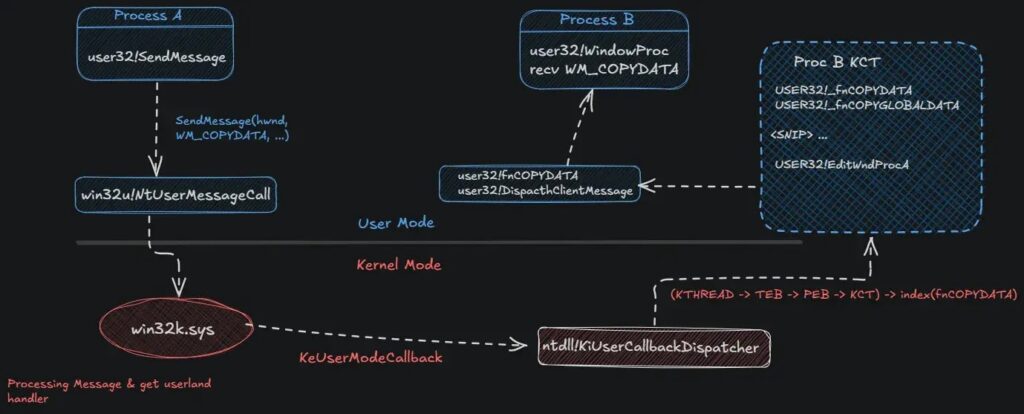
Microsoft’s interprocess communication documentation also notes that data copy through Windows IPC requires cooperation between the sending and receiving applications. In this research context, the same legitimate mechanism becomes useful as a trigger for a hijacked callback path.
What Makes the Technique Harder to Spot
The main stealth benefit comes from where the tampering happens. If defenders only inspect the KernelCallbackTable, they may miss the change because the table entry itself can remain untouched.
The researcher’s callback detouring research describes this as a cleaner execution route than some conventional process-injection primitives. The method uses an expected callback dispatch chain before the malicious redirection takes place.
MITRE ATT&CK already tracks KernelCallbackTable abuse under T1574.013, a sub-technique of hijack execution flow. MITRE notes that adversaries may abuse the KernelCallbackTable to hijack a process and run their own payloads.
- The technique targets GUI-enabled Windows processes.
- It depends on a legitimate kernel-to-user callback dispatch path.
- It uses WM_COPYDATA as a reliable message-based trigger.
- It can bypass checks that only validate the KernelCallbackTable pointer values.
- It still requires suspicious memory tampering that defenders can monitor.
Defenders Need to Look Beyond the Table
Security teams should not treat a clean KernelCallbackTable as proof that the process is safe. The more useful defensive view includes memory permissions, inline changes to callback targets, message patterns and suspicious activity around GUI processes.
The n0qword GitHub project states that the material is for educational and defensive research in authorized lab environments. Even so, the method shows how attackers can hide inside trusted Windows behavior when monitoring remains too narrow.
For detection, teams should watch for unusual writes to user32.dll callback targets, unexpected executable memory inside GUI processes and abnormal WM_COPYDATA traffic between unrelated applications. These signals become stronger when they appear together in the same process chain.
| Defensive signal | Why it matters |
|---|---|
| Inline patching of callback routines | The new method detours the function referenced by the table |
| Unexpected executable memory | Injected payloads often need memory with execution rights |
| Unusual WM_COPYDATA traffic | The message can trigger the hijacked callback path |
| Memory protection changes in GUI processes | Callback targets may need writable permissions before patching |
| Suspicious cross-process activity | Process access, memory writes and GUI messaging together raise risk |
Why This Matters for Windows Security
KernelCallbackTable abuse has appeared in the security community before, but the WM_COPYDATA callback detouring path adds another reminder that Windows internals can offer attackers subtle execution routes. These routes often look less obvious than a newly created remote thread.
Microsoft’s WM_COPYDATA documentation describes normal application-to-application data transfer, not an exploit. The risk comes when an attacker combines that legitimate message flow with process tampering and a hijacked callback target.
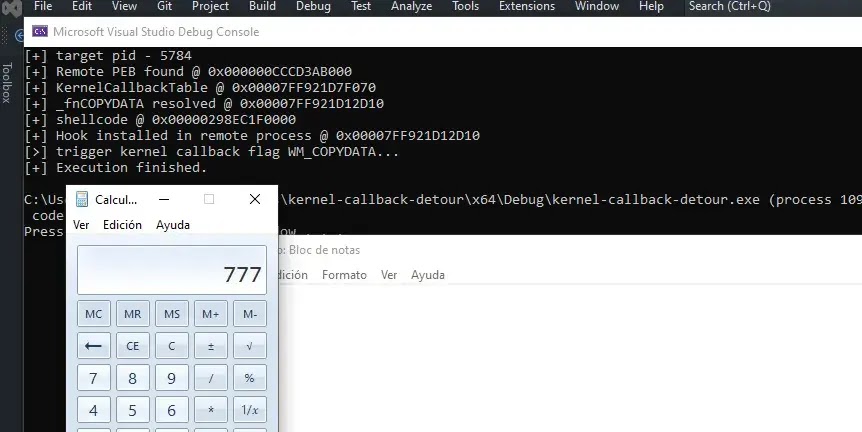
Defenders should map the technique to KernelCallbackTable hijacking and update detection logic accordingly. Monitoring the table alone can miss this variant, so endpoint visibility must extend to function-level modifications and the surrounding behavior.
The same principle applies to interprocess communication more broadly. Legitimate Windows messaging remains essential for desktop applications, but security tools need context to separate normal communication from message traffic used to trigger hidden code execution.
FAQ
WM_COPYDATA callback detouring is a research technique that abuses a legitimate Windows callback path to redirect execution inside another GUI process. It focuses on the __fnCOPYDATA callback linked to the WM_COPYDATA message.
The disclosure describes an injection technique, not a newly patched Microsoft vulnerability. It relies on process tampering and abuse of legitimate Windows callback behavior rather than a standalone CVE.
The KernelCallbackTable stores callback function pointers used by GUI-enabled Windows processes. Attackers can abuse this area to hijack execution flow, and defenders often monitor it for signs of process injection.
It can be harder to detect because it leaves the KernelCallbackTable entry unchanged and instead patches the function referenced by the table. Tools that only check table integrity may miss the function-level modification.
Defenders should monitor inline changes to user32.dll callback targets, unexpected executable memory, memory protection changes, unusual WM_COPYDATA traffic and suspicious cross-process activity involving GUI applications.


Read our disclosure page to find out how can you help VPNCentral sustain the editorial team Read more


Improve this guide



User forum
0 messages