
Accenture Confirms Security Incident After Hacker Claims 35 GB Source Code Theft


 8 min. read
  Published on

Accenture has confirmed an isolated security incident after a threat actor claimed to be selling 35 GB of data allegedly stolen from the consulting and IT services giant.
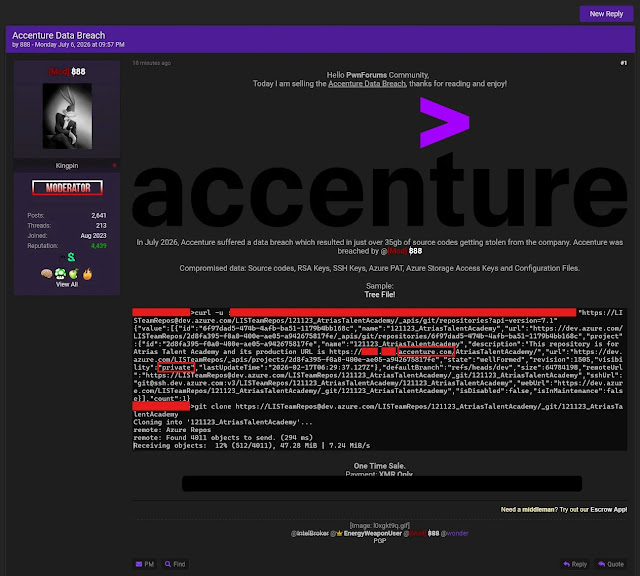
The claim was reported by BleepingComputer, which said a cybercrime forum user known as “888” alleged that the stolen material included source code, RSA keys, SSH keys, Azure personal access tokens, Azure Storage access keys, and configuration files.

Access content across the globe at the highest speed rate.
🔥 Save 81% + 2 bonus months! 🔥
70% of our readers choose Private Internet Access
70% of our readers choose ExpressVPN
2
Browse the web from multiple devices with industry-standard security protocols.
🔥 Save 73%! 🔥

Faster dedicated servers for specific actions (currently at summer discounts)
🔥 Save 69%! 🔥
Accenture did not confirm the claimed 35 GB figure or the specific types of data allegedly taken. The company told SecurityWeek that it was aware of the isolated matter, had remediated its source, and saw no impact to operations or service delivery.
What the hacker claimed
The threat actor posted the alleged data for sale on a cybercrime forum in early July 2026. The listing described the material as a one-time sale and reportedly requested payment in Monero, a privacy-focused cryptocurrency commonly used in cybercrime markets.
The alleged sample appeared to show command-line activity involving Azure DevOps, including a request to a dev.azure.com endpoint and a git clone operation for a private repository. The repository name shown in reporting was “121123_AtriasTalentAcademy.”
Help Net Security said the forum post claimed the data came from Accenture in July 2026, but the extent of the incident remains unknown.
| Item | Current status |
|---|---|
| Company involved | Accenture |
| Threat actor alias | 888 |
| Claimed data volume | About 35 GB |
| Claimed data types | Source code, RSA keys, SSH keys, Azure PATs, Azure Storage keys, and configuration files |
| Company confirmation | Accenture confirmed an isolated matter, but not the claimed scope |
| Operational impact | Accenture said there was no impact to operations or service delivery |
| Key unknowns | Initial access method, exact data accessed, client impact, and whether secrets were valid |
Accenture says the issue is contained
Accenture’s public statement through media outlets was brief. The company said it remediated the source of the matter and that its operations and service delivery were not affected.
That statement confirms an incident, but it does not verify the attacker’s full claims. Accenture has not publicly detailed how access happened, whether any client data was involved, or whether the alleged credentials were active when obtained.
The BleepingComputer report also said the publication could not independently verify the full scope of the stolen data.
Why the alleged Azure DevOps data matters
The most sensitive part of the claim is not only the alleged source code. It is the mention of access tokens, keys, and configuration files that could help attackers understand internal systems or attempt follow-on attacks.
Microsoft’s Azure DevOps documentation says a personal access token acts as an alternative password for Azure DevOps and determines what the user can access based on its scope.
That makes exposed PATs risky even when they are tied to a limited project. If still valid, they may allow repository access, pipeline activity, package access, or other actions depending on permissions.
Source code exposure can create follow-on risk
Source code theft can matter even if production systems remain online and business operations continue normally. Attackers can search code for secrets, hardcoded credentials, API endpoints, dependency weaknesses, infrastructure names, and internal architecture clues.
Configuration files can be just as valuable. They may reveal cloud resources, service accounts, storage paths, database connection strings, build pipeline settings, and deployment assumptions.
SecurityWeek reported that the actor claimed the data included Azure access keys and tokens, configuration files, RSA and SSH keys, and source code.
- Source code can reveal application logic and internal dependencies.
- Configuration files can expose infrastructure details.
- SSH keys can support unauthorized server access if not revoked.
- RSA keys can create cryptographic or authentication risks depending on use.
- Azure tokens can grant scoped access to repositories or services.
- Storage keys can expose cloud data if they are valid and over-permissioned.
Azure Storage keys need special attention
If Azure Storage access keys were exposed, organizations should treat them as high-value secrets. Microsoft’s Azure Storage key management guidance explains how administrators can view, copy, and regenerate storage account access keys.
Storage keys often carry broad access to storage account data. If an attacker obtains a valid key, the risk can extend beyond one application, especially if multiple services share the same storage account.
Teams should rotate potentially exposed storage keys, update applications to use the new keys, and check logs for suspicious access before and after rotation.
What customers and partners should watch
Accenture said it saw no impact to operations or service delivery, which is important for customers that rely on the company’s consulting, cloud, managed services, and technology work.
Still, customers with shared projects, joint repositories, integrations, or service accounts should not ignore the claim. The safer approach is to review any access paths connected to Accenture-managed or Accenture-supported systems.
The Help Net Security coverage framed the extent of the breach as unknown, which means customers should avoid assuming either worst-case compromise or complete irrelevance without checking their own exposure.
| Team | Recommended action |
|---|---|
| Security operations | Review alerts tied to Accenture-related accounts, repositories, and shared cloud resources. |
| Cloud engineering | Rotate shared secrets, PATs, storage keys, and service credentials where exposure is possible. |
| DevOps | Audit repository access, pipeline runs, package publishing, and permission changes. |
| Legal and compliance | Request formal incident details if contractual or regulatory obligations may apply. |
| Vendor management | Confirm whether any shared projects, client repositories, or managed environments were in scope. |
How organizations should respond to similar claims
Security teams should avoid waiting for a full public leak before taking precautionary steps. When a credible actor claims source code and credentials, the first priority is to determine whether exposed secrets are still valid.
Azure DevOps administrators should review Azure DevOps auditing to check organization-level events, including access and security-related changes where audit logging is enabled.
They should also use Microsoft’s personal access token guidance to review scopes, revoke unnecessary tokens, shorten token lifetimes, and replace broad access with narrower permissions.
- Identify repositories and projects that may match the alleged sample.
- Revoke and reissue potentially exposed Azure DevOps PATs.
- Rotate SSH keys, RSA keys, storage keys, and service account secrets.
- Review Azure DevOps audit logs for cloning, permission changes, token activity, and pipeline changes.
- Check cloud storage logs for unusual reads, exports, or external access.
- Scan affected repositories for hardcoded secrets and leaked configuration values.
- Notify customers or partners if shared systems may have been exposed.
Why the 35 GB figure remains unverified
Threat actors often exaggerate breach claims to increase the sale price or create pressure on the victim. A screenshot of a repository clone can support the possibility of access, but it does not prove the total data volume, the sensitivity of the archive, or whether every claimed credential type was included.
That is why the distinction between confirmed incident and confirmed stolen data matters. Accenture confirmed the isolated matter, while the hacker supplied the 35 GB number and the list of alleged data types.
Security teams should treat the claim as credible enough for defensive review, but not as fully proven without forensic confirmation, validated samples, or a detailed company disclosure.
Cloud and DevOps credentials remain a major target
Modern breaches increasingly target the systems that build, deploy, and manage software. Azure DevOps repositories, CI/CD pipelines, storage accounts, and configuration files can give attackers a map of enterprise environments.
Microsoft’s audit log documentation says Azure DevOps auditing records organization-level activities to support security and compliance monitoring.
Microsoft’s storage key documentation also shows why key rotation matters after possible exposure, since administrators may need to regenerate keys and update applications that use them.
Bottom line
The Accenture incident is confirmed, but the attacker’s larger claim remains only partly substantiated in public reporting. The company says it remediated the issue and saw no operational or service delivery impact.
The alleged data types still make this a serious security story. Source code, tokens, keys, and configuration files can create downstream risk even when a company says business operations continue normally.
For customers and security teams, the best response is measured but fast: verify shared exposure, rotate secrets where appropriate, audit repository and cloud activity, and request more information through official vendor channels.
FAQ
Accenture confirmed an isolated security matter and said it remediated the source. The company also said there was no impact to operations or service delivery.
A threat actor claimed to have stolen about 35 GB of Accenture source code and related data, but Accenture has not publicly verified the claimed data volume or the exact types of data involved.
The threat actor claimed the data included source code, RSA keys, SSH keys, Azure personal access tokens, Azure Storage access keys, and configuration files. Those claims remain unverified by Accenture.
Organizations should review shared repositories, rotate potentially exposed tokens or keys, audit Azure DevOps and cloud logs, check for unusual access, and request official incident details through their Accenture contacts.


Read our disclosure page to find out how can you help VPNCentral sustain the editorial team Read more


Improve this guide


User forum
0 messages